

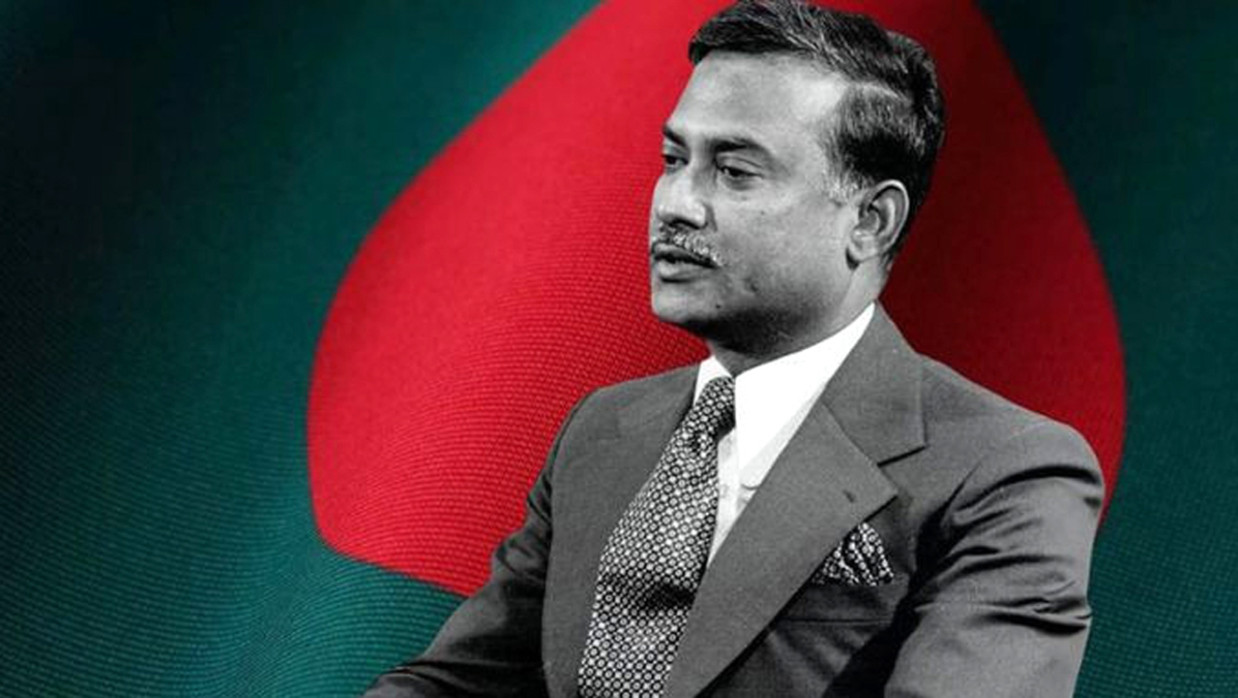
A Warrior, Leader, Architect of Nation & his Unsolved Mystery Surrounding his Assassination
Bangladesh observed the 45th martyrdom day of President Ziaur Rahman on May 30, 2026. He is undoubtedly one of those figures who had the greatest impact on the country following independence. Rare is the leader who can influence Bangladesh so greatly in politics, the economy, foreign policy, and national identity. To his followers, he was Bangladesh's modern nationalist, bringing salvation to a nation on the brink of political instability and economic ruin. His opponents may argue about certain of his policies. However, few can deny that Bangladesh still feels his impact, even after 45 years of his assassination.
His story is one of humble origins, rising to become a decorated freedom fighter, then a military officer, then a reluctant politician, and ultimately a President who tried to change the course of his country. While his life story is the stuff of legends, his death is one of Bangladesh's most sinister moments in history and one that has left many mysteries unanswered.
From Military Officer to Liberation War Hero
Ziaur Rahman was born on January 19, 1936, in Bogura. He enlisted in the Pakistan Army and was commissioned from the Pakistan Military Academy at Kakul. By the late 1960s, Zia had gained a reputation as a skillful and professional officer. Zia's place in history was secured when he became involved with the Bangladesh Liberation War of 1971. A Major in the East Bengal Regiment, Zia became one of the most influential military figures in the fight for Bangladesh's independence. After Pakistani dictator General Yahya Khan announced general elections, the Awami League won an overwhelming majority in Bangladesh, then known as East Pakistan.
During the early phase of the war, Ziaur Rahman earned worldwide attention after he read out the Proclamation of Independence of Bangladesh on behalf of Bangabandhu Sheikh Mujibur Rahman from Kalurghat Radio Station in Chittagong. Zia played an important role throughout the nine-month war. He led Sector 11 and later Z Force, two of the Mukti Bahini's main fighting forces. Zia's leadership skills on the battlefield gained him popularity amongst both freedom fighters and civilians. He was honored with Bangladesh's second-highest military gallantry award, Bir Uttam. The liberation war greatly influenced Zia's vision of Bangladesh. He realized the importance of being stateless and was determined to ensure Bangladesh would never be helpless again. From then on, he always prioritized independence, self-sustainability, and pride.
War-ravaged Bangladesh faced a bleak reality after independence.
The economy lay in ruins, institutions were fragile, and political fissures deepened daily. Independence euphoria soon gave way to economic crisis, bureaucratic deadlock, and political strife.
Things took a dramatic turn when Mujib was assassinated on August 15, 1975. The country was thrown into its deepest crisis. There were numerous coups and countercoups in the country. Ziaur Rahman emerged as a powerful figure in the Bangladesh military during this chaotic time.
Zia played a mysterious role in Sheikh Mujibur Rahman's killing, which continues to invite historical controversies. All ascertainable facts indicate that Zia was neither in nor near the council of conspirators that masterminded the August 15 coup. But following the political chaos that ensued after Mujib's killing and the consequential coup, Zia played a pivotal role in reining in the army and helping stabilize the country.
He was briefly ousted in the November 1975 coup by army Brigadier Khaled Mosharraf. Still, he was reinstated after another military revolt, and by 1976, Zia had become the de facto leader of Bangladesh.
The Turbulent Post-Independence Years
Bangladesh was left severely crippled by the war. Her economy was in ruins, institutions were frail, and politics were increasingly polarized. Independence euphoria was slowly replaced by economic distress, administrative deadlock, and political polarization.
When Sheikh Mujibur Rahman was assassinated on 15 August 1975, the nation was thrown into its darkest hours of uncertainty. There followed a series of coups and countercoups. It was during this turbulent period of time that Ziaur Rahman began to make his presence felt in the armed forces.
What exactly Zia's involvement was in the killing of Sheikh Mujibur Rahman has been the subject of much historical debate. What can be said with reasonable certainty is that Zia was not part of the core group of officers who planned the August 15 coup. But after the political turmoil and the ensuing reshuffling of the military hierarchy, he played a key role in bringing some sense of order to the army and state.
Briefly removed from power by a countercoup in November 1975, led by Brigadier Khaled Mosharraf, Zia was restored to his position after yet another military revolt. By 1976, Zia was Bangladesh's de facto leader.
Restoring Stability to a Nation in Crisis
When Zia assumed power, Bangladesh was suffering from repeated military rebellions, administrative dysfunction, and economic stagnation.
One of his priorities was restoring discipline within the armed forces. Through firm and often controversial measures, he re-established the military chain of command and suppressed numerous mutinies and coup attempts.
His defenders claimed it kept the country from falling apart. International commentators agreed at the time that Bangladesh was only now recovering from an exceptionally chaotic era.
Political stability allowed Zia to lay the groundwork for his larger domestic policy.
The Return of Multi-Party Democracy
Among Ziaur Rahman's most significant political achievements was the restoration of multi-party politics.
The one-party BAKSAL system introduced during the final months of Sheikh Mujibur Rahman's government had severely restricted political competition. Zia reversed this model and reopened political space.
Political parties were allowed to operate. Press restrictions were relaxed. Elections were introduced at multiple levels.
In 1978, Zia formed the Bangladesh Nationalist Party (BNP), which sought to unite various political groups under a broad nationalist platform. Later that year, he won the presidential election by popular vote.
In 1979, parliamentary elections were held. After years of turmoil, steps were finally being taken to reestablish parliamentary politics. Regardless of how one perceives them, politics were reintroduced into Bangladesh once again with some degree of competition.
Bangladeshi Nationalism: A New National Identity
Perhaps no idea became more closely associated with Zia than "Bangladeshi Nationalism."
The concept sought to define citizenship primarily through territorial belonging to Bangladesh rather than solely through Bengali linguistic identity.
Its proponents said it was more accommodating towards ethnic minorities in Bangladesh. Additionally, it strengthened Bangladesh's claim to independence. The current policy also created a distinction between Bangladesh and the Bengali people residing outside Bangladesh.
The idea became a cornerstone of BNP ideology and continues to influence Bangladesh's political discourse today.
Regardless of political interpretation, Bangladeshi nationalism remains one of Zia's most enduring intellectual and political legacies.
Market-Oriented Economic Policies
Bangladesh experienced a deep economic crisis when Zia took office. His administration emphasized economic realism, productivity, rural development, and private-sector expansion.
Green Revolution
Special emphasis was placed on agriculture. Expanded investment in irrigation, high-yield seeds, agricultural extension, and rural infrastructure increased food crop output. Self-sufficiency in food production became a major goal of national policy.
Focus on Rural Development
Zia understood that Bangladesh's future would be built in the countryside his highly publicized canal-digging campaigns aimed to expand irrigation. Villagers were organized through programs such as local institutions and cadres to ensure active participation in rural development projects. Zia also instituted reviews of the field performance of government agencies and ministries, emphasizing implementation instead of planning.
Better Management of the Economy
The capacity of public-sector managers improved during Zia's rule, and foreign assistance was utilized more efficiently.
Trade Liberalization
His government gradually moved away from excessive state control and encouraged private investment.
The emergence of Bangladesh's ready-made garment industry during this period would eventually transform the country's economy, making it the largest export sector.
Two-Year Reconstruction Plan
Aware of institutional weakness, Zia initially abandoned visionary long-range plans in favor of the realistic Two-Year Reconstruction Plan. Emphasis was placed on infrastructure, the reactivation of the rural economy, and the improvement of administrative capacity.
These reforms contributed to rising economic growth and helped lay the foundations for Bangladesh's future development success.
Inspiring a Generation
Zia understood that nation-building required more than economic growth.
He sought to inspire young people through patriotism, achievement, and public recognition.
His administration expanded the scope of national awards, including the Ekushey Padak and the Independence Award. Programs like Notun Kuri encouraged young talent in culture, education, and sports.
One such program that stands out was Promod Bhromon ("Excursion with the President"), during which meritorious students joined him on tours aimed at instilling national pride and civic consciousness.
Through these programs and others like them, Zia inspired hope in a generation that knew little but war, political upheaval, and instability.
Foreign Policy and Global Engagement
Zia pursued a foreign policy based on sovereignty, development, and diversification.
He strengthened Bangladesh's relationships with the Muslim world, China, Western countries, and multilateral institutions.
His diplomatic efforts helped create labor export opportunities to Gulf countries, generating remittance flows that would become vital to Bangladesh's economy.
Perhaps his most visionary international initiative was the proposal for regional cooperation among South Asian nations.
This eventually evolved into the South Asian Association for Regional Cooperation (SAARC). Although SAARC was formally established after his death, the concept originated from Zia's efforts to promote regional dialogue and cooperation.
His foreign policy reflected his belief that Bangladesh should maintain balanced relationships while preserving its independence and dignity.
The Final Visit to Chittagong
In May 1981, political tensions within the ruling BNP had intensified, particularly in Chittagong.
President Zia visited Chittagong. It was officially meant to set aside some differences within his party and bring all party workers under one banner of political unity. But as ex-Deputy Commissioner (District Magistrate) Ziauddin M. Chowdhury later stated, "it seemed a usual tour except for some political heat below the surface." He also remembered President Zia as someone who spent most of his time in Chittagong talking about politics and running the government.
Few observers suspected that the visit would become his final journey.
The Assassination at Chittagong Circuit House
During the night of May 29–30, 1981, armed officers attacked Chittagong Circuit House, where President Zia was staying.
Shots were fired around 12:15 am. Chowdhury would later say chaos ensued. Radio communication failed, many orders were misunderstood, and the chain of command became confused. Witnesses would later claim the attack involved hand-to-hand combat within the building.
President Zia was assassinated.
Bangladesh suddenly found itself learning that its president had been assassinated.
The incident was blamed on troops under the command of Major General Abul Manzur, who was the district commander in Chittagong at the time.
To this day, many questions remain unanswered about the incident.
The Mystery of General Manzur
One of the most debated dimensions of the assassination concerns General Manzur.
Historically, Manzur and Zia had been comrades during the liberation war and were regarded as having maintained a professional relationship despite military factional tensions.
After the assassination, Manzur was arrested but was killed while in military custody before a full judicial examination of his role could occur.
His death removed a potentially crucial witness and fueled decades of speculation regarding the extent of his involvement and whether others may have played larger roles behind the scenes.
Unanswered questions remain
Several Army officers were arrested after the killing and were later executed after trial.
But there were still questions remaining. Historian Ziauddin M. Chowdhury later wrote, "It is difficult to say now if the whole truth came out. I do not want to speculate on conspiracy theories. Still, it must be said that the investigation and trials did leave many questions unanswered about larger motives, institutional culpability, and potential conspirators."
Historians still debate:
If the killing was only the work of a group of army officers.
If there was political motivation behind it beyond the accused who were caught.
Why was security so easily breached?
Why was Gen. Manzur killed before his complete testimony could be documented?
If everyone who knew was ever discovered.
Legacy of a Statesman
Forty-five years after his death, Ziaur Rahman's legacy continues to shape Bangladesh.
His supporters remember him as a freedom fighter, nation-builder, democratizer, economic reformer, and champion of sovereignty.
His administration helped stabilize a fractured state, restore political competition, encourage private enterprise, strengthen rural development, and diversify foreign relations.
His concept of Bangladeshi nationalism remains one of the defining ideas in the country's political evolution.
The pages of history rarely offer up flawless leaders. Bangladesh's Ziaur Rahman is no exception. Opinions of his life and policies remain fiercely contested. But few would argue that Zia didn't change the trajectory of Bangladesh at a pivotal time in its history.
Zia's presidency was cut short when he was assassinated. His mission was to turn a vulnerable post-war state into a proud and stable nation that could look after itself. Questions surround his death. Questions and achievements that mark his life deserve reflection, too.
May 30th marks Bangladesh's 45th martyrdom anniversary of President Ziaur Rahman. He was not only one of the founding fathers of independent Bangladesh, but also a major hero of the country's liberation war. He was also a leader who provided Bangladesh with direction after years of tumult, and his legacy lives on today.

0 Comments
LEAVE A COMMENT
Your email address will not be published