

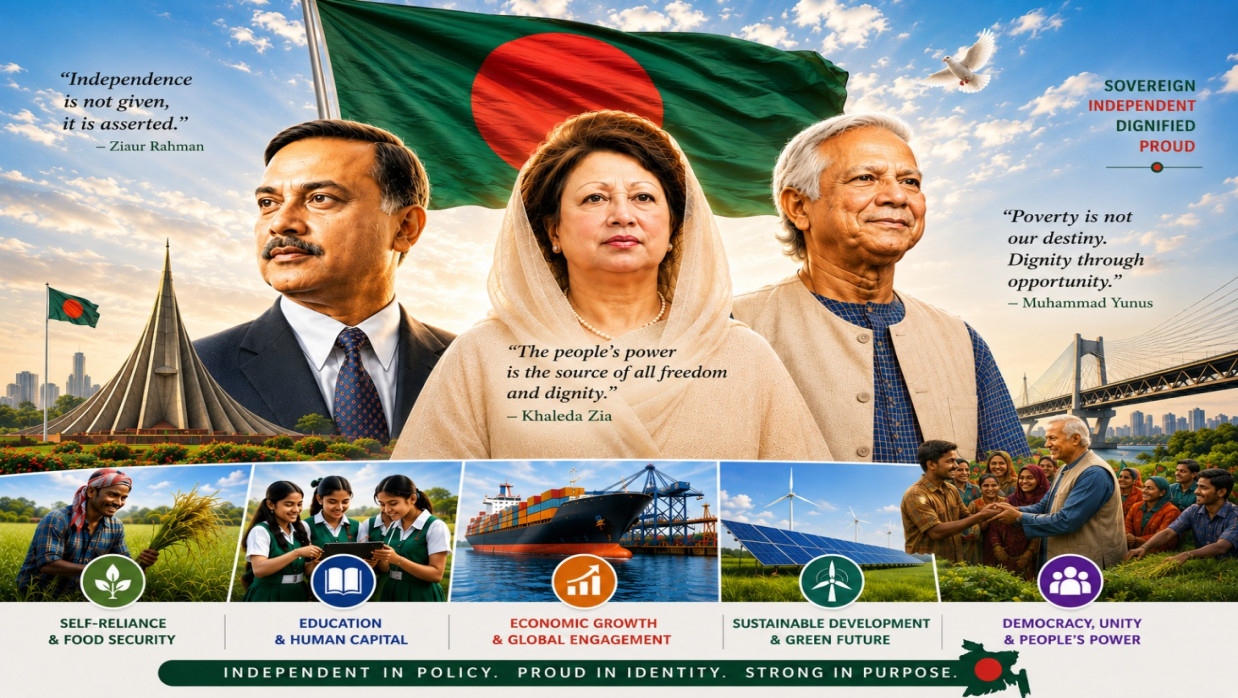
The post-liberation history of Bangladesh has been characterized not only by internal political struggle but also by challenges to maintaining national sovereignty amid regional power politics. Bangladesh, a small country surrounded by a larger power neighbor in South Asia, has had sovereignty and independence as key themes in the nation’s political and historical development throughout the post-liberation period. In such circumstances, three leaders—Ziaur Rahman, Khaleda Zia, and Muhammad Yunus—have emerged at various times in history, embodying the image of sovereign Bangladesh.
Despite differences in their leadership styles, periods of existence, and domains of activity, all three have sought to advance the idea of an independent nation-state grounded in pluralistic and sovereign principles.
The Geopolitical Context of Bangladesh and Its Challenges
The post-independence era in Bangladesh has been characterized by the nation's continuous struggle to define its sovereignty and autonomy amid the overwhelming influence of a neighboring power center. International relations theories usually describe the situation of small states and their survival in the context of power politics and the international environment as “small-state sovereignty,” emphasizing the need for small states to balance their policies to maintain independence and autonomous decision-making.
Given Bangladesh's location, issues related to water sharing, border disputes, economic dependency, transit problems, population movement, and other aspects have made Bangladesh a frequently contentious geopolitical area. Thus, the problem of sovereignty and the search for it has inevitably merged with the problem of national and democratic independence.
It is within the framework described above that the political career and legacy of the three leaders mentioned should be considered.
Strategic Sovereignty and Ziaur Rahman
After years of political instability and turbulence during which Bangladesh sought to consolidate its existence in difficult geopolitical conditions, Bangladesh's leader, Ziaur Rahman, proclaimed the principle of “Bangladeshi nationalism,” aiming to create a broader national identity grounded in sovereignty, plurality, Islamic culture, and independence.
President Ziaur Rahman understood that the survival of the state would require it not to be seen solely as part of another country's sphere of influence. Hence, the state's foreign policy during this period focused on diversification and the creation of a multidimensional approach.
Under his leadership, Bangladesh established stronger relations not only with India but also with China, the Middle East, countries of the Islamic world, and Western states. Ziaur Rahman’s government also increased labor diplomacy activity in the Persian Gulf states.
Perhaps the most important of the actions taken in foreign policy by the president was striving to restore balance in Bangladesh's foreign affairs and relations in South Asia. Thus, in President Ziaur Rahman's foreign policy, there was no excessive reliance on any particular regional power.
Ziaur Rahman's leadership style conveyed the message that Bangladesh should engage with the rest of the world as a sovereign nation-state.
Political Sovereignty and Khaleda Zia
The legacy of Khaleda Zia must be analyzed in the wider historical context of the struggle for democratic independence and sovereignty in Bangladesh. The political rhetoric of this stateswoman has repeatedly emphasized the importance of maintaining Bangladesh's political independence and preventing foreign intervention in the state's domestic politics.
Khaleda Zia has always sought to build regional and international alliances and partnerships to reduce Bangladesh's economic dependence on any regional power. The government of Zia maintained strong ties with China, expanded diplomatic relations with the Islamic world, and cooperated extensively with Western states. This approach can be viewed as an attempt to create an equilibrium position in the geopolitical situation in South Asia.
Many of Zia's supporters believed that her political struggle was a struggle for the independence of the electoral process, the national decision-making process, and other political institutions. The concepts of political and democratic sovereignty thus merge into one entity.
Khaleda Zia also represents the political stream that strives to maintain the integrity and independence of Bangladesh as a separate nation-state and culture, free from ideological or geopolitical domination imposed from abroad.
Despite the polarization of domestic politics in Bangladesh during Zia's tenure, the leader's rhetoric has consistently emphasized that the country's future is decided by its people.
Moral Sovereignty and Muhammad Yunus
If Ziaur Rahman symbolized strategic sovereignty, and Khaleda Zia embodied political sovereignty, Muhammad Yunus stands for something else – “moral sovereignty.” Unlike typical politicians, Muhammad Yunus came to prominence through his work in ethics, entrepreneurship, and philanthropy.
Through his activities in microfinance (Grameen Bank), Muhammad Yunus gave a very different image of Bangladesh—a developed country with successful entrepreneurs, rather than a country of poverty and economic underdevelopment. After Bangladesh transitioned following the fall of authoritarian rule, Muhammad Yunus became a new icon of the country.
Through his leadership, Muhammad Yunus represented Bangladesh as a country seeking democratic reforms, institutional development, and good governance on the international stage. However, what distinguished Muhammad Yunus' leadership style was his extraordinary international authority and recognition. Admired by world politicians and the academic community, Muhammad Yunus endowed Bangladesh with unprecedented international moral leverage.
Through the moral superiority of this leader and through his leadership and diplomacy, Bangladesh began to pursue a multidimensional foreign policy. The country deepened relations with China through infrastructure and economic projects, strengthened ties with international financial institutions, established new diplomatic relations with other countries, and sought to redefine its foreign policy in a more balanced manner.
In general, Muhammad Yunus became a symbol of international prestige and national sovereignty for Bangladesh.
Anti-Indian Rhetoric and Sovereignty in Relation
It is necessary, however, to distinguish between Bangladesh's foreign policy and its attitude toward India as a country and a regional power center. Despite many disagreements and controversies in intergovernmental relations, both countries share many common cultural and linguistic traditions. Moreover, millions of people live in Bangladesh and India and feel interconnected because of shared historical, linguistic, economic, educational, and cultural traditions.
The main point has never been India's existence as a neighbor. The question was whether Bangladesh should conduct its relations with India on an equal, respectful basis, without interfering in domestic affairs.
Thus, any mature bilateral relationship should be founded on mutual respect and dignity.
Sovereignty and Independence do not, in this case, mean isolationist attitudes towards the neighboring state.
The desire for sovereignty should be considered in the framework of postcolonial aspirations for strategic balance. In other words, Bangladesh's desire for sovereignty implies the freedom to make decisions without geopolitical pressure.
The Rise of New National Consciousness
The emergence of a generation of young people who increasingly recognize the importance of sovereignty and national identity has been one of the most recent transformations in Bangladesh's political landscape. Modern youth, especially in the context of Bangladesh's globalization and internationalization, is highly aware of issues of accountability, human rights, and independence. Social networks, higher education abroad, international exposure, and global connectivity help Bangladeshis develop a sense of pride regarding their nation.
In this respect, Ziaur Rahman, Khaleda Zia, and Muhammad Yunus are seen as leaders of a sovereign and independent nation.
Bangladesh and Sovereignty in the Indo-Pacific Region
Bangladesh is now at a turning point in its history. Whether Bangladesh's future will be stable or otherwise will largely depend on Bangladesh's ability to establish and maintain a strategic balance in a new geopolitical environment, where India, China, the United States, and other powers compete for dominance in the Indo-Pacific.
In light of the analysis of the leadership styles of Ziaur Rahman, Khaleda Zia, and Muhammad Yunus, it becomes clear that, to survive in a new geopolitical environment, the country should diversify its diplomatic and economic contacts and ensure that the state enjoys the status of a sovereign country.
Sovereign Bangladesh does not necessarily mean confrontation with its neighbors, but rather equal cooperation with them based on mutual respect, equal relationships, and independence. As history shows, a nation achieves success when it can protect its democracy, culture, and sovereignty.
As an anti-colonial philosopher, Frantz Fanon once said:
"Each generation must discover its mission, fulfill it or betray it."
Thus, the main mission of modern Bangladeshi leaders and the government should be to preserve Bangladesh's independence and sovereignty.

0 Comments
LEAVE A COMMENT
Your email address will not be published