

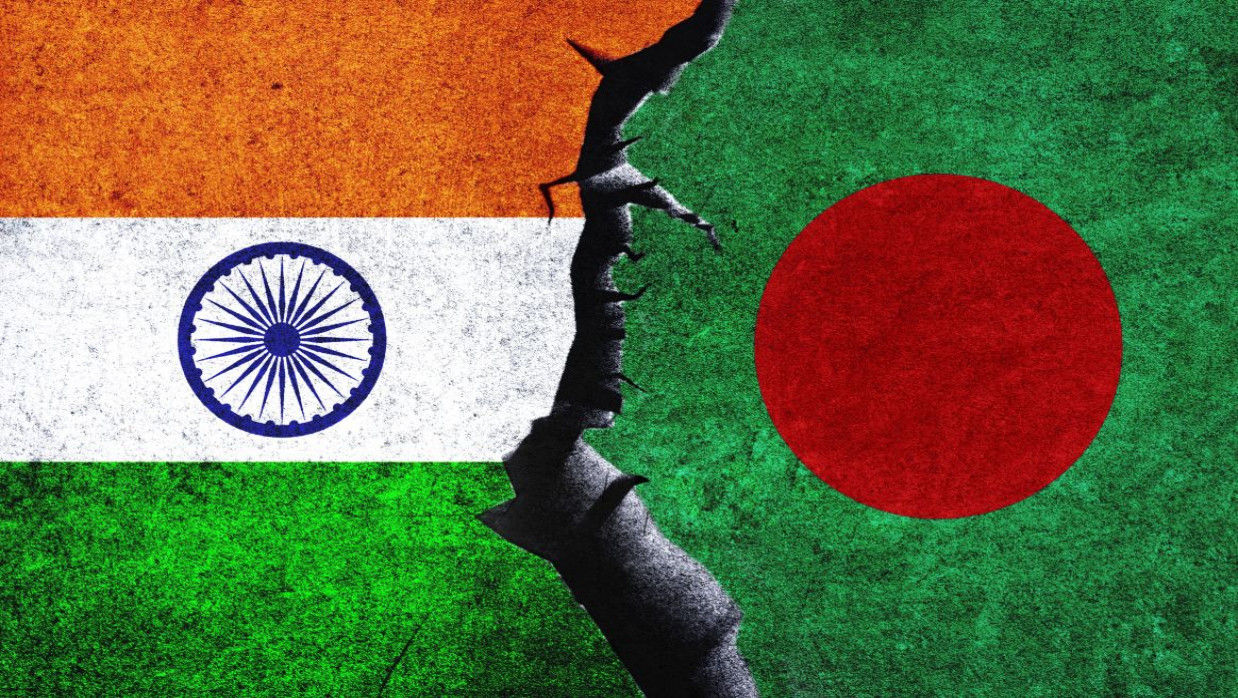
The recent interview of Indian Foreign Secretary Vikram Misri with Bangladeshi journalists in New Delhi once again exposed the complicated, layered, and often uneasy nature of India-Bangladesh relations. The discussion covered trade, visas, border security, water sharing, SAARC, BIMSTEC, and above all, the politically explosive issue of the extradition of Sheikh Hasina.
Behind this careful diplomatic language, however, lies a much larger geopolitical story: India's long-standing ambition to be South Asia's uncontested regional hegemon, and growing pushback against that ambition from around the neighborhood. Bangladesh today finds itself at the center of that debate.
India has long considered itself the natural patron of South Asia, a position it solidified following the liberation of Bangladesh in 1971. But the realities on the ground have shifted significantly since then. Nepal tilts toward China to balance India. Sri Lanka has pluralized its strategic partnerships. The Maldives swings between Indian-dominated "India First" politics and nationalist pushback. Pakistan is never going to be within India's sphere of influence. Bangladesh, which New Delhi long treated
The Hasina issue symbolizes this transformation.
The 2024 Political Crisis and India's Strategic Calculations
Reports from Bangladesh indicate that Sheikh Hasina was airlifted out of the country under a prior understanding, not as an emergency humanitarian gesture. It is commonly held in Bangladesh that she went to India as part of a "conspiracy". There were people from within the Bangladesh Army whom India could "trust" in the hour of need. We must remember that Bangladeshis, on the whole, believe there was an Indian exit strategy planned for her well in advance, involving sections of the Bangladesh Armed Forces that New Delhi deems friendly or pliable.
Whether true or not, sometimes in politics, it doesn't matter whether something is true, but rather that it is believed to be true. The idea that India has bought influence in key positions in Bangladesh's military establishment, bureaucracy, intelligence community, and political parties has gained significant currency.
India didn't help its case either by the way it handled Hasina's asylum request. India has yet to give a categorical response on her return to Bangladesh following the tribunal's ruling and the Bangladesh government's request. Instead, they take the route of saying things will take time, that it will go through the court system, that there are human rights issues at stake, etc.
But there is a problem with that explanation.
India has always championed judicial processes in neighboring countries when it suits them. Since the Bangladesh International Crimes Tribunal has now convicted Hasina, India wonders aloud about the legitimacy of that tribunal, suggesting that some ICT personnel took bribes.
The Contradictions of Indian Diplomacy
India's approach to Bangladesh exposes the hypocrisy at the heart of India's foreign policy. New Delhi talks about democracy, sovereignty, and partnership, but neighbors often feel that India's diplomatic outreach to them is meddling, paternalistic, and driven by security concerns.
Bangladesh's Hasina exposes the hypocrisy.
Indian officials do not mince words when talking about how Hasina assisted India's counterinsurgency and counter-separatist operations in its North East. For years, New Delhi saw Hasina not just as another leader of a neighboring country but as an ally India needed to safeguard its national security interests.
Hasina has featured prominently in India's national security calculus in its dealings with Bangladesh. Unfortunately, when dealing with Dhaka, India often views bilateral issues through the lens of Bangladeshi democracy rather than New Delhi's national security.
It might have served India well in the short term, but it certainly breeds resentment amongst many Bangladeshis who feel outsiders have had too much say in their internal affairs.
SAARC: The Organization India Allowed to Collapse
Talk of SAARC helps us identify another facet of India's regional approach.
SAARC was meant to be an organization in which states from South Asia could cooperate on economic, cultural, and political matters, notwithstanding bilateral disagreements.
Crucially, SAARC was Bangladesh's brainchild. It embodied Bangladeshi elites' belief that the smaller states of South Asia required an institutional mechanism that a single hegemon would not control.
India, however, has consistently emasculated SAARC.
The convenient Indian narrative is well-known: how can we cooperate with Pakistan, which is either in SAARC or bankrolling terrorists sitting in SAARC? This argument is conveniently worded. India is also a member of the Shanghai Cooperation Organization (SCO), which includes Pakistan. Indian officials meet Pakistani officials at the SCO meetings. No one in Delhi wants the SCO paralyzed.
Why then is SAARC treated differently?
Others in South Asia point to an alternative solution. SAARC was intentionally designed to establish a multilateral forum where smaller countries could exercise collective bargaining power. It weakened India's unilateral influence in the region. BIMSTEC, on the other hand, offers India a far more workable geopolitical structure centered on the Bay of Bengal and excludes Pakistan completely.
BIMSTEC and the Search for an Alternative Order
India championed BIMSTEC because it wanted an alternative to SAARC. But after years of summits, declarations, and diplomatic vim and vigor, BIMSTEC has had little to show for its institutional efficacy.
Regional trade is not integrated. Connectivity initiatives are moving at a glacial pace. Cooperation on security issues is piecemeal. Awareness among the general populace in member countries is negligible at best. BIMSTEC lacks the institutional heft of ASEAN or even the EU. It lacks the legitimacy of either.
One might say that BIMSTEC's primary strategic utility was not integration but the exclusion of Pakistan and the downgrading of Bangladesh's symbolic claims to South Asian centrality (SAARC).
That is par for the course for how India wants to act like a regional hegemon. But South Asia will not always bend to New Delhi's geopolitical convenience.
Leadership is built on trust, reliability, and respect. Might isn't always right.
West Bengal, Teesta, and the Politics of Delay
Another contentious issue he raised was the Teesta water-sharing deal, which remains unresolved. It's often said that Teesta is the single most emotive issue in Bangladesh-India ties. Bangladesh's anguish over broken promises has made Teesta a symbol of India's failure to deliver.
Foreign Secretary Jaishankar now says the change in the West Bengal government is opening up opportunities. But Bangladesh has been listening to variations of that line for years.
Indian governments, big and small, have lamented federal hurdles, state-level resistance, and bureaucratic foot-dragging. There may be constitutional merit to those claims. But it also feeds into the belief that India will always put Bangladesh's interests secondary to its own internal politics.
Visa policies are similarly murky. Officials continue to assure that improvements are underway, but offer no concrete timelines. Trade will take place. Diplomacy will take place. But trust continues to dwindle.
Bangladesh's Strategic Reassessment
Bangladesh today is not the weak post-conflict state it was four decades ago. It has become a rapidly developing economic and geopolitical player with strategic options. China. Turkey. The Gulf. Japan. Southeast Asia. The West: all see Bangladesh as a country of growing significance within the Indo-Pacific region.
Naturally, this environment incentivizes strategic diversification.
Bangladesh's desire to rejuvenate SAARC is a testament not to longing for bygone days, but to interest in a balanced regional order. Many Bangladeshis do not believe that regional cooperation can or should remain hostage to the India-Pakistan conflict forever.
Likewise, Bangladesh is increasingly seeking room to maneuver diplomatically and not simply choosing sides.
India does not necessarily take to this reality. Far too often, New Delhi views Dhaka through the lens of outdated assumptions about asymmetry and dependence. Yet 21st-century Bangladesh has more economic leverage, diplomatic agency, and geopolitical weight than at any time since independence.
Conclusion
Few interviews have taught us more about diplomatic speak-busting than the Vikram Misri interview. The interview threw into stark relief New Delhi’s vision of itself as a regional power with the realities of regional politics today. On one hand, New Delhi would like to be seen as the unquestioned leader of South Asia. On the other hand, leadership cannot be established by security footprint, political capital, or bully pulpit. India needs to win the trust of its neighbors as a leader each day.
From Sheikh Hasina's extradition demand to the rise and fall of SAARC to BIMSTEC's uncertain future to Teesta waters delay to never-ending visa issues one cannot help but sense an increasing feeling that India's neighborhood engagement policy is all about control.
Bangladesh, too, is changing, and perhaps she wants to be recognized for who she is rather than viewed through the lens of India's security concerns.
Can countries in South Asia afford not to practice sovereign equality? That is the question India and Bangladesh have yet to answer.


0 Comments
LEAVE A COMMENT
Your email address will not be published