

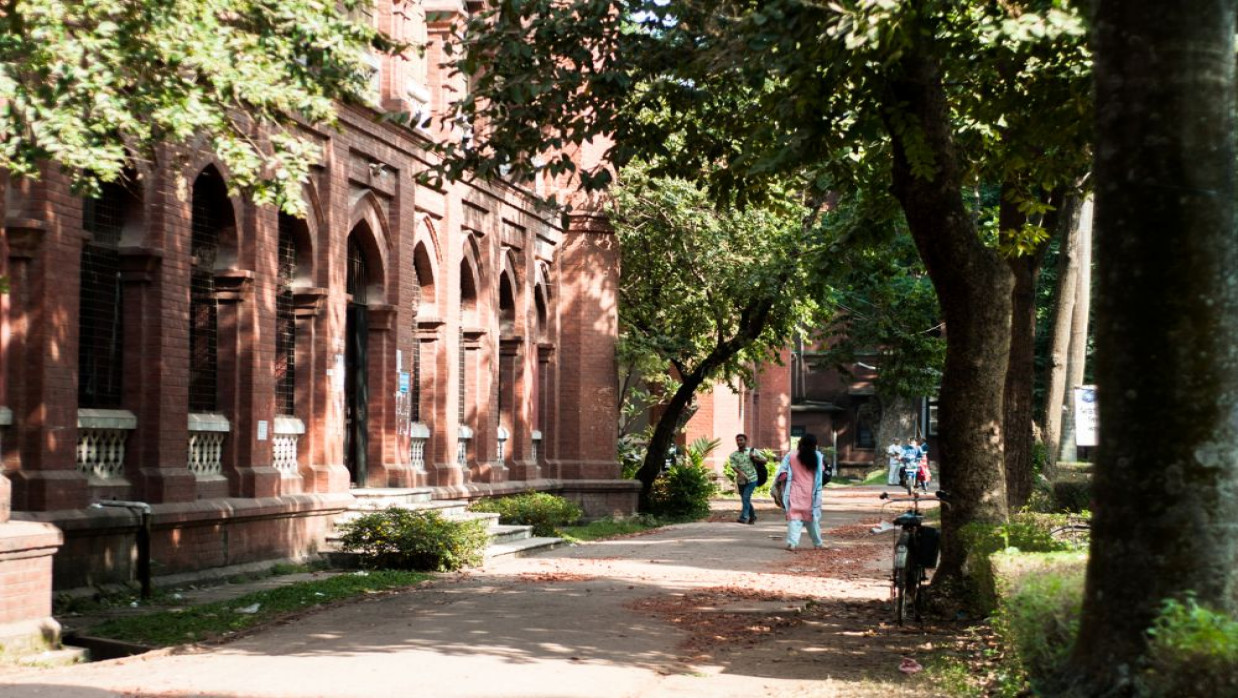
I had to go to Dhaka; I had to shed tears at Dhaka’s Paltan Ground over our national disgrace. I had to embrace and weep with the stranded Pakistanis in their camps, to tell them we are ashamed that we prioritised one crore Afghans over them, jeopardising our own country’s peace. I wanted to offer Fatiha at the grave of Abdul Malik, a poor 22-year-old student who gave his life for the Islamic education system at Dhaka University. To this day, I have been deprived of that. What can I say? The truth is that it is not easy to untie the tangled knots of history.
Pakistan was the result of an extraordinary movement, but the blood-soaked events of the linguistic conflict on the initial pages of this new state’s history created a deep rift that we have not been able to fully bridge even today. It was a cruel irony of time that a state came into being on the map of the subcontinent whose eastern wing, comprising nearly 58% of the total population (according to the 1951 census), was geographically, linguistically, and culturally distinct from the western wing. Quaid-e-Azam Muhammad Ali Jinnah’s decision to declare Urdu as the sole national language, viewed as a symbol of the unity of Muslim nationhood, to some extent sowed the seeds of alienation in the hearts of the Bengali-speaking majority. Given the different languages of five ethnic groups, the decision to make Urdu the lingua franca was arguably better. However, under the influence of nationalist propaganda, our Bengali brothers protested, considering it a violation of fundamental rights. The simple demand of the Bengalis was that if the official language of the country could not be the language of the majority, then at least both languages should be granted national language status.
As a result, the dark day of February 21, 1952, arrived. Police opened fire on a student protest procession in the streets of Dhaka, and Rafique, Jabbar, Barkat, and other youths were killed. This bloodshed was not just a loss of lives; it marked the breakdown of trust between the ruling elite and the people of erstwhile East Pakistan. This linguistic conflict, coupled with economic injustices, formed the basis for the final separation in 1971.
It is an acknowledged fact that imposing any single language based on linguistic pride is in no way justifiable. It was also essential to honour the rights of Pakistani languages. The obstinacy of the ruling classes sowed the seeds of deprivation at the grassroots level of society.
In recent years, particularly since 2024, a trend of pragmatism has prevailed in relations between Pakistan and Bangladesh. This is an opportunity to forget historical bitterness, give importance to each other’s culture and language, and strengthen the shared Muslim heritage. It is crucial to remember here that, in contrast to the English language that divided us, both Urdu and Bengali are rich in shared Islamic terminology, Sufi literary tradition, and civilisational values.
In this historical continuum, we must once again look towards Dhaka University. This institution is a significant centre in the intellectual history of South Asia. It is the very place that was once a hotbed of ideological conflict. The recent success of Ashaab-e-Yameen (right-leaning or religious-oriented student groups) at Dhaka University after the recent revolution is not merely a political slogan but an intellectual sign—proof that religious and intellectual identity is no longer a forbidden topic for the new generation in Bangladesh. Instead of rejecting religion, they want to understand it in a new way within their national and cultural framework. This change suggests that Bangladeshi society is moving towards an intellectual equilibrium.
A clear and welcome declaration of this intellectual harmony is visible in the recent activities of the Urdu Department at Dhaka University, where a magnificent international conference is being held on the shared intellectual and literary heritage of Allama Muhammad Iqbal and Kazi Nazrul Islam. This conference is a new milestone for the historical role of the Urdu language and its deep connection with Bengali culture.
Just a few years ago, my Urdu article on Iqbal’s philosophy, submitted to the research journal of Dhaka University’s Urdu Department, was rejected with the remark: “Sir, we do not include any piece of writing from Pakistan.”
The fact that the same department is now organising a global conference on the shared themes of Iqbal and Nazrul Islam proves that political geography can change, but spiritual and civilisational bonds endure. The poetry of both Nazrul Islam and Iqbal is based on themes of awakening for the downtrodden classes. Despite political division, the Urdu Department of Dhaka University has become a beautiful confluence of this scholarly relationship.
This is a moment for reflection for the Pakistani elite. It is a reminder that cultural and educational links have a more lasting impact than past political differences. We must now formulate new models for academic and linguistic cooperation. We need to initiate “Mutual Linguistic Understanding Programmes” between the two countries to enable student and faculty exchanges. Urdu should be introduced as an optional foreign language at Dhaka University, and we should have Bengali courses here. Most importantly, the governments of both countries should establish a Joint Cultural Fund to bring the new generations closer.
This wave of love rising for us from the erstwhile East Pakistan is an indicator of the new intellectual dynamics of the region. It is neither a repetition of the past nor a denial of it, but the beginning of a balanced intellectual phase.
In the language of history, this is a silent but meaningful sentence: ideologies do not change borders, but when the direction of minds is set, the languages that were wounds in the past become balms in the future. We only need to adopt the strategy of applying this balm, so that the intellectual seeds being nurtured by the new generation of Dhaka University may flourish.


0 Comments
LEAVE A COMMENT
Your email address will not be published