

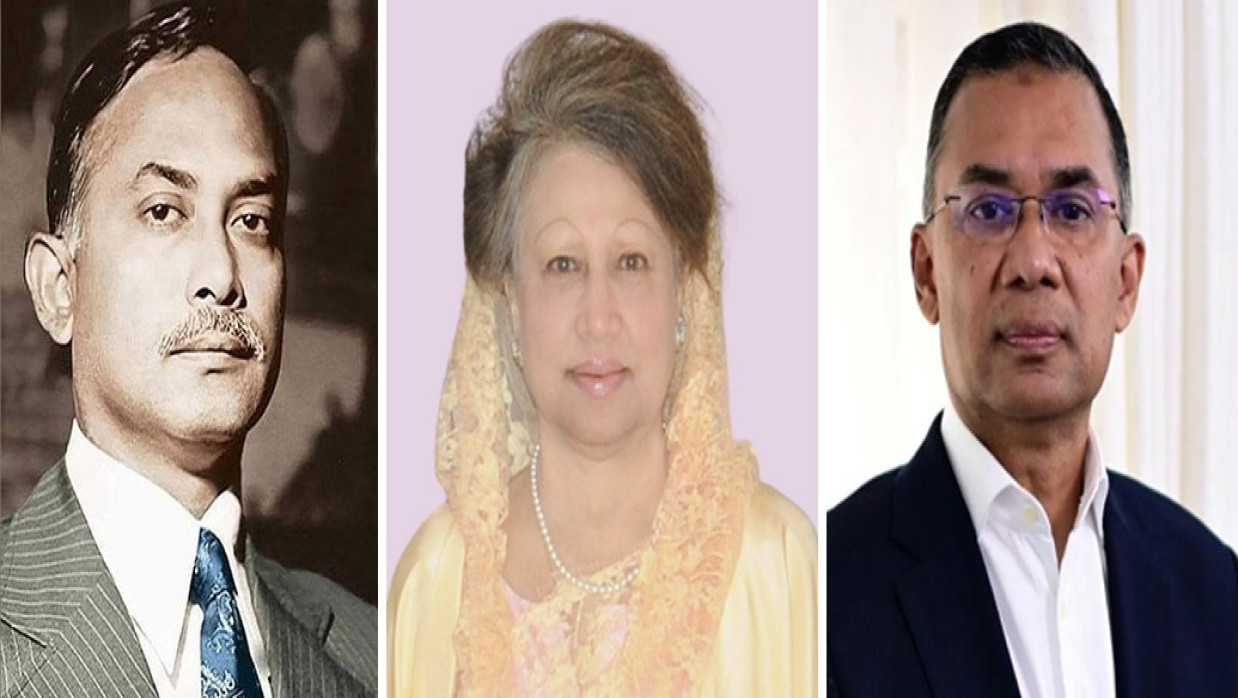
Under the leadership of Tarek Rahman, the surviving offspring of Late Ziaur Rahman and Late Begum Khaleda Zia, two of the most adored and revered leaders of Bangladesh, the BNP has returned to power with two/third majority in the Parliament.
The BNP has since formed a government with Tarek Rahman as the Prime Minister.
The 2026 BNP government
The astounding electoral victory is indeed a source of much joy to the BNP. The victory is also a vindication of years of suffering the party and its leaders have endured. However, the euphoria may prove to be short-lived.
The 2026 BNP victory could not have come at a more challenging time. At present, Bangladesh is confronted with numerous challenges, mainly economic, with serious social and political ramifications; some are inherited, and some are outcomes of recent global events.
The challenges
In recent times, Bangladesh has experienced drastic economic, social, and political changes - some good and some not so good.
On the positive side, the economy has diversified, growing consistently since the 1990s, though due to rampant corruption and the near absence of transparency and accountability in public sector expenditure, which depleted the national exchequer and contributed to burgeoning public debts, - spillovers of the recently deposed Hasina government – have made the economy falter.
Adding to the inherited woes are recent global events, such as the Israel/US/Iran war, which have caused a great deal of uncertainty in the global economy, which in turn is threatening the economic and political stability of Bangladesh.
Indeed, for the newly formed 2026 BNP government, the road ahead is certainly not strewn with roses.
So, where do the 2026 BNP go from here? How well is the Party prepared to tackle the evolving challenges? Can 2026 BNP take lessons from its own, referred to here as “the BNP”, Zia’s BNP?
So, what is “the BNP”, Zia’s BNP? Let us explore.
“the BNP,” Zia’s BNP
Interestingly and quite coincidentally, the challenges that Bangladesh is currently facing - economic uncertainties, moral lapse, entrenched corruption, inept bureaucracy, a fractured society - are the very hurdles that Ziaur Rahman, the founder of “the BNP,” encountered when he took over the reign of Bangladesh in 1976.
After assuming power, Ziaur Rahman, a person of impeccable integrity, intellect and vision realised that to rescue the war ravaged broken and regressing economy of the country and socially fractured, administratively disjointed and morally degraded Bangladesh - as things were at the time -, what were needed not empty words nor more politics but measures that would fix the economy, promote social cohesion and most importantly, by strengthening transparency and accountability in the public administration, strengthen the implementing arm of the government.
Accordingly, Zia embarked on the interlinking tasks of social mobilisation, economic remediation and administrative competencies, strategically.
Social mobilisation
To inspire and bond people, Zia introduced the idea of “Bangladeshi nationalism, an inclusive and distinctive national identity which was underpinned by Bangladesh’s long and unique history and traditions. It worked.
Regardless of religion and race, the concept of “Bangladeshi nationalism” helped mobilise people and, more importantly, made them feel proud of being a Bangladeshi, bolstering Bangladesh’s uniqueness in terms of its political and cultural sovereignty.
Selection of a merit-based governing team and reforms
Zia inherited a war-ravaged and badly managed economy, and at the time he took over the reins, the GDP was regressing at -1.7% per annum.
To address the country’s deepening economic crisis and other associated challenges, Ziaur Rahman formed a governing team composed of men and women of high cerebral capacity and moral integrity, which a Two-Year Reconstruction Plan, the 1976-1978 TYRP, to address both short-term crises and long-term measures for the moribund economy to grow and to put the country on a growth trajectory.
To make sure that the TYRP produces targeted results in time, Zia took extraordinary steps to enhance management accountability in public administration, a process in which he engaged directly with the result that the TYRP helped rebuild the war-torn infrastructure and put the regressing economy on a growth track, for the GDP to grow from -1.7% per annum in 1976 to 4.5% in1980 per annum.
Launching of “the BNP”
In 1978, Zia took steps to transition the country from military to civic governance and launched a new political party, the Bangladesh Nationalist Party – “the BNP.”
Newly formed “the BNP,” Zia's BNP, continued to pursue the same strategic framework in governance, namely, social mobilisation through “Bangladeshi nationalism,” and inspired people to engage in nation-building activities; govern the country through a competent governing team; and formulate pragmatic, consensus-based, people-centric policies that responded to and met the aspirations of people with such success that the New York Times reported at the time that Ziaur Rahman “…helped put a collapsing nation on its feet.” Noting Zia’s devotion to and prioritisation of grass-roots development, late Malcom Fraser, the then Prime Minister of Australia, similarly acknowledged that, “…One of the principal reasons for the success and popularity of [Zia] was his dedication to the development of rural Bangladesh and its immense population, who worked hard to overcome the crushing problems of food shortages and poverty...”
Zia’s assassination - Khaleda Zia, the torchbearer
A military mutiny killed Ziaur Rahman in May 1981. Zia’s murder was followed by a military coup by General Ershad, the then Army Chief, who, soon after assuming power, dislodged the sitting BNP government and put BNP into political exile.
Late Begum Khaleda Zia, wife of the assassinated leader Ziaur Rahman, a housewife then, took charge of “the BNP” in 1984, a party which at the time was in a state of complete disarray.
Khaleda Zia distanced herself and her party, “the BNP,” from General Ershad’s political diktats and, by doing so, denied Ershad, the military ruler, the political legitimacy his corrupt and autocratic government desperately needed and, at the same time, projected “the BNP” as a party of principle and people.
During Ershad’s reign (1982-1990), Khaleda Zia spent most of her time underground, reorganising and strengthening “the BNP” that re-energised the moribund BNP to grow into a cohesive nationalist political voice playing a leading role in launching a movement against Ershad and ousting him from power.
Khaleda Zia then participated in the 1990 election, won, and formed a government, with her as the Prime Minister.
Khaleda Zia’s Governing team
Khaleda Zia followed Zia’s, her late husband’s, footsteps in the selection of the governing team, giving preferences to, as did Zia, quality over loyalty. The dividends were all to see. For example, her choice of Saifur Rahman, a man of high technical competence and moral integrity, as the finance minister, who undertook drastic economic reforms and built an economic architecture that transformed and put Bangladesh on a growth trajectory, continues to stimulate growth even today and remains a shining example of economic reform not just for Bangladesh but for developing countries, including Bangladesh’s big neighbour, India, which borrowed his ideas, such that Dr Manmohan Singh, former Prime Minister of India, once noted, “I learnt economic reform from Mr Saifur Rahman.”
What made “the BNP” unique and enduring
In summary, the factors that made “the BNP” unique, relevant, and appealing, and a party that made transformative changes while in government are the following: ethical leadership; social mobilisation through the introduction of the concept of “Bangladeshi nationalism,” an inclusive national identity concept that inspired and mobilised people in nation-building; selection of men and women of merit and integrity to form governing teams who helped formulate context-specific pragmatic plans and reforms; strict overview of progress of implementation of policies and programmes at the highest level of the government and more importantly, civic engagement in governance at the grass-roots level, say for example the idea of “gram sarkar” (village government).
The 2026 BNP government – not a good beginning
The victorious BNP has since formed a government, but the beginning is anything but illuminating.
Non-endorsement of the July Sanad
Firstly, by refusing to sign on and embrace the July Sanad, a post-Uprising civic-endorsed political reform framework, a Magna Carta, designed to broaden democratic engagements and strengthen checks and balances in governance, the 2026 BNP government has trampled Uprising’s aspirations and, by doing so, has shaken citizen trust in the government. This is not a good beginning.
Poor choice of governing team
Secondly, unlike “the BNP” (Zia’s/Khaleda Zia’ BNP), which always formed and relied on governing teams made of people of merit and integrity and allowed their governing teams full autonomy to formulate pragmatic policies and programmes, the 2026 BNP government seems to have done the opposite; it has opted for bullies over brains.
Indeed, as they say, the proof is in the pudding; the recent statements and announcements of some senior members of the 2026 BNP’s governing team sound more like a cacophony at a village bazaar and not on issues that Bangladesh is currently challenged with – a fractured society, inherited and looming economic uncertainties and an inept and corrupt public administration. This is disappointing if not deeply concerning.
The way forward - reinvent “the BNP”
Given the visible gap between aspirations of the people and 2026 BNP’s not-so-inspiring beginning – a poor quality governing team, a complete lack of awareness of and/or apathy to the issues and challenges – time maybe ripe for the 2026 BNP to look back and reinvent “the BNP” and incorporate in governance the practices and norms such as social mobilisation, a merit-based governing team and context based strategic planning such as that of Ziaur Rahman’s crisis remediation 1976-1978 Reconstruction Plan, and formulate on an urgent basis, a two-year Resilience Plan and address the looming crises of economic uncertainties, deepening poverty and hunger and arrange, on an urgent basis, timely delivery of basic needs such as food and fuel to the needy and finally, to ensure sustained economic growth, explore recalibration of the economy to diversify and adjust to the shifting global economic configurations
The 2026 BNP must also adopt a policy of zero tolerance against corruption and extortion, establish strict public accountability norms and practices and, more importantly, endorse the soonest, the July Sanad, a doctrine that has the potential to promote inclusive democracy, improve checks and balances and advance social justice in the country.

0 Comments
LEAVE A COMMENT
Your email address will not be published