

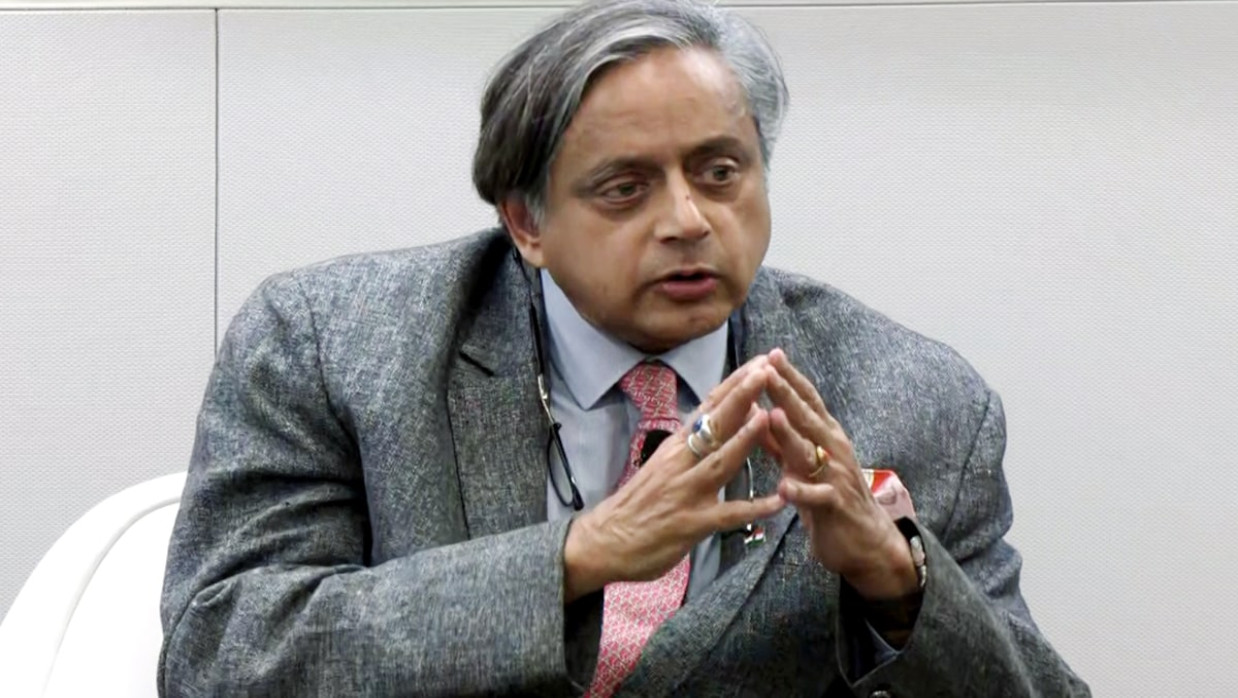
As Indian liberal democracy is facing multiple challenges and is slowly eroding under the Bharatiya Janata Party(BJP) government led by Prime Minister Narendra Modi, Dr Shashi Tharoor provides a much-needed shield to the current reactionary regime in India. His defence of India’s foreign policy under the BJP-led government of Mr. Modi in the name of national interest is not merely political opportunism on his part, but reflects the limits of his liberal pragmatism, often used to justify various illiberal ideals, actions, policies, and forms of politics that undermine reason, autonomy, and independence. Liberal universalists like Dr. Tharoor have often used liberalism to justify different forms of illiberal exceptionalism (i.e., American exceptionalism), and to rationalise individual aberrations in particular events involving an individual, an institution, a country, or a group of countries (racial capitalist countries), which liberals have failed to transcend and never forget to celebrate. The unprovoked war on Iran by the United States and Israel is not merely one such event in the history of the moral failures of liberals in defending illiberal actions, ideas, and policies.
Liberalism itself contains an amoral and indifferent core that allows such failures in the name of freedom—freedom for the powerful and war-mongering oppressors. This is where liberalism fails to apply its universalistic ideals, values, and principles, and instead hides behind relativist contexts. “Pick and choose” has been a core practice of liberals throughout the history of liberal ideology, where ‘self-assertion, self-actualisation, and self-preservation’ are prioritised over the collective foundations of peace, happiness, and shared humanity. Dr. Tharoor has been peddling such a hollow ideological narrative in India for some time now in the name of nationalism, liberalism, coupled with illiberal praxis. His article in The Indian Express (20 March 2026), titled “India’s silence on West Asia war is not moral surrender. It is responsible statecraft”, is an extension of the illiberal praxis of elite liberalism.
The BJP government led by Narendra Modi may be silent, but Indians are not. Indians have raised their voices against the unprovoked American and Israeli attack on Iran. The American and Israeli missile strikes have not only killed 170 schoolchildren but have also displaced 864,000 children from their homes. More than 3.2 million Iranians have been displaced due to the American war on Iran, according to a report by the United Nations High Commissioner for Refugees. Silence in such a context of mass injustice, deaths and destitution is neither moral nor statecraft; it is the lowest level of cowardice. Indian foreign policy is not only shaped by national interests but also upholds universal ideals of world peace, solidarity, international law, and human dignity. These values are enshrined in the Indian Constitution without any liberal contradictions. Indian foreign policy is not devoid of morality. India, under its first Prime Minister Jawaharlal Nehru, criticised the Soviet Union’s invasion of Hungary in unequivocal terms while maintaining a strong friendship with the USSR. Dr Tharoor’s article reflects a kind of historical amnesia rooted in his ideals of liberal pragmatism.
India’s non-alignment is not a balancing act, but a movement for world peace beyond the binaries of Cold War political praxis designed by the powerful. It is a movement for the self-determination of newly independent countries that challenged the war-mongering colonial and imperialist ideologies of subjugation. The Non-Aligned Movement is a moral compass in international diplomacy that enabled newly independent countries to pursue independent foreign policies without being in the shadow of colonialism or the influence of imperialism. It was not merely a strategy of survival, but a movement for peace and dignity. Dr Tharoor’s narrative lacks historical grounding. His interpretation of the Non-Aligned Movement appears to defend the indefensible silence of the BJP government led by Narendra Modi over the deaths and destitution in Iran.
Liberals and their not-so-liberal governing elites often invoke national interests and national sovereignty to protect capitalism and ideology its ruling classes. National interests are not superior to the interests of the people. When national interests are superior to the interests of people, then the nation does not belong to the people. National interests and sovereignty, without prioritising the people, amount to a hollow liberalism designed to divert attention from and undermine the material needs of people, as well as their emotional connections with one another beyond national boundaries. Silence on Iran not only undermines India’s historical legacy and its relationship with the people of Iran, but also weakens India’s current interests, particularly in terms of energy security. People are suffering in India and across the world due to the American and Israeli war on Iran. This war is accelerating the cost-of-living crisis globally.
If India’s opposition to war and injustice creates antagonism in Washington, then so be it. India is not meant to defend American imperialism in the name of protecting its national interests. Historically, Washington has promoted policies that are not in the interests of the Indian people. From agriculture to industry, from technology to the military, from foreign policy to India’s friendships across the world and within its neighbourhood, Washington has often acted in ways that undermine India’s path of development. Silence in the face of injustice undermines India and its people. It represents a surrender by the Hindutva-driven government led by the Bharatiya Janata Party under Narendra Modi to U.S. imperialism, even as Indians have raised their voices against the war, violence, and destitution caused by the American and Israeli actions in Iran.
The Gulf Arab states—their governments and peoples—once looked up to India for its principled positions in international affairs. The silence of the Modi government undermines India’s stature globally, including in the Gulf region. These countries are not only pillars of India’s energy security, but also share deep historical and cultural ties with Indians. The Indian government’s silence is therefore not only disturbing, but also risks destabilising India’s relationships in the region. Silence in the face of injustice and oppression is not a strategic choice; it reflects moral decay and complicity with the imperialist oppressor. Such a position stands in opposition to the principles enshrined in the liberal, secular, and democratic Constitution of India, which upholds the ideals of world peace. Siding with the oppressor neither protects sovereignty nor preserves peace and prosperity.
The white supremacist ideology that shapes power structures in the United States undermines India and Indians through racialised capitalism and imperialism. Standing with the marginalised and oppressed strengthens India’s position in the world. Any liberal compromise ultimately promotes illiberal forces that threaten peace beyond national borders. American alliances with the Taliban and with dictators in Latin America and the Middle East are classic examples of U.S. foreign policy inconsistencies when it comes to liberal, democratic, and constitutional principles. “Leverage” is the language of an asocial business strategy; it cannot serve as a guiding principle of foreign policy aimed at upholding world peace. Silence in the midst of struggles for justice becomes a death warrant for working people and their everyday fight for survival with dignity.
Moral courage is not about convenience but a product of moral conviction in the defence of individual lives, freedom, justice, and peace—values that so called liberalism of ruling regimes of capitalist countries and their intellectual worldwide claims to uphold. The theology of absolutism is not only reductionist but also a strategy of so-called illiberal opportunists, often used to undermine idealistic people in society. It is not idealist dogma, but opportunistic compromise, that undermines people across the world and their dignity. The silence of the government led by Narendra Modi may not amount to an explicit Indian endorsement of the American and Israeli war on Iran, but it reflects behaviour akin to that of a compliant subordinate to Washington, which is deeply troubling. Liberal principles combined with the pragmatism of Dr Tharoor cannot shield the Modi government’s foreign policy failures. Rather, it reflects a moral and strategic surrender in the name of geopolitical “realities.”
“Multi-alignment” is not responsible statecraft, but a foxy foreign policy often pursued by opportunists. It is not appropriate for a civilisational state like India, or for Indians who value autonomy and independence in foreign policymaking—principles fundamentally opposed to all forms of imperialist wars and aggression. Civilisations decline due to moral decay in the politics of governance. The Modi government is placing India on a ruinous path by silently siding with the Israeli and American war on Iran. Strategically convenient liberalism and selective morality amount to mere opportunism born of cowardice. India and its people cannot afford such a posture. Defending Iran and the Iranian people is the only moral and political position India should adopt in pursuit of world peace, in accordance with the will of its people.

0 Comments
LEAVE A COMMENT
Your email address will not be published