

Bengal was once a prosperous nation. We read in schools that during the rule of Shaista Khan (1663-1688), one could get eight maunds of rice with one taka. (Of course, we don’t know what that taka will relate to today’s value, but the message is unmistakable). For the past few centuries, its political history has not been very kind, however. The flourishing Bengal lost its independence to the British traders in 1757, and the rest of India to the English Crown a century later. Homegrown betrayers, known as Mir Jafars, made those unthinkable feats possible.
The Muslims of Bengal remained neglected, largely due to an unholy British-Hindu collaboration. During the closing days of the British Raj, they overwhelmingly opted for a separate homeland, dubbed as Pakistan, outside the Hindu India. But their fate has not changed.
The 23-year history of united Pakistan was fraught with domination of the West Pakistan based military and political overlords. The first onslaught on the Bengalis came in 1948 when the central leadership unilaterally tried to impose its tongue Urdu as the national language, ignoring Bangla, the language of the majority (56%). In 1952, a fatal shootout in Dhaka on the protesting students demanding the rightful place of their language became a rallying cry for self-determination. Their frustration led to the Popular Uprising in 1969, to the election victory in 1970 and finally to independence in 1971.
March 1971
The journey was not easy, nor was it peaceful! The eventful month of March 1971 saw the culmination of Bengalis’ movement for self-realization and independence. It also saw the Pakistan military’s monstrous crackdown on the unarmed Bengalis of then East Pakistan with far reaching consequences: Pakistan broke into two, with the eastern half becoming Bangladesh.
After the Awami League, under the leadership of Sheikh Mujibur Rahman, swept to victory in the elections in December 1970, it was the general feeling amongst the East Pakistanis that they would see an end to a 23-year domination of West Pakistan. Serving in the army in the western part of Pakistan then I had an opportunity to observe a feeling of frustration among the Punjabis that their days of bullying the Bengalis were coming to an end. A few of them seemed to have accepted it as a fiat accompli. However, the hawkish military and political leaders found it difficult to digest, and the conspiracies were being hatched to maintain their command and control.
I believed that President General Agha Mohammad Yahya Khan was not involved in the conspiracy, at least in the beginning. I felt he genuinely wanted Pakistan to return to a civilian rule; perhaps only desiring to continue as the president under the new administration. I also tend to give him some positive marks for the implementation of following reforms that went in Bengalis favor:
- He disbanded the one-unit of West Pakistan and restored the provinces of Punjab, Sind, Baluchistan and Northwest Frontier Province (NWFP). That made East Pakistan the largest province, thus ending the parity formula of former president Ayub Khan.
- Yahya introduced the adult franchise, the one-man one vote system. That gave East Pakistan 164 parliamentary seats to West’s 136, basing on population, from the previous 150:150 parity. The system made it possible for the Awami League to be the majority party in the parliament (that never materialized).
- During his two-year tenure, Yahya increased the induction of Bengalis into the military and administration. He ordered suspension of recruitment of soldiers in West Pakistan while accelerating the same in East Pakistan. Bengali cadet intakes in the academies also increased. In the 50s and mid 60s, Bengali cadets were 5% or less. The number rose to almost 15% in 1970. Similar perhaps was the statistics in the civil services.
6-Point Program
Since elections, Sheikh Mujibur Rahman had been forcefully advocating that he won a mandate on his 6-Point formula and would amend the Pakistan’s constitution accordingly. He administered a terse oath to all the 417 elected Awami representatives of the central and provincial assemblies to the effect that they would not betray the 6 Points, however ending the pledge with ‘Pakistan Zindabad!’ Earlier, Mujib had assured Professor G W Chowdhury, President Yahya’s Constitutional Advisor, that 6 Points were “no words of Bible” and could be adjusted accordingly. West Pakistani leaders, on the other hand, perceived the 6 Point as an obvious move for the eastern wing to secede. They also suspected that Pakistan’s arch enemy India had a hand in it, more so because of Sheikh Mujib’s cozy connections with Indian leadership.
Though Awami League became the majority party by winning 160 of 300 in the election, it failed to win any seat in the western part. On the other hand, Pakistan Peoples’ Party of Zulfiqar Ali Bhutto secured 82 National Assembly seats but none in East Pakistan. That gave an ominous sign of drifting faultline of the country.
For Yahya, the problem was how to bring the two major bickering political forces together to a common ground. He had been urging both Mujib and Bhutto to meet and come to an understanding. But the Bengali leader insisted that he was the majority leader, and the president should listen to him. While Bhutto contended, he was the absolute leader in the western wing and could not be ignored.
Yahya met Mujib in Dhaka on January 13 but could not reach an understanding as the latter remained adamant on his 6 Points. The president cautioned Mujib that people in the western part might find it difficult to go along with his formula. He also pointed out that as the future leader of Pakistan, he would represent the whole Pakistan and needed to care everybody’s opinion and feelings, and not just that of East Pakistanis. Mujib responded that he would manage, but the generals remained unconvinced.
Yahya left Dhaka the next day. To the inquisitive journalists at the airport, a disappointed president responded, “Go and ask these questions to Sheikh Mujibur Rahman. He is the next Prime Minister.” Bhutto could not take this remark lightly. He thought the president made a deal with Mujib without him; so, he started planning his game.
Larkana Conspiracy: The Birth of Operation Searchlight
Upon arrival in Karachi, Yahya accepted Bhutto’s invitation for a duck shooting at Larkana. Army Chief of Staff General M A Hamid and other top generals were also called in to join. Bhutto entertained his guests lavishly. There at Bhutto’s lush palace, grew the ‘Larkana Conspiracy’, the blueprint for Operation Search Light. While the homework was being done by Bhutto and the top generals, the president mostly remained busy with what he liked the most—the two ‘W’s. Then on, the president was said to be reduced to a signatory or front man only, the real authority rested on the military junta headed by Hamid and General S G M Peerzada, chief of the general staff to the president and a close friend of Bhutto.
On January 26, Bhutto came to Dhaka to explore possibility of a compromise. He found Mujib rigid on his 6 Points and left Dhaka the next day. The Larkana Conspiracy gained momentum, and Bhutto maintained his contact with the president and the junta, mostly through his pal Peerzada.
On February 13, President Yahya announced that the first session of the parliament would sit in Dhaka on March 3, 1971. Bhutto refused to go to Dhaka ‘just to endorse the 6 Points’ and threatened to ‘break legs’ of other West Pakistani parliamentarians who would dare to go to Dhaka.
On March 1, it was announced that the National Assembly session was postponed, without giving any fresh date. Dhaka reacted violently. Clashes between the military and Bengalis erupted everywhere with loss of lives. The non-Bengali Biharis sided with the military, so they faced the wrath of the local Bengalis. Some of those clashes were said to be instigated by vested groups, local and outside, with unfortunate consequences—lives lost, women defiled, property destroyed or looted.
Sheikh Mujibur Rahman called for a total non-cooperation with the Pakistan’s center and became the de facto ruler of East Pakistan. He issued orders to run the administration on a day-to-day basis. He also called for a rally at Suhrawardy Uddyan on March 7. Radical leaders and student activists pressed Mujib to make the unilateral declaration of independence (UDI) on the day. But he was hesitant to do so, considering its various implications and his persona stake. In the meantime, couple of significant developments took place:
- On March 6, President Yahya had a telephone conversation with Sheikh Mujibur Rahman. Yahya reportedly asked Mujib not to do anything from where ‘there would be no return’. As an olive branch to the Bengalis, he said the parliament would sit in Dhaka on March 25, 1971. The same evening, Mujib had a meeting with his AL high command. Demand for UDI was prominent.
- In the midnight on March 6, Mujib sent two personal emissaries to Dhaka GOC Major General Khadim Hussain Raja with a message that he was under tremendous pressure from the extremist elements to make the UDI. He was in a dilemma-- he was doomed if he did, he would be doomed if he didn’t. So let the military arrest him. General Khadim did not buy the idea. Arresting Mujib at that juncture would be the worst thing to do; it would make him a martyr. He responded that as a politician Mujib should be able to handle the situation. He also threatened he would do his duty as a military commander if there was a UDI. (Ref: Witness to Surrender by Siddiq Salik)
- On the morning of March 7, the US ambassador Joseph Farland warned Mujib not to count on the US if he made any declaration of independence.
The March 7 Speech
The 18-minute speech of Sheikh Mujibur Rahman at the Suhrawardy Uddyan on March 7, 1971, was said to be his masterpiece. He did not make any UDI; rather put forward 4 demands to the authorities: 1) Lifting of martial law; 2) military’s return to the barracks; 3) enquiry into the civilians’ killings and 4) immediate transfer of power to the elected representatives. Then watching a kind of impatience and disapproval among the stick wielding crowd, he thundered with the magic words: “Ebarer sangram muktir sangram, ebarer sangram swadhinatar sangram.... Tumra ghare ghare durga gore tolo. Rokto jakhan diyechi, proyjoney aaro rokto debo. Ei desher manushke mukto korey charbo insha-allah. (This time our struggle is for our emancipation, our freedom. Make a fortress of your house. We have given blood before and will give more, if needed, yet I will liberate our people, Allah willing.)” He left the podium immediately without talking to anyone. The confused crowd dispersed, somewhat disappointed.
Call for Independence
Sheikh Mujb’s followers and Awami leaders maintain that Mujib’s March 7 speech was itself the announcement or call for independence. Main reason for this version is to undercut the announcement made by then Major Ziaur Rahman of 8 Bengal Regiment at the Chittagong radio station on March 27, 1971. There appear a few contradictions surrounding those views.
Firstly, if March 7 speech was the ultimate call for independence, then why did Sheikh Mujib engage himself in lengthy parleys with Yahya, Bhutto and other Pakistani leaders from March 16 to 24, ostensibly to chart Pakistan’s future? After the talks on March 24, Mujib angrily retorted to the inquisitive journalists that if there was no progress in the discussion, he was not a fool to continue the talks. He further informed them that he had an exclusive meeting set with Yahya the next morning (Please see the Ittefaq and other newspapers of March 25/26, 1971). Alas, little did Mujib know that Yahya had boarded a plane for Karachi next afternoon, leaving instructions to his generals for the implementation of “Operation Search Light,” that is, a wholesale crackdown on the Bengalis.
If the March 7 speech was the declaration of independence, as contended by the Awami League and its followers, there was no need for a separate declaration on March 25/26, 1971. Why is then so much talk about sending written declaration to Chittagong to M A Hannan or Zuhur Ahmed Chowdhury, who supposedly made the announcements? And where was that announcement made and who heard that?
Points to Ponder
- Why was it difficult for Sheikh Mujib to understand that the Dhaka talks from March 16-24, 1971, was a smokescreen while the junta was militarizing the province for the ‘Search Light’ kill? Landings of plane and ship loads of troops and military wares at Dhaka and Chittagong were no secret.
- Captain Amin Ahmed Chowdhury brought a message from Lt Col. MR Chowdhury, Major Ziaur Rahman and other senior Bengali officers in Chittagong and conveyed it to Col M A G Osmany, military adviser to Mujib. Pakistan military in Chittagong was preparing for the crackdown on Bengalis. They could take countermeasures if a political direction is obtained. When conveyed, Mujib balked at the information. “I am talking and we are making progress. I do not want our military to preempt any trouble and sabotage it.” Never in his life did Mujib take military seriously!
- Couldn’t we avert the huge catastrophe in men and material, if right decision was taken at the right time by our political leaders?
Sheikh Mujibur Rahman was repeatedly requested by his top partymen and student leaders to declare independence and go hiding. According to Sharmin Ahmad, daughter of Tajuddin Ahmad, Secretary General of the Awami League, her father prepared a Declaration of Independence and took a radio for Mujib to record it. Mujib declined, saying it would be evidence of treason against him. Mujib also refused to join the liberation war. (Ref: Tajuddin Neta O Pita, Sharmin Ahmad, Oitijja, Dhaka, 2014). It thus appeared that Mujib’s March 7 speech was all but bluff!
In fact, the leader had his own plan. Through US Ambassador Farland, he made arrangement to surrender to the military. His family would be protected by the military with a comfortable subsistence allowance. During the war, Sheikh Hasina delivered son Joy at the Dhaka military hospital amidst much fanfare, and her paternal grandmother was heli-lifted from Tungipara to Dhaka for a minor treatment. General Tikka Khan, otherwise known as the “Butcher of Bangla,” regularly visited the Sheikh family to enquire about its welfare (Ref: Amar Fansi Chai, Motiur Rahman Rentu, onetime Hasina aide). That spoke of the collaboration Mujib had with the Pakistani junta! Zoglul Husain, a renowned political analyst, terms Mujib and his family as the first collaborators with Pakistan and betrayers with the country in 1971.
On April 1,1971, frontpages of all Pakistani newspapers carried the picture of a Sheikh Mujibur Rahman at the VIP lounge of Karachi airport.
Conclude
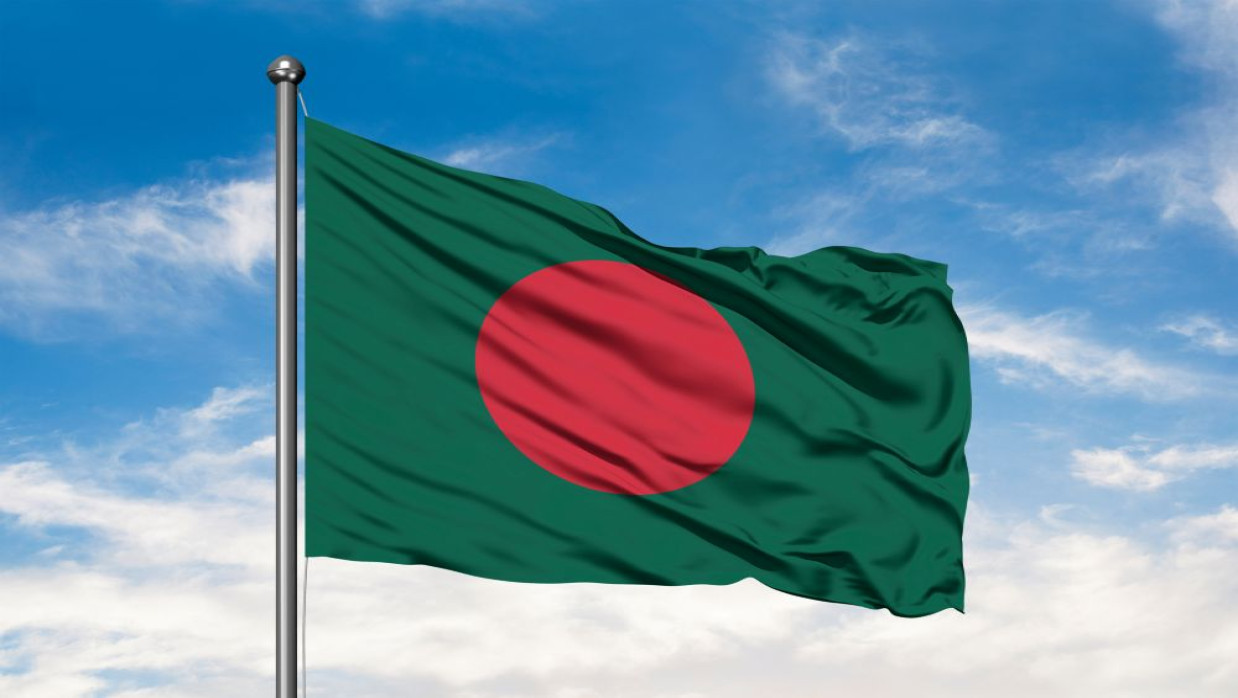
Traversing a sea of blood shed by hundreds of thousands fighting martyrs and wounded, and millions of sufferers, Bangladesh won victory on December 16, 1971. A beautiful red-n-green flag proudly stands in the world community since.
Bangladesh became independent but got little else. At home, Mujib turned into a ruthless dictator with all its ugly manifestations and human suffering. On the other hand, the Awami leadership helped the big neighbor to make the newborn country its hegemonic ground. For the people, it was a jump from burning pan to the blazing fire.
After the fall on Mujib in 1975, the country saw an all-round progress for a few years under President Ziaur Rahman, much to the dislike of the enemies of the state. He was soon eliminated in a suspected Indian putsch. Later, with the help of a willing traitor, army chief General Moeen Uddin Ahmed, India maneuvered to return to the controlling seat on January 11, 2007. The country is yet to come out of that deep tangle!
“July 36” ousted long-running fascist Sheikh Hasina, daughter of Mujib and a tested servant of Delhi, where she is presently sheltered. The replacement with Professor Muhammad Yunus generated some hope. But the Nobel Laureate was outmaneuvered by the same self-seeking vested quarters. After winning the election handily, the new administration of the BNP appears to be dancing to the same (Indian) tune. Suspicion of an Awami-Indian hand in the election engineering is fast bearing truth.
The syndrome of suffering cycle for the people is far from over.


0 Comments
LEAVE A COMMENT
Your email address will not be published