

Bangladesh Interior Minister Salahuddin Ahmed has recently brought an old debate back to life. It seems to have settled itself earlier, but each time Bangladesh politics move forward, the issue of constitutionality arises. Ahmed recently said that Bangladesh politics must be run "according to the constitution". At face value, this sounds like common sense, but as soon as the words left his mouth, dozens of tongues wagged, asking whether Bangladesh's politics had been run in accordance with the Constitution over the last year and a half.
While his statement may or may not have been technically correct, most people are left wondering one thing: if not now, when should Bangladesh's politics have followed the Constitution over the last 17 months? If the Constitution is the ultimate yardstick of legitimacy, critics ask, does that mean the country was governed by an extra-constitutional arrangement during that period? The implication is troubling, but it illustrates the complex relationship between legality and political necessity that has long characterized Bangladesh's democratic journey.
Democracy Versus Realpolitik in Bangladesh
Bangladesh finds itself in a dilemma. Constitutional rhetoric has become something of a staple in politicians' mouths these days. For much of the last year-plus, many of today's vocal defenders of constitutionalism either supported or acquiesced to a political settlement that fell outside constitutional parameters.
Comments made by Salahuddin Ahmed, therefore, struck a nerve. On the one hand, his statement that the Constitution is the roadmap for all political decisions was applauded by those who think Bangladesh needs to reinstate a stronger rule-of-law structure following years of political instability. On the other hand, the comments have been criticized by many as rather academic in light of the recent political transition, which involved obvious circumvention of the Constitution.
Bangladesh is not unique in this struggle between constitutionalism and realpolitik. A constitution can only go so far in describing how government should operate. When pushed, politicians will often resort to crafting their own solutions to a crisis. Bangladesh has certainly seen its share of these kinds of crises, and the events of the last seventeen months have shown us again.
The Election Delay and the Legitimacy Gap
The most commonly discussed scenario relating to this issue is the postponement of general elections. According to Article 123 of the Constitution, elections must be held within 90 days of the dissolution of Parliament. The interim government headed by Muhammad Yunus took office on 8 August 2024, and, as per the constitutional deadline, the election must have been held in early November 2024. However, elections were held on 12 February 2026, approximately 553 days after the deadline. No crisis made holding elections impossible. Elections were delayed due to extended political negotiations, administrative adjustments, and efforts to restore credibility after the fall of the previous government. Voters accepted the delays silently, believing they were necessary to restore faith in the election system. However, constitutional experts viewed it differently. Legally speaking, there is a problem: the Constitution does not allow such a postponement.
Legality, Legitimacy, and the Politics of Power
Bangladesh's political scenario has been such that legitimacy and constitutionality have not always aligned. While Sheikh Hasina's administration appeared constitutional, many of her critics charged that elections were rigged and that she wielded too much power unilaterally. The legitimacy of the caretaker government was derived from popular dissent and political expediency, but its constitutional mandate was murky at best. The incumbent government was elected in February 2026, and while it has electoral legitimacy, there remain questions about whether all constitutional criteria for elections were met.
This complicated interplay between legality and legitimacy has turned constitutional rhetoric into a political tool. Competing actors invoke the Constitution selectively, depending on whether it strengthens their political position. Constitutional principles are sometimes emphasized after political power has already been secured, rather than consistently guiding the process through which that power is obtained.
It is within this context that Salahuddin Ahmed's recent remarks have gained prominence. His insistence that the Constitution remains supreme echoes well-established legal doctrine. He has pointed out that there is no constitutional provision for a Constitutional Reform Council, and that any referendum results must ultimately pass through Parliament to become formal constitutional amendments.
From a purely legal perspective, he is correct. The Constitution requires that a two-thirds majority of Parliament approve amendments under Article 142. Moreover, the Bangladesh Constitution contains no provision allowing referendums to amend the constitutional framework directly.
Yet critics argue that these constitutional concerns seem to have become important only after the political transition was completed. Few voices raised similar objections when the election timetable was extended far beyond constitutional limits or when new political mechanisms—such as the Constitutional Reform Council and the July Charter were created outside the constitutional framework.
Institutional Confusion and Cabinet Dynamics
Another dimension of the controversy concerns the Interior Minister's institutional role. In most parliamentary democracies modeled after the Westminster system, constitutional interpretation typically falls within the domain of the Law Ministry or the Attorney General's office.
The Interior Ministry is generally responsible for law enforcement, internal security, and the management of police forces. Its primary role is to maintain order rather than interpret constitutional doctrine.
The fact that the Interior Minister has become the principal public voice on constitutional questions has therefore raised eyebrows. Observers wonder whether this reflects a lack of coordination within the government or a deliberate effort by one ministry to dominate the public narrative surrounding constitutional reform.
If the Interior Ministry were to act as the government's constitutional authority, the institutional balance within the cabinet could become blurred. Such confusion risks undermining public confidence in the administration's coherence and professionalism.
The Origins of the July Charter
The controversy surrounding constitutionality also extends to the creation of the Constitutional Reform Council and the July Charter. Both initiatives emerged during the immediate aftermath of the political upheaval that reshaped Bangladesh's political landscape.
Supporters of the reform process viewed these mechanisms as necessary instruments for translating the aspirations of the street protests into structured institutional reforms. The July Charter, in particular, was designed as a broad political agreement outlining the goals of democratic reconstruction and governance reform.
Critics, however, emphasize that neither the Reform Council nor the Charter has formal constitutional standing. Any attempt to implement their provisions without parliamentary approval could therefore conflict with existing constitutional procedures.
The Law Minister's Clarification
Law Minister Mohammed Asaduzzaman tried to put some points across yesterday amid this debate. Addressing reporters, he claimed that everything that has come out of NCP leaders was due to their frustration over the agitation they staged earlier and to their not understanding the ground reality.
The minister said his government is ready to face any criticism in Parliament as this is the venue for debate on national issues. Dismissing NCP's arguments that Supreme Court lawyers have raised on legal grounds, he said amendments to the Constitution can be passed only through Parliament debates, not through rallies.
He said that his government has no reason to backtrack on implementing the July Charter. But, he said emotionally, that may not happen because most issues raised in the Charter require amendment to the Constitution, and amendments have to be made in a particular way, as the Constitution itself states.
Translation: Implementing the July Charter is good, but please don't expect it to be implemented overnight through politics.
The Presidency and the Logic of Continuity
One question that remains dangling amid Bangladesh's political transition is the presidency. President Mohammed Shahabuddin swore in the Chief Advisor and members of the interim government, but Shahabuddin's removal was one of the primary demands of many leaders of the July revolt. Elected uncontested as the AL's candidate in 2023, Shahabuddin was seen by many protesters and opposition leaders as a stooge of the previous regime. After the regime change, calls grew for his impeachment/removal from office, citing political responsibility for not preventing the excesses of Sheikh Hasina's regime.
The changed reality after August 2024, however, puts a spanner in the works for those calls for immediate constitutional action. With Parliament dissolved, Article 60's constitutionally-specified process of impeachment is largely moot. The question of President Shahabuddin's removal thus becomes a political matter for discussion among the members of the interim setup.
The President also came under criticism from the protesters for being a "die-hard" AL apparatchik. However, Shahabuddin was vocal against the ousted regime later on, accusing it of having "fascist" inclinations. Supporters of the new regime, however, question the legitimacy of such a dramatic political volte-face.
Further, while the presidency might be a politically contentious institution today, it nonetheless remains an important constitutional office. The abrupt removal of the President amid an uncertain transition might complicate the relationship among political leadership, civil bureaucrats, and the military high command. A degree of continuity might work better for Bangladesh at this stage.
Parliament or the Streets?
In the final analysis, the great uncertainty in Bangladesh is whether there will be power-sharing struggles in Parliament or a return to street agitation.
The Supreme Court could ultimately decide the legitimacy of the Reform Council, the date of the election, or the validity of any referendum. A court review could validate or invalidate the political settlement on constitutional grounds.
Opposition groups have threatened that unless the July Charter is honored, people will take to the streets again. Popular agitation can move mountains in Bangladesh, but citizens are getting fatigued with confrontations.
A Test of Political Responsibility
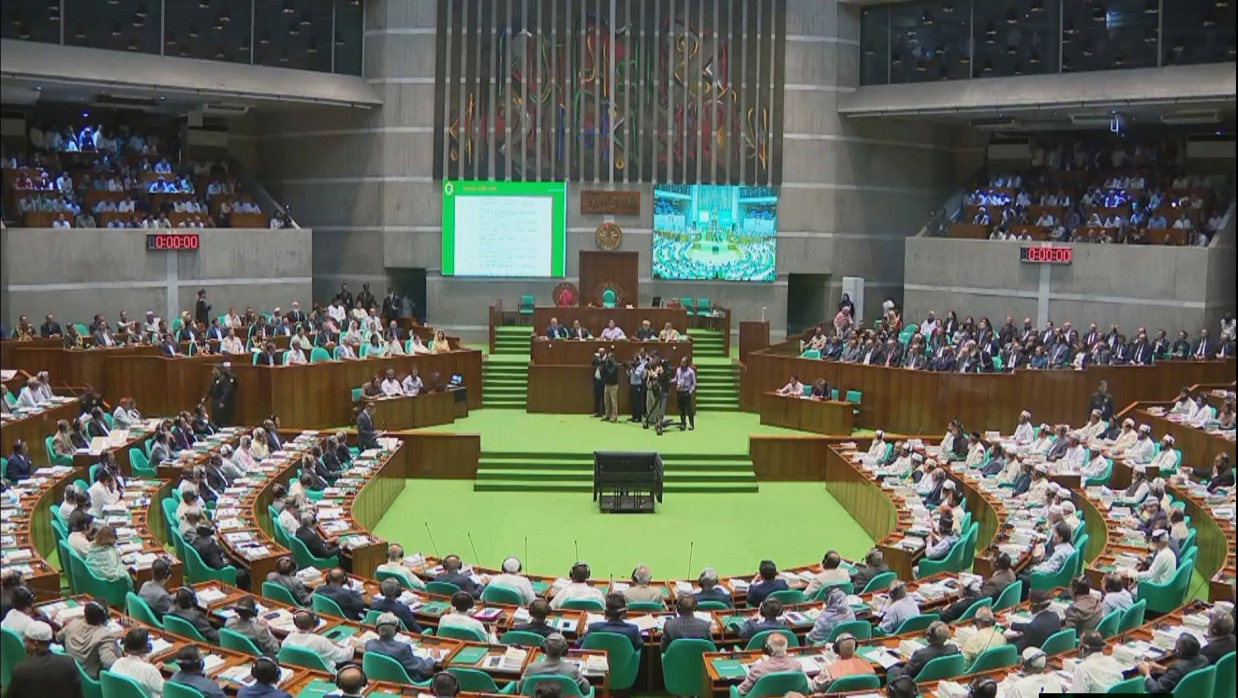
BNP has already secured two-thirds of the seats in Parliament. Now the ball is in their court. If BNP is sincere in implementing the points of the July Charter, they can amend the Constitution through Parliament, where they have the requisite majority.
Discussion in Parliament will help identify which provisions should be adopted and which need to be amended. Through Parliament, we can turn political understanding into law and make it Constitution-binding by consolidating democratic support.
If not, this will only reopen old wounds, leading to public cynicism and political division. Bangladesh cannot afford the Street Politics of toss-and-smash anymore.
Restoring Public Trust
A common theme on both sides of the argument is public mistrust of politicians. Corruption scandals, polarization, and perceived misuse of public institutions by both major parties have contributed to widespread distrust in government.
BNP and its acting chairman, Tarique Rahman, have their work cut out for them if they are to restore trust amongst the people. Merely paying lip service to upholding the Constitution will not be enough. They will have to walk the talk by acting with honesty, transparency, and accountability.
Crack down on corruption within their party and break ties with politicians who seek power only for personal gain and economic enrichment.
Otherwise, they will fall into the same pitfalls as their predecessors and lose whatever credibility they have to lead Bangladesh through this transitional phase.
Bangladesh at a Crossroads
Bangladesh, therefore, stands at a critical crossroads. The political settlement that has gradually emerged over the past two years now requires formal constitutional validation.
If Parliament successfully translates the principles of the July Charter into constitutional amendments, the country could move toward a more stable and legitimate democratic order. If not, the unresolved tensions between legality and political necessity may continue to haunt the nation's political landscape.
As long as the debate sparked by Salahuddin Ahmed's remarks continues, fundamental questions about Bangladesh's constitutional future will remain open. Whether those questions are answered through parliamentary debate, judicial intervention, or renewed public mobilization will shape the next chapter of Bangladesh's democratic evolution.

0 Comments
LEAVE A COMMENT
Your email address will not be published