

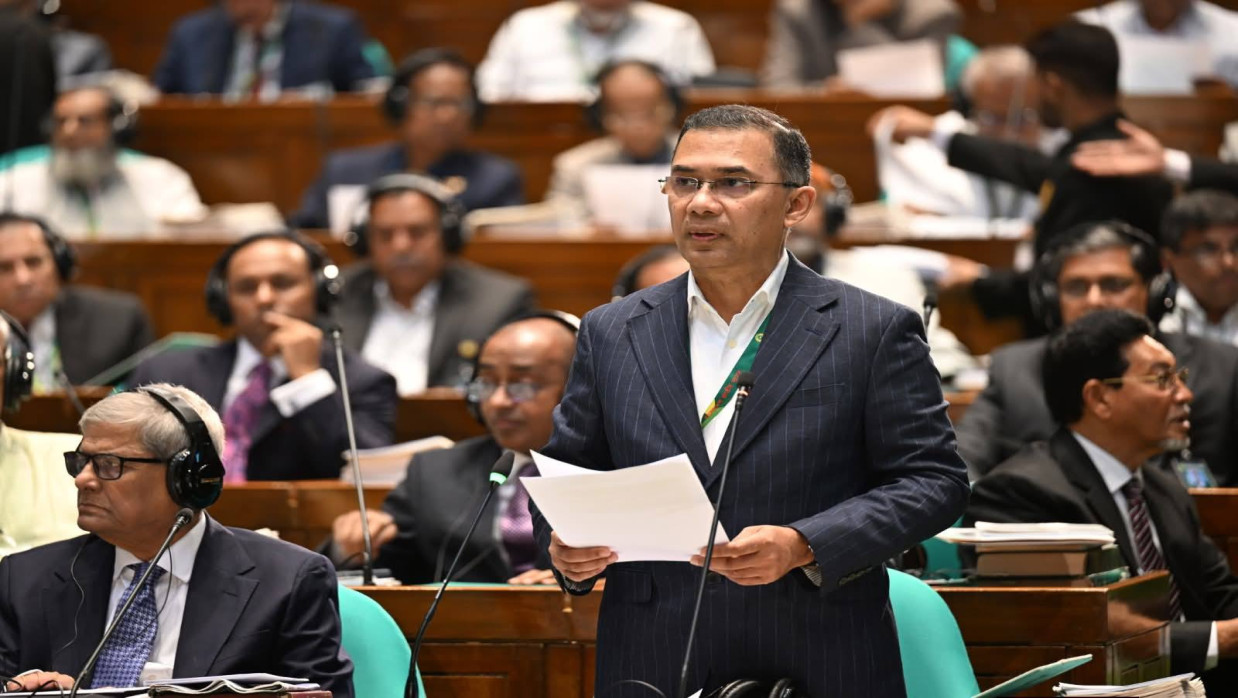
The Trials and Tribulations Before Rahman’s Government: Bangladesh has reached a significant crossroads after having elected Prime Minister Tarique Rahman. Following years of political turmoil that left the country’s institutions in dire shape, Rahman’s administration is poised to face great pressure to “democratize” Bangladesh once again by rebuilding investor confidence, restoring economic growth, and most importantly, strengthening government institutions that have been plagued by polarization and mistrust during the previous regime. Rahman will face several obstacles in the first few months of his government, including economic vulnerabilities, politicized bureaucracy, pressure from the international community, and dissent within his own party. Will Bangladesh’s second transition yield democratic dividends?
A Historic Moment in Bangladesh's Political Journey
Tarique Rahman’s ascension to the premiership of Bangladesh is destined to go down as one of the pivotal moments in Bangladeshi politics. Rahman took office following Sheikh Hasina’s two-decade reign, widely perceived as having corrupted democracy and closed political freedoms.
Millions rejoiced at Rahman’s victory. The election represented hope for Bangladeshis who had felt stifled by electoral fraud, authoritarianism, and democratic fatigue.
In many ways, Rahman’s arrival represents a new beginning for the country. The formation of a new government in parliament, coupled with renewed electoral politics and responsive leadership, provides hope for democratic renewal.
Tarique Rahman knew better than most. Months of campaigning left him tempered and pensive. Rahman spent much of Bangladesh’s contested political era abroad and knows there is much to be done.
Ironically, we often find that moments of celebration are the precursors to tragedy. Few elected leaders will inherit a country quite like Bangladesh. It is a nation of over 179 million people and barely over 147,000 square kilometers of land. Mr. Rahman will not only have to answer to his supporters but also address years of institutional degradation and poor economic governance.
Governing a Complex and Fragile State
Bangladesh confronts structural weaknesses in governance. It faces the triple challenge of a high-density population, environmental risk, and economic vulnerability.
Bangladesh’s GDP has been boosted by success in certain sectors, including ready-made garments exports and international remittances. However, the country suffers from low capital investment, a lack of skilled workforce, an unstable energy grid, infrastructure constraints, and poor financial management.
One area of particular weakness has been the banking sector, which has been rocked by years of political meddling in loans and poor financial oversight. Rising inflation has undercut domestic consumer purchasing power. Unemployment among young Bangladeshis is a persistent problem. Private sector investment has cooled as economic policy remains in flux.
Now more than ever, Bangladesh Bank must stand up and lead.
Unfortunately, there are signs that rent-seeking elites and crony capitalists are already trying to pull financial policy strings from behind the scenes. If Bangladesh Bank loses its autonomy and the public’s trust, stabilizing the economy will be that much harder. Investors need to know that money is being managed responsibly.
Economic risk has been building in Bangladesh for some time. Much of the institutional weakness can be traced to the Awami League’s sixteen-year tenure. Critics say that centralizing power in the party leadership and stacking committees with loyalists has left businesses unchecked.
Restoring macroeconomic health will be one of Rahman’s top challenges. Creating jobs, growing exports, and attracting investment will depend on his ability to provide competent stewardship.
Of course, economic reform also depends on political stability. Unfortunately, confidence in Bangladesh’s governing institutions has been undermined by political infighting.
The India Factor: A Relationship of Necessity and Caution
India is Bangladesh’s biggest neighbor and largest trading partner. Cross-border commerce, energy links, and infrastructure connectivity tie South Asia’s economies together.
Bangladesh-India relations have historically ebbed and flowed in line with domestic political calculations in Dhaka. The ties between Hasina’s government and New Delhi were the closest in recent times.
For Prime Minister Tarique Rahman, recalibrating that relationship without unsettling New Delhi will require careful judgment and diplomatic balance. There are several reasons for prudence. Awami League–affiliated networks continue to exist within Bangladesh and among certain segments of the Bangladeshi diaspora in India. Moreover, many bureaucrats and security officials who advanced through the ranks during the Awami League years may retain personal or institutional loyalties formed during that period. At the same time, within the BNP itself, there are senior figures known for their close alignment with India whose motivations may at times be influenced by personal or financial interests rather than broader state considerations.
Neglecting that reality opens up space for the new government to be exploited. State institutions cannot function at half-strength if parts of them are politically aligned against the government.
Internal Party Pressures: The Challenge from Within
Ironically, the most immediate threat to Rahman's government may not come from opposition parties but from within his own organization, the Bangladesh Nationalist Party.
Across many political systems, victorious parties often struggle to manage their supporters' expectations. After years of political repression under the previous administration, BNP activists and leaders who endured hardship may now feel entitled to compensation.
Grassroots activists may attempt to capture local administrative processes, viewing development projects as opportunities for patronage or financial gain.
Meanwhile, senior party figures may demand government contracts, business concessions, or political appointments in recognition of their loyalty.
The prime minister, therefore, faces a dilemma.
Rejecting these demands risks alienating loyal supporters. Accepting them, however, risks recreating the same patterns of corruption that undermined previous governments.
History demonstrates that systemic corruption often begins precisely in this manner.
The Bureaucratic Question
Another critical challenge lies within Bangladesh's administrative machinery.
Over the past fifteen years, sections of the bureaucracy have become heavily politicized. Career advancement often depended not only on professional merit but also on political affiliation.
Attempting to reverse this politicization too quickly could provoke bureaucratic resistance. Yet ignoring the problem would allow entrenched interests to obstruct reform.
At the same time, professionals who quietly supported the BNP during its years in opposition may now expect preferential treatment.
Granting such demands would only deepen the politicization of the civil service.
A professional bureaucracy loyal to the constitution rather than to political parties remains essential for the long-term stability of the state.
Parliament and Democratic Culture
Frequent boycotts, confrontational politics, and limited legislative scrutiny have marked Bangladesh's parliamentary history since the restoration of democracy in 1991.
The new parliament provides an opportunity to change this culture.
If the opposition, including the Jamaat-e-Islami, participates constructively, Bangladesh could witness meaningful debates on national policy.
Such a transformation would strengthen democratic institutions and enhance the legitimacy of the political system.
However, this outcome will depend heavily on the political maturity of both the government and the opposition.
A Narrow Window for Reform
New governments typically enjoy a short "honeymoon period" during which they possess maximum political capital.
Rahman currently stands at the peak of public expectation. This moment presents a rare opportunity to implement difficult reforms, discipline party structures, and strengthen national institutions.
If these reforms are postponed, political resistance will inevitably grow, and the opportunity for meaningful change may disappear.
Conclusion: Leadership at a Defining Moment
Prime Minister Tarique Rahman now stands at a defining crossroads in Bangladesh's political history.
His government has the opportunity to restore democratic institutions, rebuild economic confidence, and reshape the country's political culture.
Yet the obstacles before him are formidable.
Geopolitical pressures, bureaucratic inertia, internal party expectations, and regional strategic complexities all pose potential risks to his administration.
Above all, he must remain vigilant against the subtle traps of political complacency, whether they emerge from entrenched bureaucratic networks, opportunistic allies, or external strategic pressures.
If Rahman succeeds in strengthening institutions and governing with integrity, Bangladesh could enter a new era of democratic stability.
If he fails, the cycle of political disappointment that has repeatedly plagued the nation may repeat itself.
History has given him an extraordinary opportunity.
What he does in the early months of his leadership will determine whether that opportunity becomes a turning point or a missed chance in Bangladesh's long struggle for democratic governance.
History has given Prime Minister Tarique Rahman a rare and consequential opportunity. Moments such as this appear only occasionally in the life of a nation when public expectation, political authority, and the demand for reform converge at the same time.
Whether Bangladesh moves toward institutional renewal or falls back into familiar cycles of political dysfunction will depend largely on the decisions made in the early months of this government. Power has been placed in Rahman's hands not merely to govern, but to reform.

0 Comments
LEAVE A COMMENT
Your email address will not be published