

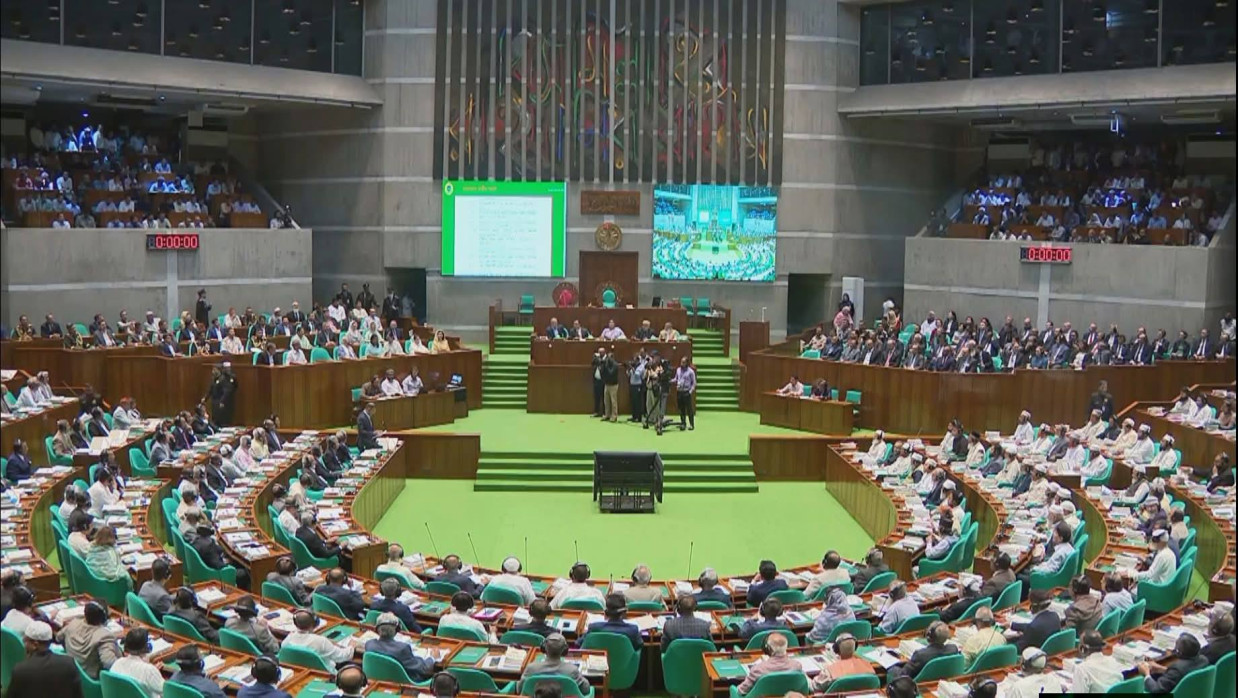
The inauguration of Bangladesh's 13th National Parliament was expected to mark the beginning of a new political chapter after a long period of turmoil and transition. Instead, the opening session has exposed deep fractures in the country's political landscape and raised serious questions about whether the new government is beginning its tenure on the wrong footing.
At the center of the controversy is the appearance of President Mohammad Shahabuddin, a figure many critics associate with the recently overthrown Sheikh Hasina government. To many people, his attendance at the opening ceremony of the Parliament cast a shadow of the past regime over the proceedings. Instead of celebrating democracy, it turned into another round of political hostilities.
Members of the opposition reacted strongly. Opposition parties left the room while the President was speaking, accusing him of humiliating the nation. Their argument was simple: if the country had truly moved beyond the authoritarian legacy of the previous government, why was the same President perceived as a loyalist of the former ruling establishment, presiding over the birth of a new parliament?
The Inaugural Session and Its Symbolism
The first session of the 13th Parliament followed formal parliamentary procedures. Bir Muktijoddha Hafizuddin Ahmed was elected Speaker, with Barrister Kaiser Kamal chosen as Deputy Speaker. President Shahabuddin administered the oath of office for the newly elected members, while Tarique Rahman formally assumed his role as parliamentary leader and Prime Minister.
In a strictly procedural sense, the session restored parliamentary politics after a prolonged period of political uncertainty. However, symbolism matters enormously in politics, and the moment's symbolism raised uncomfortable questions.
The opposition, including members of Jamaat and NCP, staged a walkout during the President's speech. Their protest reflected a deeper political sentiment circulating in the country: that the new government might be willing to accommodate elements of the very political order that voters believed had been rejected.
The Shahabuddin Controversy
President Shahabuddin has become the center of the controversy. As some see him as the continuation of the much-criticized politico-administrative system of the previous regime, Shahabuddin's presence in the President's office itself became a subject of dispute. People toppled the Hasina regime through street protests demanding the restoration of democracy, which they alleged was destroyed under her rule.
Many find it difficult to believe the change of regime if the President himself hails from that era. He has even been termed 'fascist's accomplice by some quarters.
President Shahabuddin's speech added fuel to the fire. Political commentators remarked that some portion of his speech contradicted what he had said during the earlier political turmoil. His critics instantly seized on this as proof that his speech was similar to that of the ousted regime.
Opposition MPs walked out of Parliament expressing their protest.
The July Charter and a Broken Promise
One of the most serious accusations against the new government has been the apparent degradation of the July Charter. Issued during the tumultuous political period leading up to the election, the charter was believed by many to be laying down principles for democratic reform and restructuring following the disintegration of the old regime.
Citizens hoped that the new regime would use the charter as a guideline for re-establishing democracy. Many now say that the actions taken by the new regime in its infancy show a reluctance to follow through on the charter.
What concerns some even more is that members of the new regime don't want to grant the July Charter any political standing. If people believe there are strong factions within the new regime that want to maintain the status quo, it will discredit the new regime when it needs all the public support it can get.
Suspicions of Political Rehabilitation
Adding to worries is speculation that the ruling Bangladesh Nationalist Party (BNP) is setting the stage to rehabilitate the politicians of the recently vanquished Awami League (AL).
Reasons for such speculation are hard to find, beyond some seemingly innocuous political signals, soothing words and gestures, and the absence of ousting old regime elements from government offices. To some critics, however, they add up to evidence that the new government is looking for ways to co-opt the challenges to it by reintegrating some of the old guard into the system.
If so, they may be making a serious mistake. The anger that fueled the political fight against the old government was as much against perceived authoritarianism as against corruption. Bringing back the cronies of that regime risks turning back the clock on the change voters were promised.
Perception is reality in Bangladeshi politics.
Parliamentary Functioning and Institutional Concerns
Apart from the controversy of the presidential issue, the inaugural session reflected further institutional ailments, Minister of Law, Md. Asaduzzaman presented 133 ordinances to Parliament, raising eyebrows over the excessive use of ordinances during the caretaker government.
Observers have said passing a large volume of ordinances would mean taking major policy decisions without Parliament debating them. Policy decisions taken outside parliamentary ambit shall now be put under intense scrutiny if Parliament is to remain the battleground of democracy.
Another troubling issue concerns the mysterious absence of the previous Awami League Speaker. Reports suggest that the former Speaker sought refuge in the cantonment. Yet, the government has not publicly clarified the situation or explained why the constitutional procedures surrounding the parliamentary transition were not followed.
In a country where constitutional norms have often been fragile, such ambiguities can quickly fuel suspicion.
Internal Frictions Within the Government
Observers have pointed out that there were also signs of strain within the new power structure. As some important ministers were absent or only participated briefly during the inauguration, it has been speculated that there may be factional power struggles within the government.
Analysts also cited the delay in naming a new Attorney General as evidence that the new government has not yet fully cemented its power. While delays like this may be technical in nature, they can often indicate political fault lines within ruling coalitions.
For a government entering office with high public expectations, internal divisions could quickly undermine its ability to implement reforms.
A Fragile Democratic Moment
Despite these tensions, the resumption of parliamentary politics remains an important development for Bangladesh. For nearly seventeen months, the country was governed under an interim arrangement that many critics described as unconstitutional. The restoration of an elected parliament, therefore, represents a step toward institutional normalization.
However, normalization alone is not enough. Democratic legitimacy depends not only on elections but also on the public perception that the political system reflects the will of the people.
At present, that perception remains contested. The opposition still commands roughly 31 percent of the national vote and retains significant street-level mobilization capacity. If parliamentary debate fails to address key political grievances, street politics could once again dominate the national landscape.
The Road Ahead
Events at the opening of the 13th Parliament signal some of the challenges ahead for Bangladesh.
Will the government want to be seen as representing real political reform, or will it simply maintain the status quo? How it responds to issues raised by the July Charter, President Shahabuddin's position, and accountability for the past regime will be critical to public perceptions of government direction.
Mixed messages so far. Opening Parliament is good news. The controversy surrounding it shows how precarious that good news is.
Bangladesh is at a critical juncture politically. If genuine issues raised during this first session are not appropriately addressed by the new government, the goodwill and enthusiasm for change that a democratically elected government represents may be short-lived.
The session began with an opportunity to unite the country and restore confidence in democratic processes. Instead, it showed that Bangladesh may still have many lessons to learn from its past.

0 Comments
LEAVE A COMMENT
Your email address will not be published