

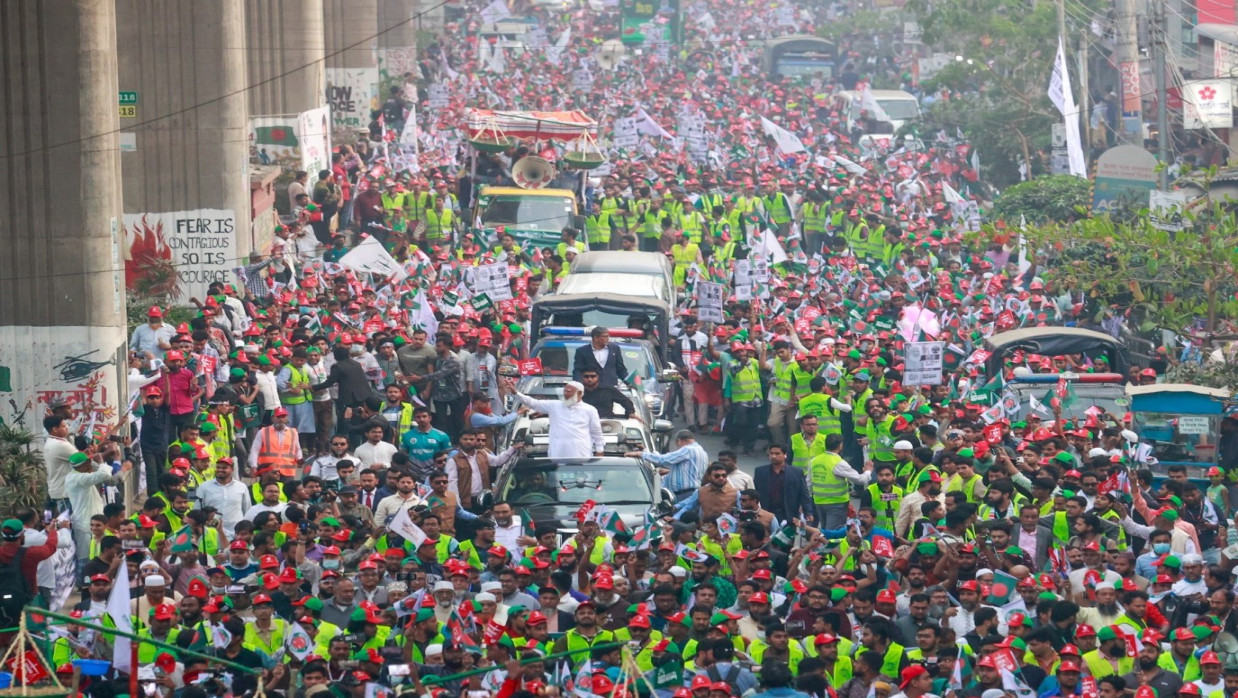
Bangladesh has a history of Islamic parties shaping its politics. As things stand today, Islamic parties will likely continue to exist in Bangladesh. However, evidence indicates they are likely to shrink over time, rather than grow. Regional factors like Hindu nationalist parties gaining power in India have kept Islamist parties politically relevant for the time being. However, the electoral and structural landscape of Bangladesh suggests that Islamist parties will have difficulty building independent support in the coming years.
Islamist politics in Bangladesh are crowded and do not operate on a single platform. Bangladesh Jamaat-e-Islami, Islami Andolan Bangladesh, Khilafat Majlis, and Hefazat-e-Islam are the most recognized Islamist groups today. Hefazat-e-Islam does not officially operate as an electoral party but acts as a social pressure group. Each group has different levels of organizational strength, approaches to electoral politics, and Islamist ideologies. This fragmentation prevents Islamist parties from coming together when it matters politically. Fragmentation is arguably the biggest factor inhibiting the growth of Islamist politics in Bangladesh.
Bangladesh Jamaat-e-Islami has been the most well-known Islamist party for decades. Jamaat’s party organization, student wing, and committed cadre have given it an electoral strength that other Islamist parties have been unable to match. Jamaat has previously been part of successful coalitions, serving as a kingmaker. However, Jamaat-e-Islami’s role in the Bangladesh Liberation War of 1971 has given it a reputation that many Bangladeshis find troublesome. This has hindered Jamaat-e-Islami from gaining widespread support, even when participating in elections has been politically permissible. Jamaat will likely remain confined to its core supporter base unless it overcomes these political roadblocks.
Islami Andolan Bangladesh has existed for a shorter time than Bangladesh Jamaat-e-Islami. However, over time, Islami Andolan has grown its support base through Qawmi madrasas and religious communities. Islami Andolan positions itself as an alternative to both Jamaat-e-Islami and secular parties by claiming to be more trustworthy. But Islami Andolan has been unwilling to consistently join forces with other Islamist groups due to holding onto its desire to be an independent party. Khilafat Majlis and other small Islamist groups operate in Bangladesh today, but they lack a national party organization and play only limited roles at the local level.
Ideological and leadership conflicts between Islamist parties have prevented them from consolidating power. Bangladesh Jamaat-e-Islami, Islami Andolan, and factions of the Qawmi madrasa movement all operate with the desire to win over conservative Muslim voters. Jamaat-e-Islami has entered into coalition governments with parties such as the Bangladesh Nationalist Party and the Awami League in the past. Islami Andolan Bangladesh has sought to contest elections independently. Some factions of the Qawmi madrasa movement have publicly cursed Jamaat-e-Islami and claimed that voting for Jamaat is forbidden. As Islamist parties cannot agree to coexist politically, they will struggle to grow their influence in Bangladesh.
Take the last election, for example: in what was essentially a two-party race between the BNP and JI (or, as some would call it, a “vacant field” where the Awami League was not allowed to take part), Islamic parties had a field day. Multiple Islamist parties contested elections. They held rallies, released manifestos, mobilized voters… but ultimately did not gain significant ground. Votes were divided among multiple Islamist parties and also went to individual candidates, such as the BNP and independents. Awami League votes bolstered both BNP and Jamaat. As a result, the Jamaat gained the highest number of seats in parliament ever. Whether this momentum will continue when the Awami League joins future elections is doubtful.
Furthermore, electoral maths will never allow Islamist parties to reach the heights that they want to reach. Looking back at previous elections, the vote share that Islamist parties have collectively received has never reached a point where they could one day contest an election and win on their own. They’ve been most successful when acting as kingmakers and allying with larger parties (such as the BNP and AL). Even if every Islamist party came together to form a single party (highly unlikely), they would still likely have to join forces with another party to realistically form the government. Bangladeshis are still largely secular and pragmatic: they care about economics, stability, governance, and credibility abroad just as much as they do about religious identity.
However, the regional atmosphere cannot be ignored. Bangladesh is indirectly fed by the Hindu nationalist politics of India. Due to the BJP’s polarizing rhetoric and discourse against Muslims and other minorities, many religious voters have come to a realization that there is regional polarization against them: Hindus are becoming increasingly radical in India, while here in Bangladesh, Muslim identity is being questioned at every corner. Jamaat-e-Islami is often seen as a form of resistance against the BJP and Hindu nationalism. While the BJP has been able to grow with relative impunity due to its electoral victories, Islamist parties in Bangladesh have been able to stay relevant despite their lack of electoral successes.
The problem is that India is going down a path where anti-Muslim riots are becoming far too common, and Hindu nationalist violence against minorities is growing more popular and organized by the day. Bangladesh does not have that. Yes, we still see incidents happen against minorities from time to time, but do we really see an ideological state-driven movement to politically and socially exclude minorities? We still have minority representatives in our parliament and in our cabinet. Political parties still don’t dare go full throttle on anti-minority rhetoric for fear of losing votes. Without being able to explicitly say that you are protecting the religious majority from “attacks”, Islamist parties cannot rally the masses.
So in short, Islamists will likely stay in politics as part of a coalition. They will probably remain relevant as opposition partners, thanks to seat-sharing agreements, political concessions, issue-based politics, and tactical collaborations with larger parties.
In the future, however, we can expect Islamist parties to lose influence. Between internal party divides, unhelpful electoral maths, secular and pragmatic voters, and Bangladesh’s dependency on foreign trade, Islamist parties cannot truly expand their influence in politics. They can stay relevant due to regional religious polarization, but their overall influence will likely remain the same, if not decrease.

0 Comments
LEAVE A COMMENT
Your email address will not be published