

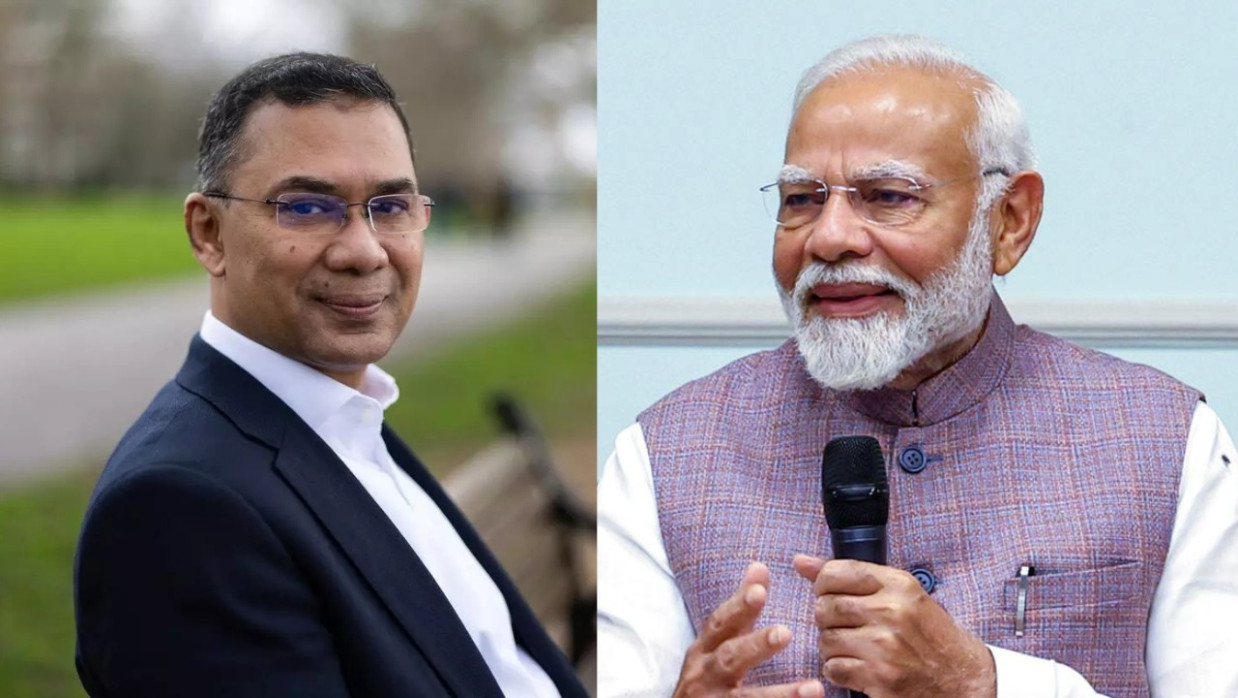
As Bangladesh has constituted a new government under the leadership of Bangladesh Nationalist Party (BNP) after a largely fair & peaceful national election on 12 February 2026, the people of eastern India (the region virtually embraces the poverty stricken country except a few kilometers in Myanmar and the Bay of Bengal) hope for a progressive regime in Dhaka enjoying political stability and pursuing economic developments to over 170 million people in the south Asian nation. The Muslim majority country continues to grow as a headache for the north-eastern states, more precisely Assam, for at least two reasons namely unabated influx of migrants and regional security concerns affecting millions of indigenous families in their homeland.
The region’s land connectivity with the rest of India is often picked up by a section of motivated Bangladeshi elements mentioning the challenges surrounding the Siliguri corridor (popularly known as chicken’s neck). Some of them even fantasize incorporating a large part of eastern Bharat to establish a greater Banglasthan. They convincingly argue, an affluent nation should have a sea, a fertile valley with water bodies and also a range of mountains, eventually indicating parts of Bhutan and Tibet too in their day-dream. Many others strongly believe that Bangladesh, which nurtures a single linguistic identity (Bengali), should now attain mono religion (read Islam) characteristics.
The election in a festive mood, otherwise not witnessed in Bangladesh, recorded around 60 percent voters’ turn out giving the BNP a whopping 212 seats in the 300-member Parliament (another 50 women members will be added to the Jatiya Sansad). Sixty years old Tarique Rahman, son of former Prime Minister Khaleda Zia and former President Ziaur Rahman, led the mainstream party in the electoral battles with no instigating anti-India rhetoric, which is understood as a common tactic to gain instant popularity among the Bangladeshi nationals. Even after taking oath as the new premier, Rahman remained cool and overviewed holistic relations with the neighbouring countries, including India.
The popular anti-India speechifying got momentum after the ousted premier Sheikh Hasina took shelter in New Delhi, where she along with thousands of her party (Awami League) leaders continue to seek political asylum since her sudden departure on 5 August 2024. The interim government, formed under leadership of Nobel laureate Dr Muhammad Yunus, repeatedly asked for Hasina’s extradition, as she faces death sentence by a Bangladeshi tribunal, but generating no positive responses from India. PM Rahman, here also, avoided any aggressive comments against Hasina, who termed the 13th Jatiya Sansad as a farce, only pointing out that her repatriation should be addressed with legal initiatives.
When Bangladesh attracted international media attention with a series of atrocities on religious minority families in recent years, four non-Muslim candidates including two Hindus (namely Goyeshwar Chandra Roy and Nitai Roy Chowdhury) could emerge victorious in the last election. Nominated by the BNP, both defeated Jamaat candidates. Two other winning candidates from minority communities namely Saching Pru and Dipen Dewan were also nominated by the BNP. PM Rahman also inducted Roy Chowdhury and Dewan in his ministry. Needless to mention, the Hindus constitute a dwindling population of around 13 million (only 8% of populace ) in the country, whereas during the partition they had over 22 % of the population. So the atrocities on religious minorities continued since long back including the long tenure under the Hasina administration in Dhaka.
Prime Minister Narendra Modi promptly congratulated the BNP leadership for the decisive victory in polls. Modi became the first global leader to call Tarique Rahman and expressed interest in working with Dhaka for mutual benefits to both the neighbouring countries. The BNP leadership promptly acknowledged Modi’s gesture and stated that Dhaka looks forward to engaging constructively with New Delhi to advance a multifaceted relationship, guided by mutual respect, sensitivity to each other’s concerns and a shared commitment to peace, stability and prosperity in the entire region. Later Modi congratulated PM Rahman for the responsibility and even invited him along with family members to visit India at a mutually convenient time. Though could not respond to the BNP chief’s invitation to attend his swearing-in ceremony on 17 February, Modi assigned Lok Sabha speaker Om Birla to represent India in the auspicious ceremony held at the southern courtyard of Jatiya Sansad Bhawan in Dhaka.
Earlier, in his last televised address to the nation as the caretaker government’s chief adviser Dr Yunus described the election ‘not merely as a power transfer but the beginning of a new journey for Bangladesh’s democracy’. The globally acclaimed microcredit initiator and social business promoter reminded the countrymen that the interim regime started working from minus (not even zero), as the poverty stricken country was made rubble by the former ruler (read Hasina). The reputed economics professor reiterated his emphasis on the enormous opportunities for Bangladesh with a potential growth of regional cooperation with Nepal, Bhutan and north-eastern Indian States. He concluded by appealing to the Bangladeshis, along with political leaders, to uphold and strengthen the momentum for peace, progress and reforms with unwavering unity in the coming days.
Speculations mounted in Dhaka that former interim government chief Prof Yunus may be appointed as the 17th President of Bangladesh even though the BNP has a number of choices for the ceremonial Head of the State including Khalilur Rahman (national security adviser in the Yunus administration, who now joins the BNP-led government as a minister) or BNP veteran Khandaker Mosharraf Hossain. The stipulated five-year term of current President Mohammed Shahabuddin will expire in 2028, but he may resign prematurely following the change of political landscape in the country. President Shahabuddin, who was elected unopposed as the nominee of the then ruling Awami League, recently expressed his wish to retire due to various reasons after the election.
It may be mentioned that the referendum on the National July Charter, which went simultaneously with the 12 February polls achieving ‘Yes’ votes from more than 70 percent voters, proposes more power to the President. Moreover, it added, the presidential election should be held through secret ballot among elected representatives of the lower house of Parliament (proposed to have a 100-member upper house also). If Dr Yunus becomes the President, the populous and developing country may get a lot of advantages from his in-depth connections with the western world, precisely the USA, but the question that arises, if PM Rahman will prefer an alternative power centre in the capital with an influential personality like Prof Yunus in Bangabhawan?
Nonetheless, concerns for India in general and Assam in particular remain as Bangladesh Jamaat-e-Islami, an Islamist party that opposed the1971 liberation movement taking side of the western Pakistan, has emerged as the main opposition party in Jatiya Sansad for the first time in the history of Bangladesh. The Jamaat guided an alliance of 11 parties to win 77 seats, where the Shafiqur Rahman-led party alone won in 68 constituencies, amazingly in most of West Bengal bordering constituencies. On the other hand, the newly surfaced political party, National Citizen Party (which was formed by the students, who orchestrated the July-August 2024 uprising to topple Hasina’s government in Dhaka) had joined hands with the Jamaat in electoral battles and won six seats. The political observers believe that a potential threat is looming at large for the landlocked Indian region which needs to be addressed efficiently by New Delhi after recalibrating bilateral ties with the troubled neighbour!

Nava J. Thakuria
Nava J. Thakuria is a Guwahati (Northeast India) based journalist, who contributes to NewsBlaze and various media outlets throughout the world.

0 Comments
LEAVE A COMMENT
Your email address will not be published