

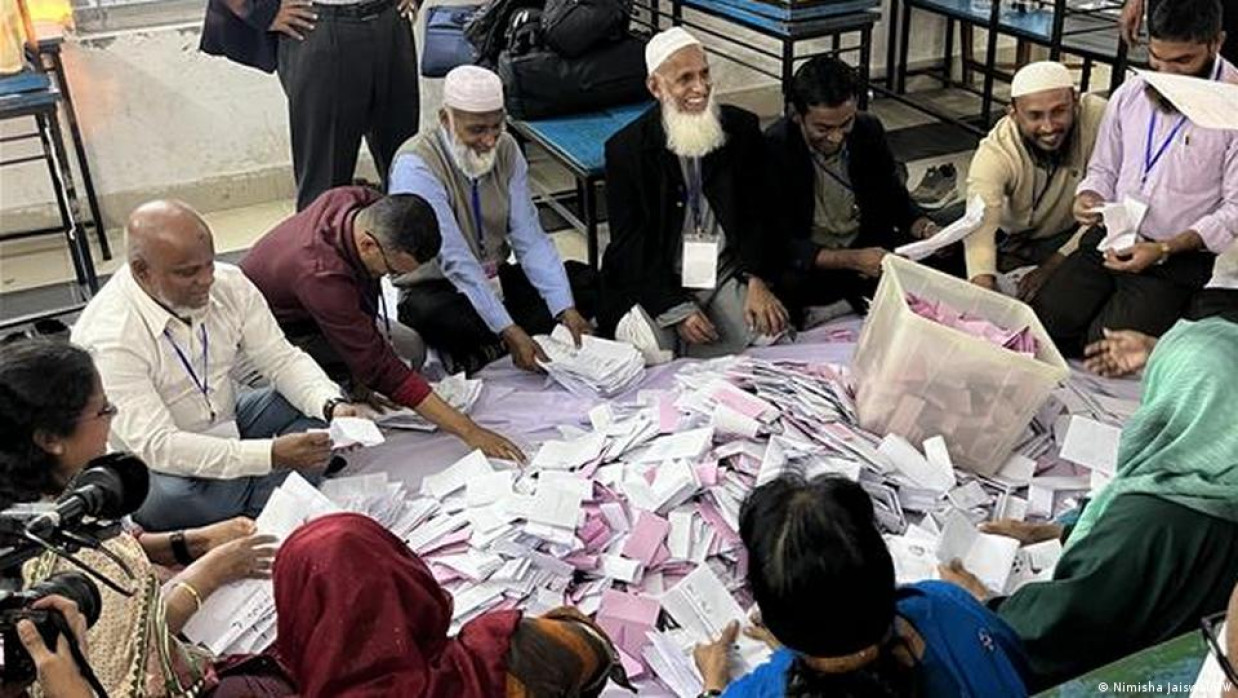
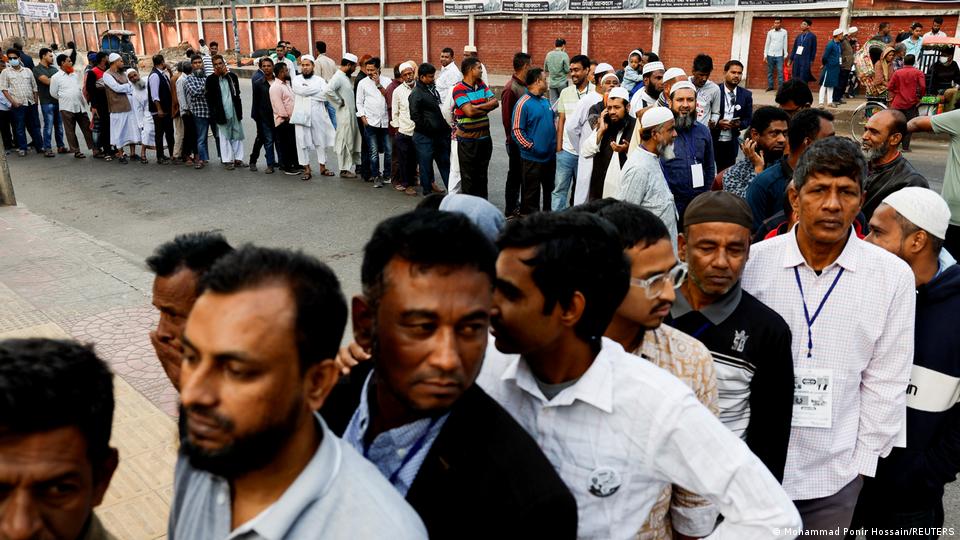
Bangladesh and elections share a love-hate relationship that extends from Bangladesh’s creation to the present. Elections played a pivotal role in 1970, giving the people a free mandate to form their government and leading to Bangladesh’s independence. In 1996, two elections were held one after another. In 2008, a contested election took place, and almost 90% of voters cast their ballots. Bangladesh also experienced non-free and rigged elections, orchestrated referendums, and boycotted polls in between these years.
The upcoming election and referendum will have the greatest impact on Bangladesh’s democracy. There is hope, as never before, people are impatient to cast their votes after many years of electoral darkness. On the other hand, there is doubt about whether the elections will be free and fair.
Elections were held almost every year after the country’s independence, either under a party rule or the military regimes. Bangladeshis have never been this polarized for such an extended period as they are today. Following two decades of controversial elections, resulting governments, an economic meltdown, and the erosion of trust in institutions by those whom the institutions were designed to serve, Bangladesh is going to hold elections again.
Editor Matiur Rahman Chowdhury recently took to Facebook to respectfully criticize Dr. Muhammad Yunus for failing to deliver the much-needed reforms the nation needed during his caretaker government stint. Chowdhury expressed the view that Yunus had cleared his personal controversies but could not initiate significant changes nationally.
The long version of his criticism said that even though Dr. Yunus had cleared all allegations regarding personal use of funds and assets.
Bangladesh Election’s Rollercoaster Ride
1970: The Decisive Election That Led to Liberation
In 1970, Pakistan witnessed one of South Asia’s most momentous elections. Sheikh Mujibur Rahman’s Awami League won 167 of the 300 seats allotted to East Pakistanis in Pakistan’s national assembly. The election held under the Joint electorate was boycotted by the communists. The Awami League campaigned on its Six-Point program, demanding autonomy for East Pakistan.
However, the Awami League's majority vote was seen as a threat to West Pakistani elites and the military. As a result, Bangladesh was denied its legitimate existence. The refusal to allow Bangladesh to become a reality sparked the Liberation War of 1971 and culminated in the country’s independence.
One-Party Rule Post-Liberation
In 1973, Bangladesh finally had its first-ever parliamentary election after gaining independence. Awami League won 293 of the 300 parliamentary seats, almost sweeping the election. While the election was held to restore normalcy and restore parliamentary democracy after years of war, there were early setbacks to democracy.
Opposition parties were weak and divided during the election. There were reports of vote manipulation and intimidation of opposition party activists. Bangladesh slipped into a pattern of one-party rule with limited checks and balances over the coming years.
Pakistan had officially dissolved years ago, but the same sentiment continued through the next few election cycles as well. Sheikh Mujibur Rahman was assassinated in 1975 in a military coup. Bangladesh finally got its second elected government under President Ziaur Rahman in 1977. Zia’s government held elections in 1979 and introduced the Bangladesh Nationalist Party (BNP), which won. Elections during this period were contested but held under military supervision.
1981: Regime Change Through Elections
President Ziaur Rahman was assassinated in 1981 while in office. He was succeeded by President Abdus Sattar, who was elected through a process supervised by the sitting president. However, President Sattar was overthrown by the military’s Chief of Staff, General Hussain Muhammad Ershad, in 1982.
Bangladesh experienced another pivotal moment in its electoral history in 1991. This year, Bangladesh saw its first free and fair election after independence. BNP won the election with 140 seats while Awami League came in second with 88 seats.
Like before, disputes arose over the management of elections, with both parties accusing each other of trying to use the Election Commission for their own benefit.
1996: One Election, Two Outcomes
In 1996, Bangladesh held two elections in one year. The first election was boycotted by almost all the major political parties and held under the BNP government. As expected, it was widely protested, and people came onto the streets.
In response to the mass protest, the government agreed to pass a constitutional amendment establishing a neutral caretaker government to oversee elections.
The June 1996 election was held under a non-partisan caretaker government and saw the Awami League return to power, securing 146 seats. Both the 1991 and 1996 elections were deemed fair by international and domestic observers.
Subsequent elections in 2001 and 2008 were also supervised by the caretaker government and received global acknowledgment.
2008: International Acceptance
The 2008 election was supervised by the military-backed caretaker government. Voter turnout was high at 87%. The Awami League-led alliance won the election by a landslide majority. This election showed the will of the people, as it was one of the fairest elections that Bangladesh had seen since independence.
For the first time in decades, Bangladesh achieved international recognition of its election results, both domestically and internationally.
2014-2024: Politics of Disillusionment
The caretaker system was abolished in 2011, and the BNP boycotted the 2014 election. More than half of the seats were uncontested as there was no opponent to run against the candidates put forth by the ruling party. Voter turnout was abysmal, leading many to question the election’s legitimacy. The election was not internationally accepted.
In 2018, an election was held in which all major parties except Jamaat-e-Islami participated. There were widespread reports of ballot stuffing and the blocking of the opposition party’s monitors at polling stations. Allegations of letting people vote overnight to inflate voter turnout numbers were rampant. Bangladesh’s Election Commission displayed partisan leanings towards the ruling party by quickly dismissing all allegations. The 2018 election was seen as one of the least free elections Bangladesh has witnessed since independence. There was no domestic or international acceptance of this election.
In 2024, Bangladesh witnessed a dummy election. The entire engineering competition was displayed at the voting booths, yet voter turnout was almost nonexistent. This election was not free or fair; however, it was held in accordance with all legal requirements. This election was accepted by no one except India.
Criticism
While Bangladesh has seen quite the rollercoaster ride in terms of its election history, editor Matiur Rahman Chowdhury took to social media, saying we still haven’t learned our lesson from history. In his Facebook post, he respectfully criticized Dr. Muhammad Yunus for failing to meet the expectations of most Bangladeshis.
Mr. Chowdhury went on to say that although Dr. Yunus cleared his name of any personal use of funds and property, he failed to initiate any meaningful national-level reforms to ensure free and fair elections.
While Dr. Yunus has gained moral legitimacy in the eyes of the people by clearing the controversies that have long surrounded him, institutions do not gain credibility from who runs them. Institutional reforms were the need of the hour, and Dr. Yunus had failed to deliver on that front.
Conclusion
Bangladesh is having an election today in an already unsteady environment. Jamaat-e-Islami, which has been almost non-existent in the political scene for the past 15 years, has gained substantial ground by running an organized and well-oiled party machinery. Unlike other parties, Jamaat-e-Islami maintains an active grassroots presence by caring for the poor and running various social welfare programs.
The High Court has ordered the Awami League not to participate in politics and will sit out of the upcoming election. BNP will try to ride the wave of people’s frustration and anger towards the current regime. The youth voter will decide this election. There are estimated to be over 40 million youth voters in Bangladesh. These voters want accountability, jobs, and good governance.
Will this election be close? You bet!
Politics of Violence
Bangladesh also witnessed the death of multiple people due to election-related violence. There have also been major administrative obstacles that the Election Commission must overcome if free and fair polls are to be held.
Will the Election Be Accepted Internationally?
The international community, especially Western governments and election observers, will base their judgment on whether the election was free and fair on transparency and voter participation.
India will most likely welcome whoever forms the next government in Bangladesh. India has always valued stability in Bangladesh over any political affiliation. We have already heard from all major parties that India-Bangladesh relations will not be affected by who comes to power. India will acknowledge the election results as long as they are credible.
Will Bangladesh regain international acceptance if the election is fair?
Bangladesh’s economy will boom, investment will pour in, and relations with all democratic countries will strengthen if a fair and free election is held. International isolation and economic uncertainty are all but guaranteed if the election is boycotted or rejected.
How close will the election be?
No one can deny that this election is too close to call. T
* Approximately 30-odd seats are going to be highly competitive throughout the country.
* There is a huge youth vote, as well as first-time voters, who can turn the tide in favor of either side.
* There is no party in power that has a clear majority.
* Key issues like inflation and a deteriorating economy will play a huge factor in how people vote.
Scenarios:
* Coalition government
* Single-party minority government
* Hung parliament
In none of the above scenarios will the results be readily accepted unless the election process is deemed free and fair by all parties involved.
Democracy’s Dawn or Darkness?
Will the upcoming election be the dawn of a new era of democracy in Bangladesh or, once again, another dark chapter in Bangladesh’s electoral history books? That remains to be seen.
One thing is for sure. Bangladeshis believe in elections and will vote if given a fair chance. The only thing they don’t trust is the institutions that help facilitate these elections.
Will the will of the people prevail?
That, and whether the outcome will be accepted by all parties, is the question that will determine Bangladesh’s democracy for years to come.


0 Comments
LEAVE A COMMENT
Your email address will not be published