

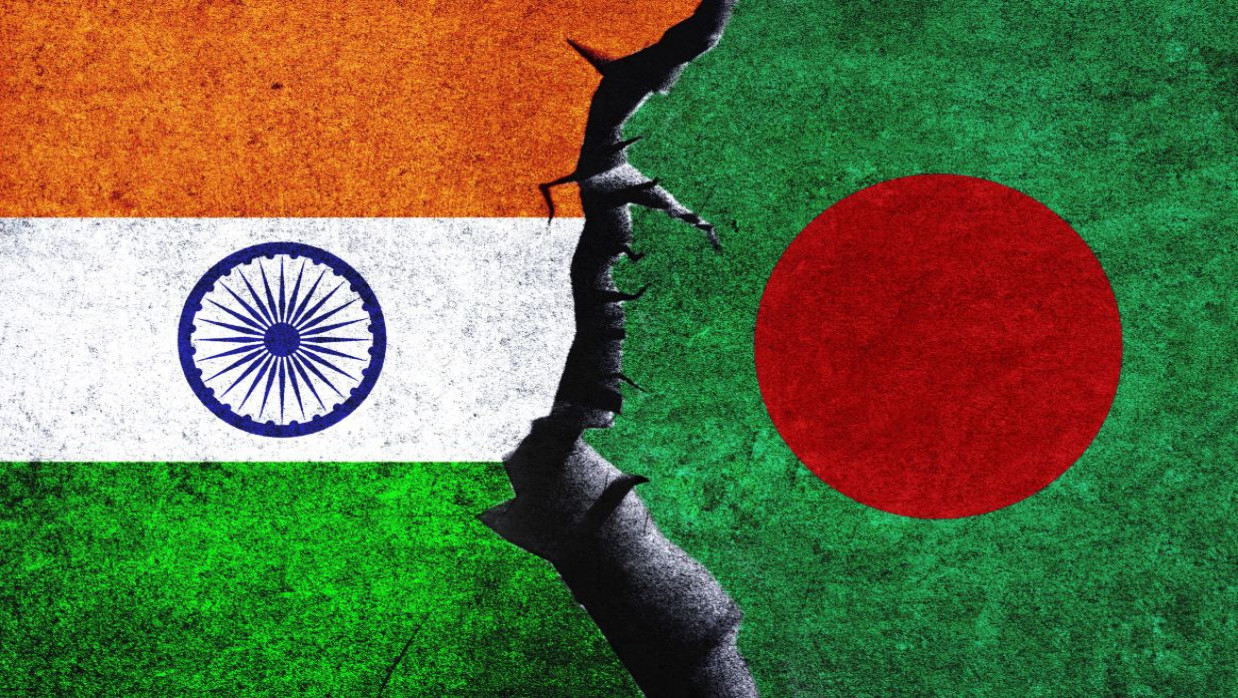
After the fall of the fascist Hasina regime, it has become clear as daylight in the last one and a half years that India does not consider us as friends. Its actions have repeatedly shown this. Those who had doubts about this earlier have surely been disillusioned. India still wants to see a loyal government in power in Bangladesh. New Delhi is not willing to allow any government outside its control to function independently in Dhaka. They are no longer satisfied with the big-brotherly attitude, which is also unjust; they want absolute dominance. They consider Bangladesh a satellite state and wish to continue colonial exploitation here, like during the Hasina era. Hasina's only aim was to retain the power for herself, her family, and her fascist party forever with the help of India. And India's aim was to keep Hasina and the Awami League in power by any means so that it could exploit and keep Bangladesh under its control. The people of Bangladesh and their legitimate interests were outside their calculation.
Only the benefited agents and the blind followers of New Delhi can deny this truth. If Bangladesh cannot get out of its clutches, there will be no real liberation. Much has been written about these issues. Now we have to decide how we can run the country well without India´s involvement. Given our geographical location, we cannot ignore India's physical presence, as it surrounds us on three sides. Let it remain on our three sides. But can't we exist without doing significant transactions or business with India by sacrificing our vital interests? Shall we have to go to India for Eid or Wedding shopping? Can't we avoid going to Kolkata or Vellore for treatment? If we must go abroad, aren't there alternative countries? There are many countries from which we can import raw materials, such as cotton, for our garment industries. It has recently been shown that the government does not face significant difficulties even if it does not rely on India for goods such as onions. Yes, the prices may be a little higher. But this price is nothing compared to how much the hegemonic neighbor is exploiting us commercially and economically, meddling in our internal affairs, trying to decide our issues by installing a puppet government, and threatening our sovereignty.
The question will arise: will they then hit us with a fluctuating water supply, block us on water, land, and air? No, it is not that easy. India wants to stop the water supply from the Indus River to Pakistan. Islamabad has taken the issue to the concerned International Court, and the court has already given a temporary ruling in favor of Pakistan. The upper riparian countries are also unable to make unilateral decisions on the flow of the Nile River´s water. After the martyred President Ziaur Rahman raised the issue of sharing the Ganges water at the United Nations, India was forced to sign a water-sharing agreement with Bangladesh. It contained a guarantee clause that ensured a minimum amount of water supply to Bangladesh during the dry season. If the initiative taken during Pakistan period to build the Ganga Barrage had been implemented, India would not have been able to dry us out in winter without providing water or drown us in the rainy season by releasing excessive amounts of water. It has become evident that they will not provide us with a fair amount of water in the Teesta. If we allow China to implement the Teesta project, we can also solve this problem. This requires strong political will and courage to ignore India's rude eyes. If India agrees to sign the Teesta agreement with binding international involvement that will protect our fair interests, then we need not consider alternatives.
The appointment of Indians in the IT sector and garment management has harmed us instead. There is no shortage of our own manpower in this sector now. Indians working in Bangladesh are taking away thousands of crores of taka from our country every year, which we can prevent. Those who think that Bangladesh will become immobile without Indian experts, products, and goods are wrong. India had stopped the entry of Indian cows into Bangladesh. We have now become self-sufficient in this sector. If they want to trade with us on a fair basis, it will be beneficial for both countries. Otherwise, we must make alternative arrangements.
Bangladesh does not have to be North Korea. We have no shortage of friends outside. Although India surrounds us on three sides, there are many other countries around us too. Due to our geographical location, we also have several strategic advantages. The Bay of Bengal has opened up opportunities for communication with the outside world. There is nothing to fear so much from Indian naval power. Keeping submarines brought from China at a standstill out of fear of New Delhi or in the hope of getting favor from them is just an example of a knee-jerk foreign policy. We can increase our naval power several times. Many powerful allies, both in the East and the West, are willing to help us. But we have to take the initiative.
Ziaur Rahman nearly resolved the Chakma issue and the broader Chittagong Hill Tracts problem. At a critical juncture in the country's politics, the then Hasina government, under pressure from India, reversed Zia's solution by signing the so-called Hill Tracts Peace Accord. In this agreement, the Bengalis living there were permanently reduced to a minority in the political sense. However, in reality, they are almost as numerous as the small ethnic groups. The small ethnic groups are not the sons of the Chittagong Hill Tracts and therefore are not indigenous. Many of them have come here to seek refuge from the oppression of the Myanmar rulers. The Chakmas and other small ethnic groups, who were expelled from other countries and found refuge here around 150 years ago, have become indigenous people, and those Bengalis who come from the plains of the same country have become outsiders – this is ridiculous and an unbelievable claim. Even before the arrival of the small ethnic groups, there were settlements of people from the plains. This problem was also created by India in its own interests. Alas, some of the most progressive intellectuals of our country are supporting this unjust claim. The state must do everything to protect the small ethnic people´s identity and economic development. That is undoubtedly important, but a different matter. India's strategy is to keep Bangladesh under pressure through these small ethnic groups.
India wants to keep Bangladesh under pressure with the collaboration of the 5th columnists. We should ensure the highest security of the minority community and instill a strong and unequivocal confidence in them so that they definitely think that their permanent interests lie with the interests of Bangladesh. And everyone knows that the minorities in our country are much better off than the minorities in India. Paid agents in the disguise of members of the so-called civil societies must be unmasked continuously.
In this situation, we need to prepare multiple contingency plans to deal with India's anti-Bangladesh stance. Plans should be made keeping in mind the possible changes in the relationship. If the relationship is normal and protects the interests of both parties, then there is no problem. But we see that India rarely considers our legitimate interests. They achieve their incredibly unjust interests by installing a loyal government here. We have to draw up a Contingency Plan assuming that India will not behave in a friendly manner towards us. In that case, our Think Tanks can help us most. We know what important role think tanks like the Carnegie Endowment, the Brookings Institution, the Wilson Center, the Atlantic Council, Chatham House, and CEPS play in the US and the UK. Such institutions also play a significant role in France, Germany, and Spain. Stockholm International Peace Research Institute (SIPRI), a think tank in the small country of Sweden conducts world-class research and analysis on the dynamics of global arms production and trade. The Fabian Society is an excellent example of how a good think tank can bring about a revolutionary change not only at the national level but also in the basic concepts of international politics. Although not on par globally, our country has a few research institutes, such as BIISS. BIDSS. These institutes can help the country in many issues, including India-Bangladesh relations. Therefore, they need to be adequately supported. As public policy institutes, Think Tanks will definitely work on other issues as well. But India-Bangladesh relations will be of special importance for our think tanks dealing with international and strategic affairs. We no longer have any headache or worry about Pakistan. Because geographically, they are located 1200 miles away. Since we do not have a common border with them, they are not a threat to us. Certain quarters are intentionally talking about the Pakistani mentality. This is pure nonsense. The observations and reviews of think tanks will, of course, include the United States and China, which need no explanation. But the primary focus will be on India. They should study the possible course of action of any future government that may come to power in India. We do not close the door to friendship with India. We want good neighborly relations with India on equal terms, where both countries respect each other's sovereignty and legitimate interests. If India changes its policy in the future, does not behave like a hegemon, and agrees to build a relationship with us based on fairness, there will be no reason to consider it an adversary. Such a government might come to power in New Delhi. The Think Tanks will explore all possibilities. But the bottom line is, we must have a genuine, patriotic, and 100 percent pro-Bangladesh government within the country. At the same time, New Delhi must abandon its desire to install a loyal, puppet government in Dhaka.

0 Comments
LEAVE A COMMENT
Your email address will not be published