

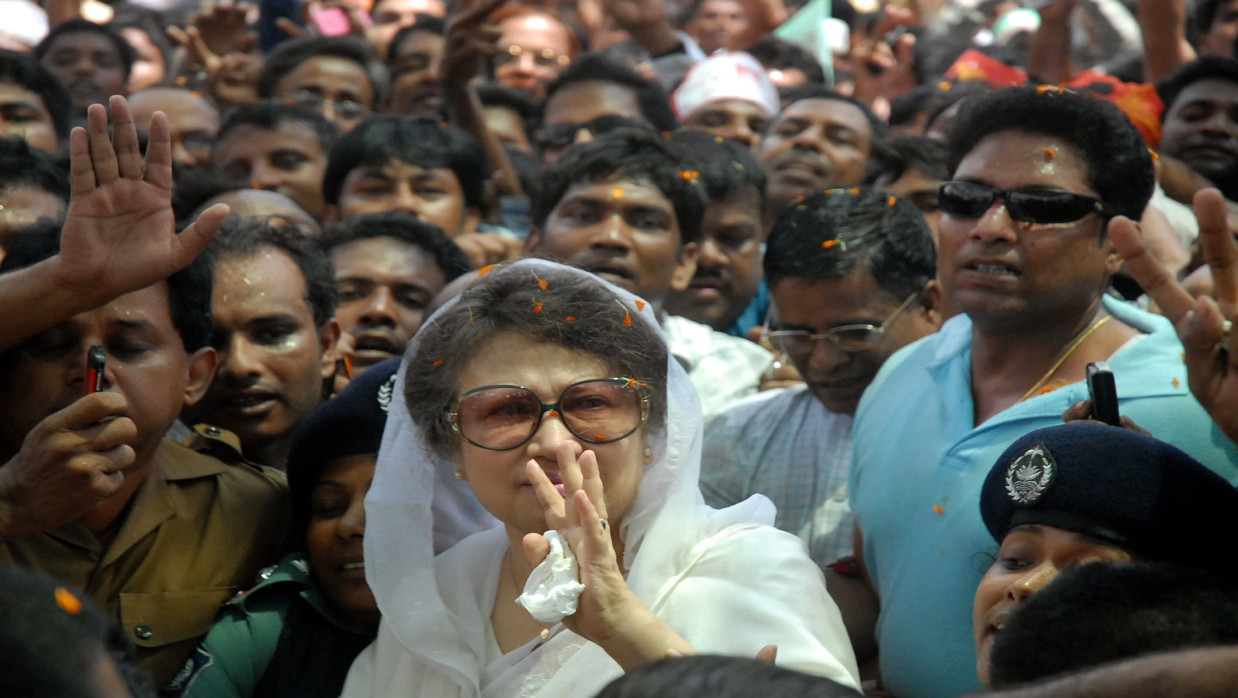
(Obituary. Begum Khaleda Zia, the Chairperson of the Bangladesh Nationalist Party (BNP) and a three-time Prime Minister of the country, passed away on December 30, 2025, amidst deep grief of the whole nation. A greatly respected and popular leader, her funeral attracted an unprecedented number of mourners--some estimates say 10 million-- that included senior political leaders from Pakistan, India and other neighboring countries. She was laid to rest in the capital city Dhaka by the side of her late husband former President Ziaur Rahman, one of the greatest sons of the soil.)
Begum Khaleda Zia, Chairperson of the Bangladesh Nationalist Party (BNP) and then Leader of the Opposition in the Parliament, was thrown out her cantonment residence on November 13, 2010, in full media glare. The drama of her ouster was not a peaceful one, nor was it voluntary, as claimed by the military’s Inter Service Public Relations (ISPR). Dozens were wounded in the police-public clash during the action. Distressed but undaunted Begum Zia told the reporters that security forces had broken her front door and dragged her out of her home. “They entered my bedroom and ransacked all the furniture,” she added. “They even beat up my personal staff.”[1]
The ISPR press release on the issue left much to be desired and many questions remained unanswered. As the concurrent Defense Minister, then Prime Minister Sheikh Hasina Wazed controls the ISPR. No wonder she was seen enjoying Nero’s grin when her archenemy was being publicly humiliated.
Resolving a Serious Anomaly. Really!
The way the judiciary, administration and Awami cadres played with the issue, it appeared that this was a crisis of the highest order that must be resolved immediately if the nation were to survive! Yet, some top Ministers and Awami stalwarts shrugged at the final episode to feign that it was a judicial matter and the government had nothing to do in its process. Borrowing a line from Abraham Lincoln, I may say the Hasina administration might fool all the people some of the time and some of the people all the time, but it could fool all the people all the time. Members of the public knew whose direction those actions were taken. They were also not unaware of the partisan credentials of the learned judges who gave the verdict on the issue. They had no ambiguity about the loyalty of the Law Minister and the Attorney General, as well as the enthusiasm of the Home Minister.
Then Brigadier-General Ziaur Rahman was allocated House No. 6 on Shaheed Moinul Road in the Dhaka Cantonment after he took over as the Deputy Chief of the Army Staff in June 1972. He continued to stay in that house when he became the army chief in 1975, and when he retired as Lieutenant General to become the President in 1977. Ziaur Rahman was killed in 1981, and his bereaved family was allowed to stay in the house under a government order. Later, President Hussain Muhammad Ershad granted the ownership of the house to Begum Khaleda Zia, as a token of the nation’s love, respect and gratitude to the assassinated president. Begum Zia and her family had been living in the house for nearly four decades. Nobody ever raised any question about its validity or legality.
However, things changed when Sheikh Hasina Wazed started her second inning in the helm of Bangladeshi affairs in January 2009. It looked as if her singular mission this time was to destroy Zia’s image and Zia's family. (Also read “Hasina’s Zia Phobia [2] )
The Awami League and its sponsors/supporters tried to eliminate Ziaur Rahman. But over two million people gathered at his funeral, an unprecedented event in Bangladesh! That spoke of the love and respect Zia the man and leader commanded from the people of Bangladesh.
Circumstances forced Begum Khaleda Zia to join politics and carry her the late husband’s mission forward. However, Ershad and Hasina jointly connived to thwart that. In his book Democracy and the Challenge of Development, Maudud Ahmed tells of the ‘box of crores’ from Ershad to Hasina as stated by Sheikh Selim, Hasina’s cousin. [3] That made Khaleda an “Uncompromising Leader” in the face of all odds, repeated humiliations and harassments by the Ershad regime. During the elections in 1991, following the ouster of Ershad, Ziaur Rahman, the former leader, became the issue. Everywhere people sang: জিয়া তুমি আছো মিশে, সারা বাংলার ধানের শীষে ! (You are embodied in every sheaf of paddy, Zia!). Sheaf of Paddy was the election symbol of Zia’s BNP, presently led by his able wife Khaleda. The emotional slogan created magic in people’s hearts, and they overwhelmingly voted for the BNP. Hasina’s anti-Zia slogans and activities boomeranged.
In 1996, Sheikh Hasina managed to win a thin majority and formed the government, thanks to helping hands from the Election Commission (CEC Abu Hena being an Awami supporter), a section of bureaucracy and media. An ever-active RAW was behind them all. Sheikh Hasina spent much of her energy during her first administration fulfilling her two oft-quoted promises: 1) rehabilitating the image of her father Sheikh Mujibur Rahman, and 2) hanging his killers. She largely succeeded in her dual missions. At the same time, she tried to demean, defame and obliterate everything Zia, Khaleda or the BNP did or stood for. The public response was shown in the rejection of Sheikh Hasina in the next election in 2001.
General Moeen’s Betrayal
In the elections to be held in January 2007, Sheikh Hasina saw that the BNP-led alliance was heading for another victory. She couldn’t allow it. She started an all-out destructive activity, at a huge loss of men and materials, to foil the election, on one pretext or the other. That gave the pretext to Army Chief, General Moeen U Ahmad, to betray the nation. In a palace coup, he replaced the existing neutral Caretaker Government (CTG)--charged to hold elections-- with one of his choosing, declared emergency and ran a martial law-type administration for the next two years. According to most analysts, it was a pre-arrangement conspiracy by India to subjugate Bangladesh, as the subsequent developments testify. New Delhi tagged along the US, the UN and other major players on the false premise of preventing Dhaka from going the Islamic fundamentalist way, a Western phobia. To the contrary, Bangladesh enjoyed a relatively peaceful and harmonious society, certified by many external dignitaries including those from the US and India. Once again, Bangladesh lost its sovereignty to India, thanks to General Moeen, the Betrayer.
A stooge of India, General Moeen did not make secret of his admiration for Sheikh Mujibur Rahman and preference for Awami League, destructive dictatorship of Mujib and the oppressive fascism of his daughter Hasina notwithstanding. Nor did he hide his dislike for the BNP, which installed him as the Army Chief in the first place, superseding a few seniors on the recommendation of his pal former Major Sayeed Eskandar, brother of Khaleda. Royal-style treatment and a cavalry gift to Moeen in New Delhi point to an underhanded horse-trade. It was widely believed that the Moeen-backed caretaker administration had worked to see Hasina’s Awami League win the election they masterminded in December 2008, a fact later publicly admitted by Hasina’s newfound “brother” and Jote partner, Ershad. Former Indian President Pronob Mukherjee also revealed it in his book The Coalition Years, 1996-2012 (2017, Kolkata) of an Indian collusion with the Moeen-led CTG to ensure a Hasina victory in the next election. [4]
Hasina’s Humiliation of Zia Family
Securely settled in power and backed by her sponsors, Hasina started a crusade to demolish Zia, his family and the BNP. While she nullified over 7,000 cases, ranging from corruption to murder, against her and her own party members, she not only strengthened those cases against the BNP and opposition leaders filed by Moeen’s CTG, but also continued to add new cases against them. Flimsy and unsubstantiated cases kept adding against Khaleda and her two sons, Tareque Zia and Arafat Zia. All of them were finally taken to custody. The younger Zias received inhuman torture in the hands of Moeen’s goons. They had to be sent abroad for treatment. The administration of Hasina has been issuing daily warnings to the effect that these two Zia-sons would be sent to the torture cells again if they dared to return home, surely aimed at serving punishing mental doses to the mother. Arafat had already succumbed to the aftereffects of torture in Bangkok in January 2015.
Zia’s name has been removed from the Dhaka International Airport after 30 years, his murals were destroyed wherever they appeared, nameplates bearing his name taken off every public place. Even there was a muted conspiracy to dismantle his Mazaar near the Sangsad Bhaban. Zia’s successful presidency---which stood in stark contrast to Mujib’s repressive and failed administration in 1972-1975---has been wiped off the history books of Bangladesh by re-writing the constitution, thanks to a compliant judiciary. That was not all. Awami leaders “discovered” Zia to be an agent of Pakistan during the liberation war of Bangladesh in 1971! [5]
Science teaches us, “Every action has an equal and opposite reaction.” That theory has been found working in politics too. In the case of Zia, defaming or demonizing him and his family had always seen the overwhelmingly opposite effect among the people. We have seen that during the funerals of Ziaur Rahman, Arafat Zia and lately Khaleda Zia. On the other hand, Hasina tried make her highly oppressive and detested dictator father Mujibur Rahman a God, but there were no tears on his death, nor any volunteers for his funeral; people celebrated his fall on August 15, 1975. There would have not been any trace of Hasina’s flesh on August 5, 2024, had her nephew General Wakar not come to her rescue and help her escape to her protectors in India. Allah said in Sura Al-Imran: I honor whom I desire, I humiliate whom I want. We say in Bangla: রাখে আল্লাহ মারে কে।


0 Comments
LEAVE A COMMENT
Your email address will not be published