

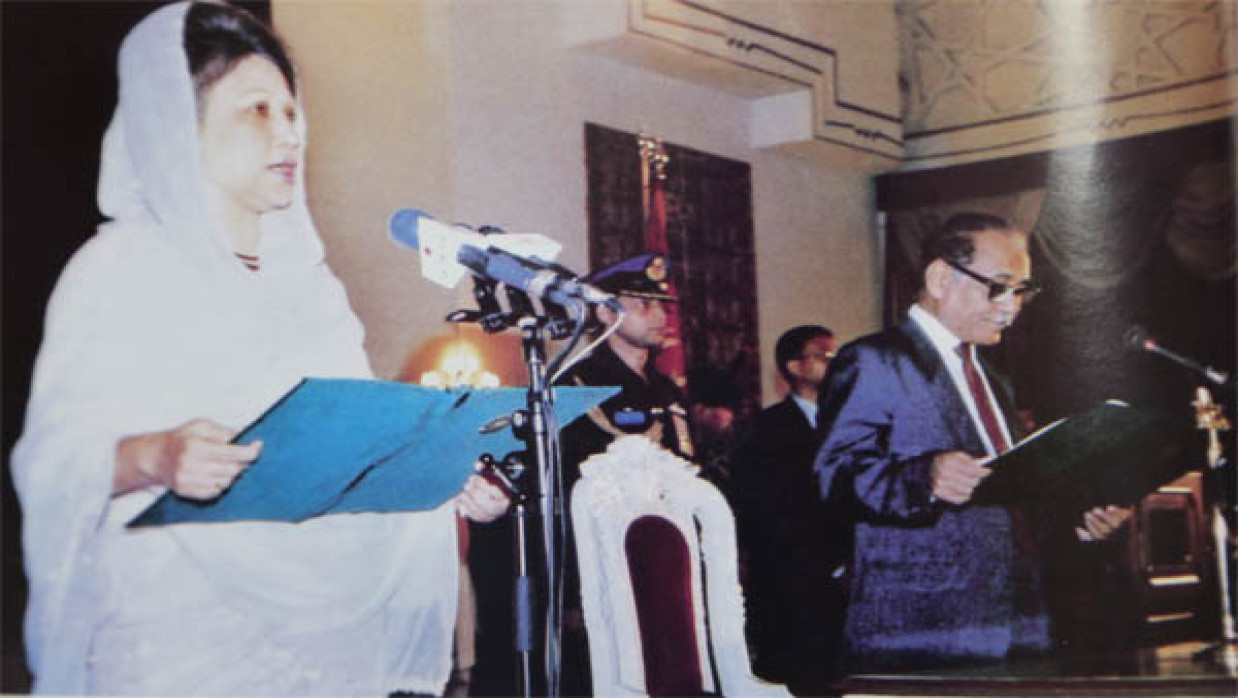
Vast areas of southern Bangladesh were hit by one of the deadliest cyclones and tidal bores of 20th Century only 39 days after Begum Khaleda Zia (1945-2025) assumed office of the prime minister for the first time on 20 March 1991. The calamitous situation was handled quite efficiently by her government despite acute shortages of relief and rehabilitation materials. The inflation rate was brought down to an all-time low during her tenure, and industrial cum agricultural growth underwent rapid acceleration. A new industrial policy was announced in 1991, which paved the way for private foreign investments and rapid expansion of the private sector, especially in the small and medium enterprises sub-sector. Hundred percent foreign ownership and joint ventures were allowed without any restrictions. The government actively promoted the growth of livestock sector, which led to the swift establishment of numerous poultry and dairy farms across the country. The local currency was made partially convertible for the first time and foreign exchange reserve reached an all-time high level. Pragmatic measures were taken to reduce dependence on external aid in the country's development budget by increasing the share of local resources from 21 percent to over 40 percent in five years. Value-added tax was introduced for the first time in the country at production and import levels during 1992-93 fiscal year, which opened up new avenues for augmenting the mobilisation of domestic budgetary resources. Side by side, there were massive cutbacks on customs duties at the import level as part of the free-market trade liberalisation policy.
The canal digging programme was reintroduced during this period to augment agricultural production and reduce floods. During the Fourth Five Year Plan (1990-95) period, the highest allocation was earmarked for the education sector, 70 percent of which went to primary and mass education sub-sector. A National University and an Open University were set up by the government, and establishment of private universities and medical colleges were allowed to prop up the country's higher education sub-sector. A separate Primary and Mass Education Division was created under the Prime Minister's Office in order to make the country's population literate within the shortest possible time. Primary education was made compulsory throughout the country from 1 July 1993. The Khaleda Zia government also introduced the 'Food for Education' programme in 1993 to promote education among the poorer segments of the population. Secondary education for girls was made free in the rural areas, and a stipend programme was introduced for the secondary level female students all over the country.
A permanent Law Commission was set up by the government for continuous updating of the country's laws. Significant steps were also taken during her first tenure to develop the country's communication network. These included the launching of the physical construction work of Jamuna Multipurpose Bridge on 16 October 1994, construction of the Meghna-Gumti Bridge on the Dhaka-Chattogram Highway for uninterrupted road communication between Dhaka and Chattogram, construction of a modern railway station in Chattogram, and the undertaking of a project to upgrade Chattogram Airport into an international one. For the first time in Bangladesh's history, preparatory work on Barapukuria Coal Mine and Madhyapara Hard Rock projects were completed, and agreements were signed with Chinese and Korean agencies for full implementation of these mining projects. New gas fields were also discovered at Bhola and in the Bay of Bengal.
Bangladesh's international image was greatly boosted by the holding of the Seventh SAARC Summit in Dhaka in April 1993, where Prime Minister Khaleda Zia was elected chairperson of the regional forum. Because of unrestricted press freedom, the number of newspapers and periodicals nearly doubled during her first tenure. For the first time in the country's history, satellite TV channels like CNN and BBC were allowed to broadcast their programmes in Bangladesh, and other international channels followed suit very soon. Cellular mobile telephone also commenced its journey in the country during this period.
Some administrative measures taken by Prime Minister Khaleda Zia during this period included implementation of the recommendations of National Pay Commission for enhancing the salaries and allowances of government servants; raising the age of entry in the civil service from 27 years to 30 years; simplification of the pension-sanctioning procedure, and introduction of life-long family pension for widows and offspring in case of deaths of government employees; fixation of minimum wage for workers in 17 sectors; establishment of the Coast Guard for curbing piracy and smuggling in the Bay of Bengal; and creation of a Securities and Exchange Commission for overseeing the functioning of the country's stock market. It was also her government which for the first time enacted a bill in Jatiya Sangsad for distribution of voter identity cards among the voters, and a project was launched for the purpose. There were hardly any allegations against the first Khaleda government regarding politicisation of administration. However, she attracted the wrath of a section of bureaucracy, as she tried to change the status quo and remove disparities among various cadres of Bangladesh Civil Service. The government also showed exceptional political tolerance as no crackdowns or repressions were carried out against political opponents despite record numbers of countrywide strikes, blockades, and other forms of disruptive cum violent activities during the period by opposition political parties led by the Awami League.
Prime Minister Khaleda Zia's third tenure (2001-06) in office brought more dividends for the country in terms of socio-economic advancement. For the first time in Bangladesh's history, average GDP growth rate during 2002-2006 period remained above 6 percent. The per capita national income rose from US Dollar 374 in 2,000-01 to US Dollar 482 in 2005-06. The foreign exchange reserve crossed the 3-billion-dollar mark from a mere 1 billion dollar in 2001. The flow of remittances almost trebled from 2001 to cross US Dollar 5 billion at the end of 2006. Despite the abolition of MFA quota system in 2005, the readymade garments sector continued to thrive due to efficient handling of the situation. The strides made by Bangladesh in the field of industrialisation due to investment-friendly economic policies and strategies pursued by the Khaleda government attracted the attention of foreign investors. Foreign direct investment amounted to a remarkable 2.5 billion US dollar during 2002-2006 period; around 9 thousand industrial projects worth Taka 620 billion were registered with the Board of Investment in four and a half years up to March 2006, which was more than double compared to the previous five years. As a result, the contribution of the industrial sector to GDP exceeded 17 percent and the growth rate in the sector crossed 10 percent during 2005-2006 fiscal year. A new EPZ was set up on the compound of Adamjee Jute Mills in 2004-05 after paying all outstanding dues to officers and employees of this loss-incurring state-owned enterprise.
A Poverty Reduction Strategy Paper was formulated by the Khaleda government as a medium-term plan document in line with the Millennium Development Goals declared by the United Nations. The budgetary allocation for poverty alleviation programmes was gradually increased each year and its share stood at 56 percent during 2006-07 financial year. The government expanded the social safety net programmes for direct poverty alleviation of hardcore and underprivileged people in the rural areas. A fund worth over Taka 500 million was created for generating employment opportunities in the country's Monga-infested (famine-like state) northern region during the lean season. A Taka 5 billion Char Livelihood Programme was launched for improving the livelihood of poor people living on shoals.
The population below poverty line in the country diminished by around 9 percent during the third tenure of Khaleda Zia. Numerous measures were taken for the welfare of backward and neglected segments of society. The monthly allowances received by the widows and distressed women were raised and their numbers increased. Arrangements were made for providing them with training and micro-credit, so that they could become self-reliant. The old-age allowance and the number of beneficiaries in the programme were also increased. The government also took some notable measures for environmental conservation in the country. Twenty-year-old buses and trucks were withdrawn, and CNG driven 4-stroke baby taxies were introduced on the roads in place of 2-stroke diesel-driven ones. Production and marketing of harmful polythene bags were banned throughout the country.'
The Khaleda Zia government also achieved some successes in the education sector. The net enrolment rate in primary schools was raised to 97 percent, education for female students was made free up to class twelve, and gender parity was achieved among boys and girls in schools. Besides, two new girls' cadet colleges and three new polytechnic institutes for women were also set up. Initiative was also taken to establish an Asian University for Women in Chattogram with assistance from the USA. Side by side with modernising the madrasa education system, the government decided to recognise the 'Dawra' certificate of Quawmi madrasas and made Fazil-Kamil degrees equivalent to bachelor’s and master's degrees. A number of new public universities were set up for expanding the opportunities for higher education, which mostly comprised of universities of science and technology. Many new private universities were also allowed to go into operation. Effective steps were taken for promoting vocational education. Existing vocational institutions were upgraded into colleges and their number was raised to 64 from the previous 51.
The Khaleda Zia government also implemented many programmes to reach healthcare services and concomitant infrastructural facilities to the doorsteps of the common man. The number of beds was raised to 50 from 31 in upazila hospitals, from 50 to 100 in hospitals of new district towns, and from 100 to 250 in hospitals of old district towns. Besides, some new medical colleges and hospitals were set up. Infant and maternal mortality rates declined in the country due to measures taken by the government. The rate of population growth came down to 1.47 percent due to strengthening of the family planning programme.
The Khaleda Zia government also attached much importance to the development of telecommunication sector. The number of fixed telephones in the country was increased to 12 lakh 20 thousand in 2006 from 6 lakh 85 thousand at the time of her assumption of office. The number of fixed-phone subscribers of private telephone operators also crossed 150 thousand in 2006. Digital telephone exchanges were set up in 64 districts of the country, and the upazilas were also gradually brought under digital telephone coverage. The total number of fixed and mobile telephone connections in the country crossed the 15-million-mark during her tenure. Seventeen private companies were given permission to provide fixed-phone services in order to make fixed telephones more accessible to the common people. Side by side, the government-owned ‘Teletalk Bangladesh’ also provided mobile phone services to the public. Bangladesh’s linkage with the information super-highway was reinforced through linking up with another submarine cable. As a result, overseas communication, data exchange, and internet connections became speedier, cheaper, and easier.
Although the Khaleda Zia government did not do much to raise the power generation capacity in the country, a network of 89 thousand kilometres of new transmission lines was installed during the period for supplying electricity. Because of stringent measures, system loss in the power sector was reduced to 22 percent from the previous 28 percent. It was also possible to bring almost 50 thousand villages under the purview of rural electrification programme. Fifteen new upazilas were created by the administration, thereby raising their number to 480. The post of a Tax Ombudsman was also created by the government for the first time in the country.
It was during the third tenure of Khaleda Zia that direct bus service between Dhaka and Agartala was launched and the direct railway link between Dhaka and Kolkata was finalised. Besides, railway service between the eastern and north-western part of the country via the Jamuna Bridge was also started during the period. Some notable road-bridges constructed during this period were: Shikarpur and Dwarika Bridges on Dhaka-Barishal highway, Fakir Lalon Shah (Pakshi) Bridge on the river Padma, Khan Jahan Ali Bridge over the river Rupsha on Khulna-Mongla highway, Haji Shariatullah Bridge over the river Arial Khan on Dhaka-Khulna highway, Dhaleshwari Bridge on Hemayetpur-Singair road, Mollarhat Bridge over the river Modhumati, the second Buriganga Bridge at Babubazar, the Dharla Bridge on Kurigram-Bhurungamari road, the Chandpur Bridge over the river Dakatia, and the Fenchuganj Bridge over the river Kushiara. Another notable project undertaken with assistance from the Kuwaiti government was the construction of Third Karnaphuli (Shah Amanat) Bridge at Chattogram.
It was the Khaleda Zia government that constituted the Anti-Corruption Commission through an Act passed by the Jatiya Sangsad, as a successor organisation to the erstwhile Bureau of Anti-Corruption. Another notable administrative measure taken by her government was the introduction of a new national pay-scale for government servants in 2005. However, promotions given to higher echelons of bureaucracy were not always above controversy, and there were some allegations of juniors superseding the seniors on political grounds.
Bangladesh was elected to 13 UN bodies, including the United Nations Human Rights Council, Peace Building Commission, and ECOSOC during the third tenure of Begum Khaleda Zia as prime minister. Besides, the country became a member of the ASEAN Regional Forum (ARF) in 2006. She also discharged the responsibility of SAARC Chairperson after hosting the 2005 Summit. Bangladesh played a crucial role in global peace initiatives during the period by sending the highest number of troops to the UN Peacekeeping Missions. Begum Zia’s government lent its whole-hearted support to the Western countries in the fight against international terrorism, but at the same time sought to reinforce mutually beneficial and cooperative relationships with the Muslim World.


0 Comments
LEAVE A COMMENT
Your email address will not be published