

Ebadur Rahman
I cannot write about Begum Khaleda Zia in the past tense.
She was my class, my class's taste, Bengali dignity incarnate, Dhaka society's cosmopolitanism, that peculiar synthesis of East and West, and the last public representative of a lost world and a vanished time.
She embodied, simultaneously, the rise of the post-1947 Muslim middle class, the equations of the Cold War, and the complex narrative of post-colonial state-building in the Third World, and in this concatenation of forces, her position and contribution stood distinct from, and more singular than, those of Indira Gandhi or Sirimavo Bandaranaike, those other great South Asian women who came before her.
I say this as the child of a defence family. The first chapter of my life unfolded in the cantonment, and I knew intimately the way defence wives like my mother carried themselves; their restrained, elegant comportment, their cultivated conversation, their proper social graces, even the particular manner in which they held fork and knife at parties.
In the Dhaka of the late 1970s and early 1980s, Begum Khaleda Zia's distinction cannot be understood today. In our charming, urbane, metropolitan Dhaka world, where discipline and dignity were life's keynotes, there was a specific cadence to the way refined Bengali was spoken, a distinct style to how respectable families dressed, a precise etiquette governing how people of good breeding interacted with one another. And Begum Khaleda Zia was a person of our world. She was someone we knew. She was one of us.
The Air Force Officers' Club in my childhood was like our backyard. In that club's pond, I fished sitting on my father's lap or in the laps of his friends.
In that club, as a small child, I learned to play billiards. And there, at Old Fouzian reunions or other functions, Colonel Zia and Begum Zia showed me affection. Many showed us affection, showed all us children affection, and I say this to convey something about that time's Dhaka, to explain the strange tranquil beauty of our society, its sweetness.
The military officers were living through difficult times then. The country was gripped by scarcity; coup followed coup; the bodies of unnamed revolutionaries and young officers floated down rivers, yet the Bengalis' unwavering, firm morale and brotherhood, the process of nation-building in particular, continued unabated. In this process, the immense contribution of those firebrand men's young, beautiful wives has never been researched or acknowledged. On this front too, Begum Zia's quiet but formidable presence has never been properly discussed.
I read in a South Asian journal article that those present at the inauguration of Dhaka Cantonment's new Officers' Club in January 1972 later recalled: "All the other defense wives faded into the background when Begum Zia entered the room with Colonel Zia. No one else could ever come close to her beauty, grace, and personality."
One flight attendant wrote that Begum Khaleda Zia used very little makeup, but her presence was magical; always elegant, always magnificent. This is how I want to remember Begum Khaleda Zia: as an urbane, metropolitan embodiment of taste and dignity. I never knew her as the "Putul" of Dinajpur. Rather, she was that urbane, sophisticated wife who created her own distinct presence everywhere: from Karachi to Dhaka, from the cantonment to Ganabhaban.
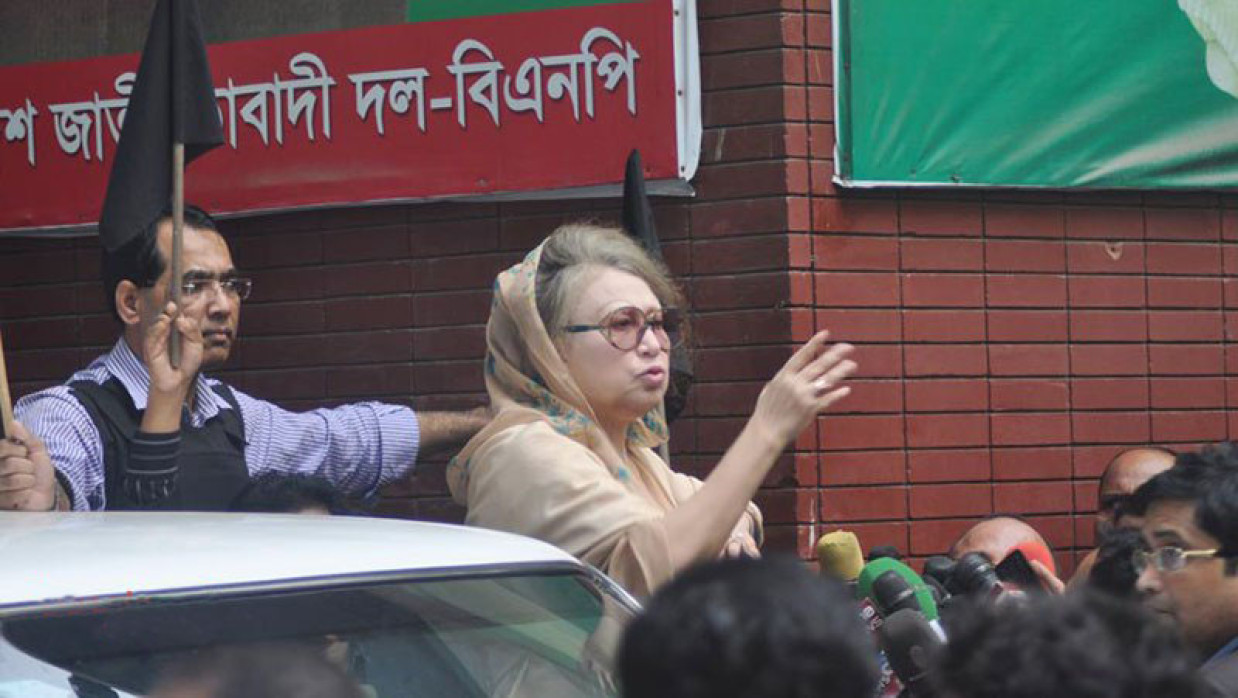
I am not a researcher of politics, and I have no taste for political discussion today. But consider her inhuman journey from May 30, 1981, to January 3, 1982: politics came looking for her; she did not go looking for politics or power. How terrible the grief, how modest and unpretentious her beginning.
Yet by 1984, when she was elected chairperson of the party, it became clear that a new center of power had emerged in South Asian politics. Consider her epic struggle from 1982 to 1990, eight years of relentless resistance against Ershad's military dictatorship, enduring house arrests, harassment, threats, yet returning to the streets again and again, more resolute, more unbending. This unyielding stance earned her the people's love and introduced her to the nation as "Desh Netri"—the leader of the country.
Then came her famous television address before the February 27, 1991 election. Do you remember that speech? And Sheikh Hasina's speech given at the same time? In that one speech, couldn't you discern Begum Khaleda Zia's class, her integrity? In that one speech, didn't she win the people's hearts even more than she won the election? The intelligentsia had assumed the Awami League would sweep to power.
Instead, on March 20, 1991, Khaleda Zia was sworn in as Bangladesh's first female prime minister, marking the rebirth of parliamentary democracy. It was not merely a political victory but a cultural revolution: a woman, in South Asia, in the Muslim world, becoming prime minister through democratic means.
Her first government transformed education. She made primary education free and compulsory for all, education free for girls up to tenth grade. In 1990, only 31.73 percent of students passed the SSC examination; by 1995, thanks to her policies, 73.2 percent passed. She introduced the Value Added Tax, established a privatisation board, laid the groundwork for Bangladesh's garment export miracle.
Yet what I remember most is the quality of discourse in those years. In her cabinet were people of learning, civility, intellectual substance. Parliamentary debates had weight of argument rather than volume of invective.
This was my lost world—where politics meant thought, principle, and dignity.
In South Asian geopolitics, Khaleda Zia's position was exceptionally clear. While she prioritised national interests in relations with India, she elevated Bangladesh's relationship with the Muslim world to unprecedented heights. She particularly empowered SAARC, understanding that Bangladesh should not be seen merely as a country caught between India and Pakistan, but as a bridge for regional cooperation. The "Bangladeshi nationalism" she established represented an intricate synthesis of ethnic and religious identity: an identity that attempted to hold both the spirit of 1971 and the Bengali Muslim legacy of the Bengal delta.
She belonged to that era when letters, telegrams, and physical presence carried particular weight. In today's digital politics, creating the "look" and "persona" she possessed is nearly impossible. There was something about the way she moved through rooms, the quietness of her authority, the measured quality of her speech, a kind of gravitas that today's shrill politics cannot manufacture.
She dressed with understated elegance. She spoke Bengali with a particular refinement. She embodied what we used to call “class”, not in the economic sense, but in that ineffable quality of bearing and comportment that distinguished a certain kind of person, a certain kind of world.
She embodied that taste, that dignity, that politics which no longer exists in South Asian politics. As I write this, I imagine Kundan Lal Saigal sitting by her bedside, melancholy, singing:
So ja rajkumari so ja / So ja maithay balihari so ja / So ja meethe sapne aaye / Sapno mein piya daras dikhaye / Ud kar roopnagar mein jaye—Sleep, princess, sleep / I am devoted to you, sleep / Sleep, sweet dreams will come / In dreams your beloved will appear / Fly away to the city of beauty.
The lullaby from a vanished era, for a woman who represented that vanishing, that particular metropolitan Muslim grace which combined Karachi's sophistication with Dhaka's warmth, which moved with equal ease in cantonment drawing rooms and on the democratic hustings, which never forgot where it came from even as it claimed the highest office in the land.
She is gone now, and with her goes the last gleaming fragment of that lost world. What remains is memory, and history, and the recognition that we who knew that world, who were formed by it, are now exiles in a country that no longer speaks our language, that no longer recognizes the codes and courtesies we were taught to value. Begum Khaleda Zia was the last public figure who embodied those values, who carried herself with that particular combination of strength and grace, who represented, in her bearing, her speech, her very presence—a civilisation that has been superseded. Without her, we are orphans of history, carrying within us the memory of a place and time that exists now only in elegies like this one.
I cannot write about Begum Khaleda Zia in the past tense.
The article appeared in the thedeltagram
0 Comments
LEAVE A COMMENT
Your email address will not be published