

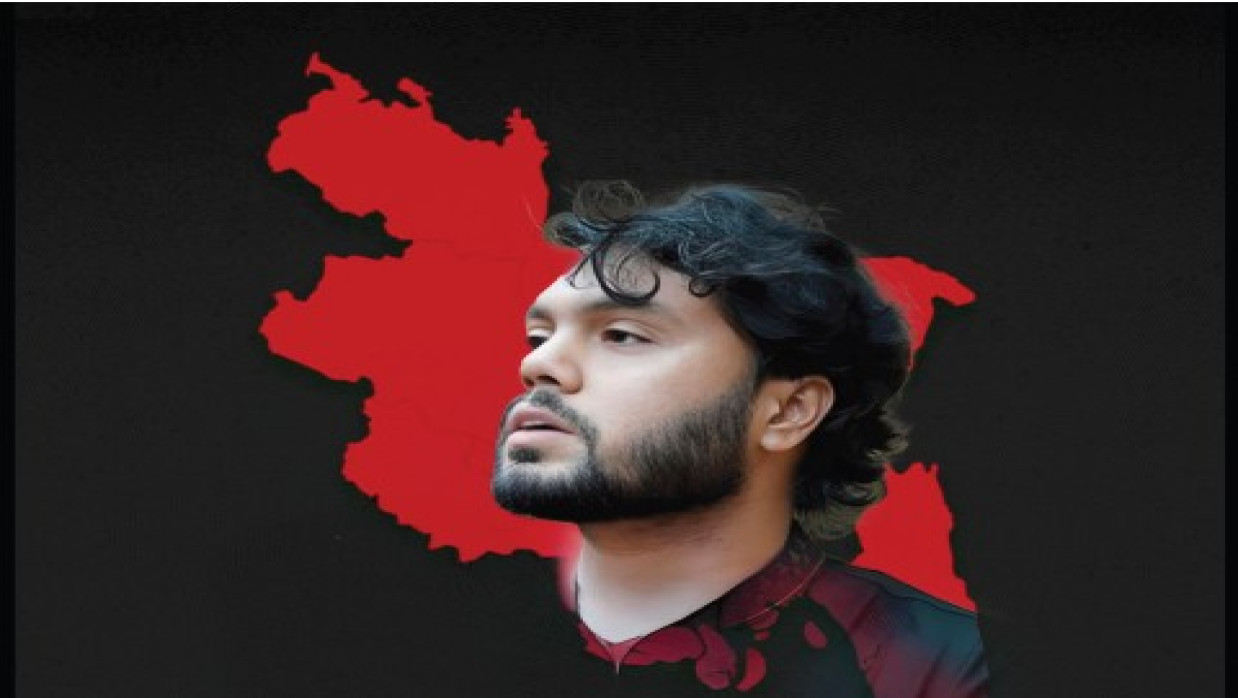
When a Voice Falls Silent, Ideas Begin to Speak
There are lives that end quietly. Such lives leave behind warm memories that become soft with the passing of time. There are other lives that slip away without offering any kind of closure. Instead, they leave behind a host of questions in different forms that don’t easily bow down to the silencing forces of history. The kind of death that Osman Hadi suffered is a case in point. Osman Hadi’s death was more than just the loss of a political voice. It shook the moral geography of public discourse in Bangladesh.
Hadi spoke at a time when language itself was being brought under discipline, when dissent was beginning to mean deviance, and when culture, which had previously been a locus of multiple loyalties, began to be transformed into a mere instrument of control. His gesture was to recognize, with unprecedented clarity, not merely the presence of authoritarianism, but instead, that of cultural fascism itself. His gesture was to bequeath, not merely a slogan, but a way of thinking about power in our time.
His views on cultural fascism, its corrosive power, and influence on democracy, sovereignty, and vulnerability to domination by a strong neighbor resonated deeply with the coming generation, with a majority of Bangladeshi nationals. It was certainly no abstract popular success, engineered by his intellect or intentions, but from the realm of truth. And truth revealed itself in its most vivid fashion on his last day of departure, as hundreds of thousands gathered for the janaza of Osman Hadi. An event of personal sorrow thus became one of collective morality.
This article is dedicated to Osman Hadi not only as an activist/organizer, but also as a practitioner of moral philosophy, one who has instinctively understood the workings of domination through memory, symbols, silence, and fear.
Cultural Fascism: Power that Governs through Meaning
The traditional definition of fascism can very readily connote violent force: constitutions suspended, press suppressed, and streets made militant. But the notion or reality of violent force can by no means constitute a feasible or sufficient methodology, since power can only ever be fashioned through the construction of consent, through culture, through education, through the institutionalization or bureaucratization of power itself.
Cultural fascism appears right at this intersection. Cultural fascism is a form of authoritarianism that rules through a meaning monopoly. Cultural fascist culture determines what histories are sacred and what histories are suspect, what identities are authentic and what identities are dangerous, what feelings are national and what feelings are treasonous. Cultural fascist culture ceases to be a shared heritage and instead becomes a weapon.
This is something Osman Hadi thoroughly understood. He recognized the fact that when a people or a particular class is the sole proprietor of the nation’s memory, “culture stops being a realm of belonging and turns into a gatekeeper.”
Bangladesh and The Quiet Architecture of Cultural Authoritarianism
Cultural fascism has not entered Bangladesh with much fanfare. It has happened slowly, sometimes under the guise of normalcy, nationalism, and the guardianship of history. The Liberation War, which was once a common moral platform, is gradually being converted into a polarized symbol, with its commemoration governed by the language of power, rather than democracy.
These are the effects of the constriction of history. Those who have dared challenge alternative viewpoints or raised questions for good or critical reasons have come under suspicion. This has led journalists, researchers, or activists to be held accountable not necessarily by direct force, but by societal stigma referred to by such descriptors as the ungrateful or the morally depraved.
His arrival was alarming because it interrupted this process. His message was that nationalism should never be associated with subjection and that admiration for history was not a valid reason to disregard the present. Cultures, according to him, were not meant to dictate citizenship; rather, they were meant to make citizenship more humane.
The External Dimension: The Indian Hegemony and the Politics of Silence
The analysis by Hadi went into a domain that has long been considered to be highly embarrassing to the public discourses in Bangladesh. Hadi pointed out that the cultural fascism prevalent in Bangladesh cannot possibly be analyzed and understood without referring to the pressures exercised by the Indian hegemony. This did not mean a rejection of the need to share history and the need for the future to work together.
Indian hegemony, according to Hadi, is achieved far more through superior storytelling than through force. “Stability in the region is imagined within terms that elevate Indian strategic concerns above all other rival claims” while “concerns over border killings, rights over joint water resources, and preservation of the country’s democratic ideals tend to get marginalized, made invisible within regional discourse,” according to Syed Nurul Ain Ahmed: “The Indian Hegemonic Project and Its ‘Invisibility’ within Bangladesh,” in her foreword: “The Indian Hegemonic Project.” “The cultural compliance,” in this regard, may involve “The demand Hadi made,” continues El Tayeb, “was very simple, very radical: either friendship means no obligation to keep silent, or sovereignty is impossible where cultural dignity is compromised.” This mirrors the notion that independence is pointless when the realm of intellect and culture is subject to its authority. This is the notion that Hadi subscribed to.
Osman Hadi as a Memorial Figure: Between Loss and Thought
To reduce Osman Hadi to the status of only a victim is to ignore the point of Osman Hadi entirely. It is in his discomfort among others that is, his power to disturb a complacent worldview with words, that the substance of Osman Hadi resides. Osman Hadi was no martyr. Osman Hadi was a man in pursuit of clarity. Clarity is often dangerous, especially during times of cultural authoritarianism.
Hadi represented a space that is quite rare, existing at the interface of theory and politics. He communicated in the idiom of the streets, but his ideas resonated with the most authoritative traditions of critical thinking. He recognized that authoritarianism sustained itself not only through the repression of bodies but also through the colonizing of imagination. His death, therefore, is not a mere individual tragedy but a reminder of the cost that must be incurred by those who refuse to find any meaning in power.
Why His Warning Is Relevant Today
It appears that, in the broader realm of South Asia, the structural setup of democracy remains intact in form, even as the moral space within which dissent or opposition to democrat-inspired ideas can be tolerated is narrowing by the day. Instead of a catastrophic end to democracy, one is currently seeing a methodical regulation of democracy itself through the regulation of every kind and form of culture related to memory and speech that is currently permissible in society.
Under the current scenario, the issue of foreign intervention cannot be overlooked. There is an increasing debate and circumstantial evidence suggesting that a strong regional country is attempting to influence the parliamentary elections in Bangladesh in favor of the ruling party, the Awami League, mostly for its own regional and political interests. Foreign intervention on such a scale has very disturbing implications for the concept of democracy. If the outcome of the election begins to reflect not the people’s choice but a regional political strategy, then democracy remains only a formality.
The relation between India and Bangladesh, or rather the influence exercised by India, goes far beyond their political or economic relations and even their narratives. This further reiterates that stability often precedes accountability and continuity, which in turn precedes contestation. In these conditions, dissenting voices do not merely counter but rather oppose or disrupt the country.
It is precisely this understanding of democracy that Osman Hadi’s voice has contemporary relevance. Hadi evoked our memory by saying that democracy is more than can be gauged by electoral success or the strict observance of the rule of law. It beats with passionate vigor in the classrooms, the forums of freely exchanged ideas without fear, the press that asks questions rather than commands them, the song, the literature, the memory that is open to second thoughts and reinterpretations, and the most fundamental right to question the truths imposed or imported.
However, the most frightening and the most prophetic threat made by Hadi is the following: “The most dangerous thing that might befall our society is repression, but repression in a less overt form, when security is confused with surveillance, silence with stability, and conformity with patriotism.” Indeed, as the regime of repression, authoritarianism does not necessarily have to make its presence known, since its presence is already felt in the lives of people on a day-to-day basis.
When recalling Osman Hadi's memories, we also remember that the politics of protecting democracy, whether in a country such as Bangladesh or, by analogy, in the South Asia region, cannot focus solely on voting, lawsuits, and constitutionality. The continued relevance of Hadi's insights lies in the fact that many citizens expressed a sentiment one hears much less often: that power is no longer seeking legitimacy from people per se, but from cultural management, ideological narratives, and behavioral norms.
This was exactly what Osman Hadi so passionately enunciated to so much effect within the younger generation of Bangladeshis, and quite rightly so, since the population has felt so politically marginalized and so culturally boxed in. The point being, of course, that Hadi so passionately enunciated an unqualified opposition to Indian hegemony within the Subcontinent, when, in point of fact, what the vastly preponderant majority of Bangladeshis so deeply feel is that their sovereignty has to carry some more than merely titular significance, since it has to carry some substance rather than be rendered mere surplusage, as its friendship with the Indian government certainly has.
Therefore, Hadi’s fame was not created or invented, but was the fruition of what he was saying, emerging from the collective experience of a nation that had long suspected that it was their own choices in politics, culture, and history that had been systematically constructed in such a way as to fulfill an alien mandate. This was what Hadi was saying in that exceptional moral space that he inhabited in fearless speech, in unconditional voice, in those exceptional times that required more of him than mere caution, in times that are defined by sincerity rather than by comfort or advantage. This was what he located in the collective heart.
EPILOGUE: MEMORY AS ACT OF RESISTANCE
In a fascist culture, memory itself becomes subversive. Not commemorative memory, but critical memory that is, the refusal of those in power to prescribe what and how we are meant to remember. To remember Osman Hadi is to disobey the erasure he warned against.
His absence leaves a void in Bangladesh's democratic conscience. His ideas, however, point the way to a future in which culture emancipates rather than conditions people, and nationalism protects dignity rather than crushing it.
Osman Hadi also has an uncompleted struggle to contend with. It is for this reason that his struggle is so significant. In his memory, in honor of his name, it is not simply an act of mourning but an act of continuing: speaking out in the face of demanded silence, thinking in the face of rewarded conformism, protecting culture as a realm of freedom, not a realm of fear.
On the one hand, however, Osman Hadi has certainly not kept silent. He has made his presence felt in history through a question that we can no longer ignore.
As Italian philosopher Umberto Eco warned, and he was certainly on target here, "The Ur-Fascism grows up and seeks consensus by exploiting and exacerbating the natural fear of difference."
Osman Hadi had known all about this long before it became a commonly accepted fact. In fact, he was much more than a critic; he was a defender of the truth in a world where he feared that democracy was going to wind up as a shell with no soul left inside. By standing firm on his ground, he found a place in the consciousness of a nation not merely as a voice of resistance, but as a symbol of defiance, a beacon of intellectual integrity, and an icon of relentless courage.
Within this huge and quiet crowd of hundreds and thousands of people it has become all too clear that Hadi has articulated what has been felt but never articulated before: that sovereignty must be exercised, not merely asserted, and that democracy cannot ever be achieved in a country where the culture of submission is ingrained. Hadi is no longer among the living, but his death has occasioned both mourning and action, memory and resistance. As the rebel poet Kazi Nazrul Islam so forcibly declared: "I sing of equality there is nothing greater than the human being.” Osman Hadi has neither grown silent; he has emerged in memory and continues to light up the road to freedom, justice, and self-respect as a democrat in the ongoing battle of Bangladesh.

0 Comments
LEAVE A COMMENT
Your email address will not be published