

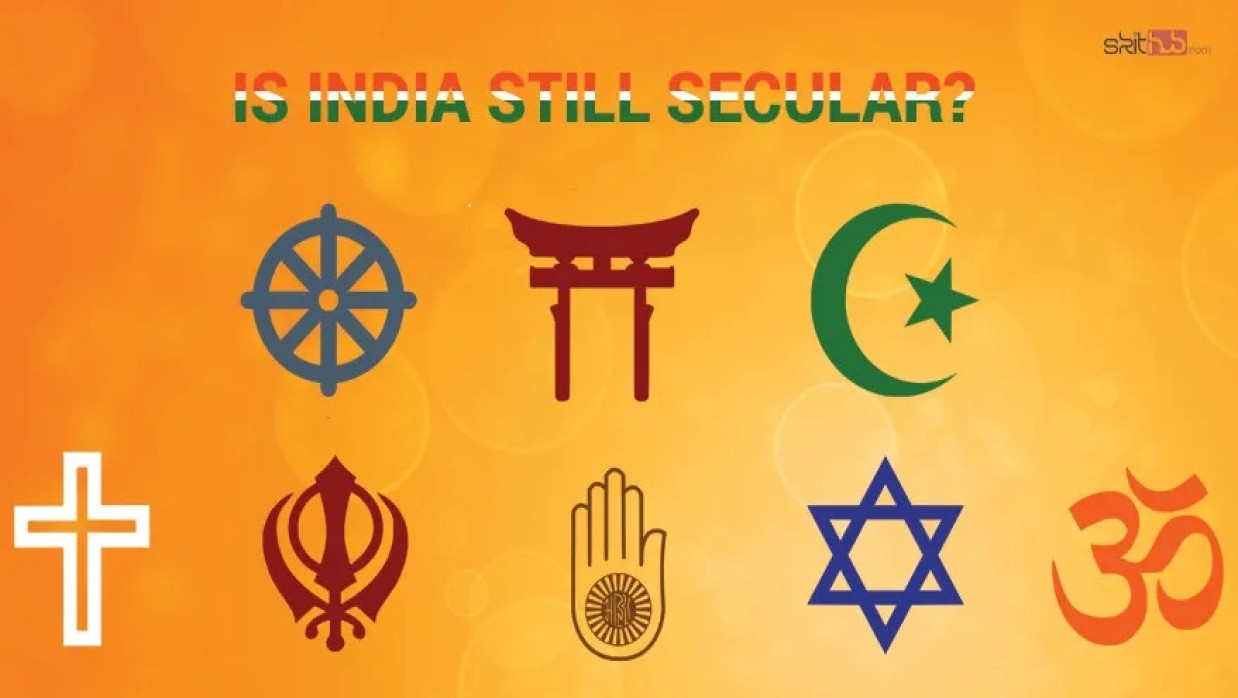
The Promise and the Departure
India’s founders conceived of their republic in 1950 as something different from other post-colonial states. It would be a pluralist republic, but not merely in name or as a rallying cry. It would be pluralist by tradition, by inheritance, by instinct: a civilization with diverse faiths and cultures at its core. It would not be a Hindu state, a Muslim state, or a state with one favored faith. It would not prioritize one citizenship over another for others. It would be a republic where religion was private, and citizenship was public. Secularism sarva dharma sambhava, the equal respect for all religions, would be both philosophy and practice.
Seven decades on, the state of secularism in India is a source of global concern and domestic anguish. The question is no longer whether the constitutional ideal is unravelling at the margins. The question is whether the center holds at all, whether the fabric is being systematically recast into a different form. The erosion has been slow, then swift, and today the very shape of the Indian republic appears to be in flux.
This paper examines the current state of Indian secularism, how political majoritarianism has been instrumentalized, how social polarization has redefined inter-community relations, how institutions have changed in tone and function, and what this portends for the world’s largest democracy.
The Historical Compact: Secularism as India’s Foundational Glue
Indian secularism was always a messy project. Western secularism, largely premised on Enlightenment liberalism, demanded a radical divorce between church and state. Indian secularism was never about this separation; it was about accommodation, about keeping one another’s hands off public life.
The Indian Constitution did not seek to erase religious identity. It did not banish religion to the wings or insist on a strictly public understanding of citizenship. It offered equal protection and dignity to all faiths. And in return, the republic would not allow any one religion to colonize public space.
India’s first Prime Minister, Jawaharlal Nehru, often said that secularism in India meant “equal protection by the state of all religions.” Dr. B.R. Ambedkar, the great architect of the Constitution, maintained that the republic would not work unless its minorities felt secure. This compact mutual trust between India’s religious communities, reinforced by a secular state, was how the country would stay together. It was the glue holding a nation of staggering religious diversity in place.
But the fault lines had always been there. Partition’s wounds had only begun to heal when they were suddenly ripped open. Religious mistrust constantly percolated in Indian politics and society. Communal riots periodically exposed the fragile underbelly of the pluralist edifice: Jabalpur in the 1960s, Gujarat in the 1980s, Mumbai in 1992-93, Gujarat in 2002. But the state still maintained a posture of secular neutrality.
The 21st century has seen a turning point. The rise of Hindu nationalism as the dominant political ideology did not happen overnight. For decades, it quietly built an ideological base. But since coming to power in 2014, it has consolidated control of the state in ways no political force has since independence.
The Rise of Majoritarian Politics: From Identity Assertion to State Ideology
The ascendancy of the Bharatiya Janata Party (BJP) under Narendra Modi is the most dramatic political change in recent India. For the first time in its history, India has a single party with an overtly Hindu nationalist worldview in power, commanding stable parliamentary majorities for more than a decade. This has shifted the definition of secularism.
The BJP and its ideological sister organization Rashtriya Swayamsevak Sangh (RSS) claim that India is a Hindu civilization by default, one that secularism has unfairly disadvantaged in favor of minority religious communities, and most pointedly, Muslims. Their solution is Hindutva, a form of cultural nationalism that defines Indian identity in Hindu terms.
Detractors say this ideology makes secularism a form of selective patronage rather than neutrality. By the state’s refusal to act against targeted violence, the vilification of Muslims in political discourse, redefinitions of citizenship, and the privileging of majority sentiment in policymaking, a new departure from the original compact can be clearly seen.
Three examples are emblematic of this shift.
Citizenship Amendment Act (CAA) discriminated against Muslims by introducing religion as a criterion for nationality for the first time in Indian history.
Article 370’s abrogation, while a constitutionally legitimate act, was accompanied by a grand narrative that cast Kashmiri Muslims as a fifth column.
Ayodhya’s Ram Mandir, built on the Supreme Court verdict that ended a legal battle, was a demonstration not only of Hindu majoritarianism’s political and legal power but of religious entitlement.
Cumulatively, these actions reflect a repurposing of the Indian republic’s ideological orientation.
Institutional Shifts: When Neutrality Becomes Negotiable
The viability of secularism depends as much on constitutional text as on the conduct of institutions. In recent years, there have been significant concerns about the behavior of state institutions.
Judiciary
India’s Supreme Court, which for long has prided itself as a bastion of secular values, in recent times has often been accused of deferring to the majority narrative. The Ayodhya judgment, inaction on hate speech, the lengthy incarceration of activists under anti-terror laws, and lack of pushback against the executive have all come under scrutiny for the court’s independence.
Law Enforcement
Police forces in BJP and its allies '- ruled states have been accused of indulging in discriminatory policing against Muslims. “Bulldozer justice” (the demolition of Muslim homes without due process) is one of its most iconic symbols. The heavy-handed use of sedition, anti-terror laws, and preventive detention against minorities and dissent has revealed a deep institutional bias.
Media
Mainstream Indian media today is as polarized as it has ever been. A large section of it amplifies majoritarian positions, demonizes minorities, and delegitimizes opposition parties and figures. The regular and relentless portrayal of Muslims as terrorists, “love jihadis,” or demographic predators has mainstreamed bigotry.
Educational and Cultural Institutions
Curricular reforms that erase or downplay references to Mughal history, secularism, or India’s pluralist past amount to a majoritarian reimagining of the Indian narrative. Government bodies such as the Indian Council of Historical Research (ICHR) and the National Council of Educational Research and Training (NCERT) have come under fire for ideological partisanship.
In sum, these institutions have not done away with secularism. But they have changed how secularism works in practice.
The Social Landscape: Polarization as a Way of Life
Beyond the state, relations between India’s religious communities have also changed profoundly. The several faiths and castes in India have always lived in an uneasy balance, but in the last decade, polarization has become everyday hostility.
Mob Lynching and Vigilantism
Muslims have become the targets of mob attacks for allegedly transporting cows, eating beef, or engaging in interfaith relationships. These attacks are often followed by celebrations on social media, with perpetrators hailed as Hindu warriors. In many cases, elected officials have openly praised or even felicitated these lynchers.
Ghettoization and Segregation
In urban India, Muslims are increasingly being denied the chance to rent homes, obtain loans or find work in many industries. Invisible walls are replacing the Partition’s concrete and barbed wire walls.
Digital Hate and Infrastructures
Spaces online, especially social media, have become battlefields for exclusion and hate. Islamophobic hashtags trend easily; disinformation campaigns against minorities are normalized. The result is an ecosystem where prejudice travels faster than truth.
The Rise of “Cultural Nationalism”
Food, festivals, dress codes, hairstyles, and public rituals are increasingly being recast as tests of loyalty to the nation. To be secular is to be increasingly suspect; to be a minority is to be a target.
Secularism in India is under stress not only because of how the state behaves but because of how people behave.
The Political Utility of Identity Politics
The decline of secularism is also a matter of political convenience. Majoritarian mobilization is electorally beneficial. Invoking religious identity has become a primary political weapon in India’s highly fractured social and economic terrain.
Economic Anxiety and Identity Consolidation
India’s economic problems, unemployment, agrarian distress, falling wages, and widening inequality have created the social context for political messaging that diverts public attention from their material woes to cultural concerns. In such an environment, communal rhetoric serves as a diversion and mobilization tool.
Decline of Secular Parties
India’s traditional secular party, the Congress, has shrunk substantially over the last 30 years. The regional parties that have come to fill the space are often caste-based coalitions that struggle to find a national voice. The political space once occupied by secular politics has become a vacuum that majoritarianism is filling.
Redefinition of Nationalism
To dissent is to become “anti-national” in the dominant state narrative. Nationalism is conflated with cultural uniformity, with adherence to a narrow set of cultural markers. Little ideological space is left for secular pluralism.
International Implications: The Global Stakes of India’s Secular Decline
India’s changes have global significance for a host of reasons.
Geopolitical Influence
India’s role in the world has long been based on its democratic values and secular pluralism. The erosion of those values diminishes India’s moral authority globally, and especially in South Asia, where many Muslim minorities are watching its trajectory with anxiety.
Diaspora Divisions
The Indian diaspora, particularly in Western countries, is becoming deeply divided along ideological lines. Hindu nationalist organizations are increasingly assertive and often in conflict with liberal or minority groups. This impacts India’s image abroad.
Human Rights Concerns
In recent years, the EU, US Congress committees, UN bodies, and human rights groups have expressed concern about India’s treatment of minorities. The Indian government regularly dismisses these as foreign interference in domestic affairs. The reputational damage for India is real.
The Road Ahead: Can Indian Secularism Be Revived?
India’s secular crisis is real, but not insurmountable. The country has countervailing forces in civil society, sections of its judiciary (at times), youth movements, and regional political traditions.
A revival of secularism will have to take multiple forms.
Political: Opposition parties need to reclaim pluralism as a democratic rather than a defensive value.
Constitutional: A renewed emphasis on the independence of institutions.
Social: A movement that recognizes that secularism is as much about the rights of the majority as it is about the rights of the minority, and more fundamentally, about the very nature of citizenship.
Cultural: A need for the Indian cultural mainstream to remember that its civilizational tradition is one of millennia of coexistence.
The question is whether all this can be achieved before secularism’s institutional foundations are altered beyond recognition.
Conclusion: A Republic Waiting for Its Reflection
The Indian secular project is at a crossroads. Its state today is best described as a paradox. Secularism is legal but not political, social but not institutional. India is no longer a theocracy. India is not a majoritarian state in the classical sense. But India is drifting closer to becoming a place where religion is the de facto determinant of citizenship, one small step at a time and with great care. The real test of secularism is not the existence of religious laws or even the adoption of a uniform civil code. The test of secularism is whether all citizens of a country, regardless of their religion, feel equal. In India today, they do not. India’s fight over secularism is a fight over the soul of the republic. India today is at a crossroads: to reclaim the pluralist legacy or to create a new majoritarian project. The choice India makes will not just determine the fate of the world’s largest democracy. It will set the moral compass for that country’s future.


0 Comments
LEAVE A COMMENT
Your email address will not be published