

For sixteen long years, Bangladesh has carried a wound that never healed. The BDR massacre of 25–26 February 2009 was one of the most brutal and politically charged tragedies in the country’s post-independence history, killing seventy-four people, including fifty-seven senior army officers who were serving within the Bangladesh Rifles (BDR). The headquarters of the Bangladesh Rifles turned into a killing field, the state machinery atrophied, and the country descended into a period of lingering questions without answers. For over a decade, the families of the martyred officers protested, mourned, inquired, accused, and waited. Rumors became urban legends; conspiracy theories melded with political allegiances; and the most sensitive of national topics became the massacre that Bangladesh can no longer forget.
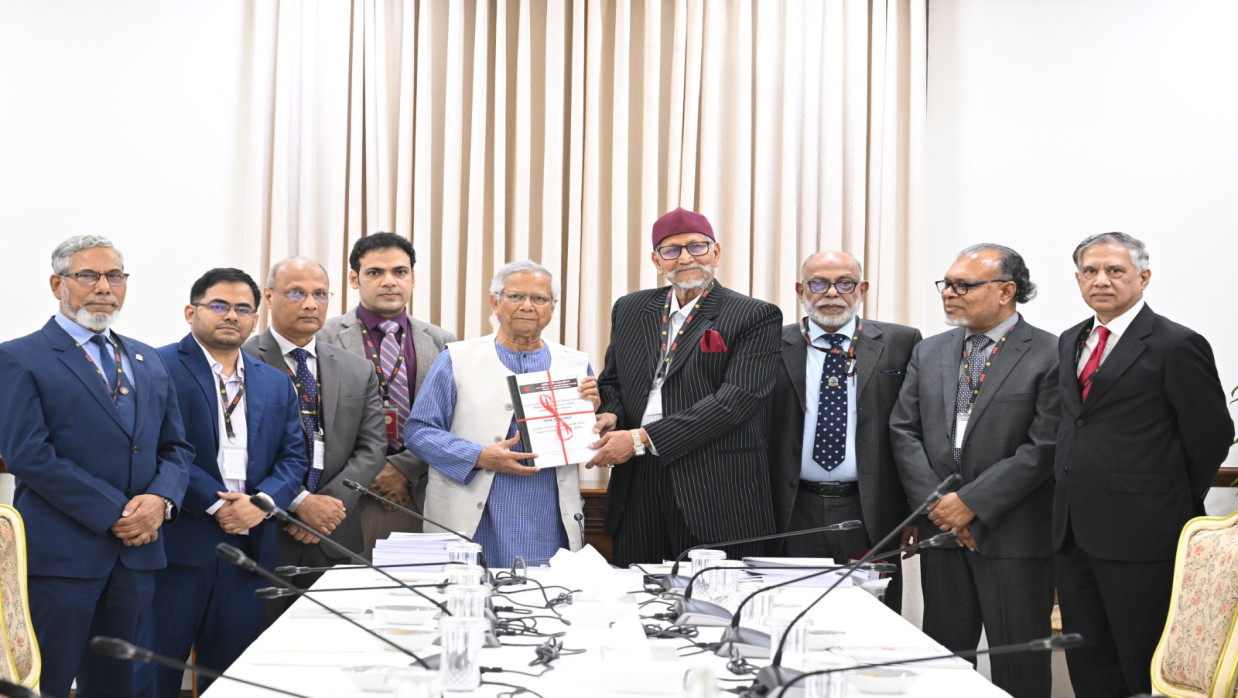
This February, Bangladesh’s National Independent Inquiry Commission, a fact-finding and reinvestigation committee appointed by the interim government, finally delivered its long-awaited final report to Chief Adviser Professor Muhammad Yunus. The much-anticipated report, which many thought would never be revealed, is in fact far more consequential than many might have imagined. It is sweeping in scope, politically incendiary, and geopolitically significant. The findings dramatically reshape how we understand what happened on that February morning, who benefited from the carnage, and what failures enabled it. But most importantly, the report shifts the narrative away from the rank and file BDR members who executed the killings, and squarely toward the political, administrative, and foreign figures that allegedly enabled, coordinated, or exploited the massacre to serve a variety of interests.
The report that emerged is both a chilling read and a portrait of premeditation, complicity, and failure on a massive scale, raising questions about governance, civil-military relations, and foreign influence in Bangladesh.
A Massacre Reinterpreted
The Commission’s final report is the product of both immense challenge and monumental investigation. The evidence left over from the carnage of 2009 was relatively small; many figures at the center of the incident left the country, and previous governments had very little interest in revisiting unanswered questions. The Commission, which was led by (retd) Major General ALM Fazlur Rahman, states in its report that it operated with the utmost professionalism and complete neutrality. Its members personally interviewed witnesses for hours at a time, collected the small remaining cache of investigative documents, analyzed archival video footage, and re-evaluated intelligence chatter from the relevant months and weeks.
The conclusion, as the report documents, is clear and without ambiguity. The massacre was pre-planned. And elements of the then-ruling Awami League party were organizationally involved.
The Commission singles out former Member of Parliament Sheikh Fazle Noor Taposh as the “principal coordinator” of the operation. In its final report, it finds that the entire chain of events unfolded with the “green signal” of then-prime minister Sheikh Hasina, and that a group of senior AL leaders, including Mirza Azam, Jahangir Kabir Nanak, Sheikh Selim, former home minister Sahara Khatun, and former defense adviser Tarique Ahmed Siddique, were also directly responsible for the killings. Furthermore, the Commission implicates former DGFI chief Lt Gen Molla Fazle Akbar and former army chief Gen Moeen U Ahmed. The chain of responsibility, per the report, thus extends from the Awami League’s political leadership to the highest levels of the military command established by government order in 2009.
But most provocatively, the Commission’s report finds evidence of external involvement in the mutiny. It clearly and repeatedly states that India was the “main beneficiary” of the crisis. The report stops short of a direct assertion that India orchestrated an operation, but it contextualizes the incident as occurring in a moment of great geopolitical opportunity for New Delhi: a Bangladesh Army weakened and demoralized by massacre, a border force restructured with little ability to assert its power, and a government in Dhaka whose foreign policy trajectory soon aligned itself very closely with New Delhi’s strategic interests.
The political reverberations of these findings alone are seismic. For the first time in an official document, a state-sanctioned body officially asserts that top leaders of the former ruling party helped facilitate the deliberate and pre-planned elimination of dozens of Bangladesh’s senior-most army officers, and that doing so was not in the best interests of the country, but instead of a foreign state.
The Unseen Hand: Foreign Interests and the India Question
The Commission’s insinuation that India benefited from the BDR massacre on February 25 and 26, 2009, is as grave as it is provocative. It is also, however, one that taps into a long-standing popular question: if not the Bangladesh state, then who gained when Bangladesh lost dozens of its best and brightest army officers in a single day?
The report itself does not conclusively answer the India question, but it certainly underlines a series of geopolitical coincidences and alignments that, when taken together, present a somewhat compelling pattern.
The first is simple but essential. A series of officers killed at Pilkhana were in fact officers known to take strong positions on national sovereignty, border management, and counter-insurgency operations that sometimes bordered on and occasionally crossed into conflict with Indian strategic preferences. The Boroibari incident of 2001, for example, was a rare moment of border violence between the BSF and BDR that left sixteen BSF soldiers dead, and several of the officers targeted for death in the 2009 massacre had played a role in handling those events. Several BDR families the War and Peace Network spoke with also suggested that these events were not coincidental. At a press conference in Dhaka on February 23, Rakin Ahmed Bhuiyan, the son of slain former BDR chief Major General Shakil Ahmed, was forthright in his accusations, stating, “The massacre was intended to warn the army officers who had negative opinions about India.”
The political developments in the wake of the mutiny overwhelmingly favored New Delhi. The Awami League government, which took power weeks before the killings, fundamentally shifted the orientation of Bangladesh’s foreign policy into an alignment with India that was unprecedented in scope. Security and intelligence cooperation deepened, transit rights expanded, and trade terms grew highly asymmetrical. Whether these developments were directly related to the massacre or were simply coincidental with it (allowing the Indian state to take advantage of a change of government) is a matter for debate, but the correlation is difficult to ignore.
Third, the Commission’s report exposes a series of intelligence failures described as inexplicable, creating a state of paralyzed power vacuum. “The police, RAB and other intelligence agencies,” it writes, “failed miserably.” The army remained “inactive for hours,” at a time when a breakdown in civil order was occurring. To have such a catastrophic failure of coordinated security response, some form of foreign facilitation or distraction of state institutions cannot be ruled out.
The question of external involvement, then, is left open by the Commission’s report. It does not make a conclusive case for foreign operational command or control, but it strongly infers a pattern that it then articulates in the starkest possible way: a weakened Bangladesh served the interests of somebody else. The report stops short of conclusively assigning blame, but by the logic of its evidence and analysis, that somebody is not Bangladesh.

Inside Pilkhana: Silence, Fear, and Weaponized Grievances
The report also has much to say about the atmosphere and events inside Pilkhana on that February morning. As is now well-documented, the carnage was swift, brutal, and unrelenting. Young officers were forced to watch their seniors be killed in front of them. Families were taken hostage; corpses were thrown into sewage drains; army officers, long symbols of national pride and discipline, were executed in a frenzy of rage, manipulation, and organized violence.
The Commission’s report, however, is unequivocal that the mutiny was not an act of spontaneous popular eruption. Internal concerns such as the “dal-bhat” program and salary disparities were not only real, but were raised in the mutineers’ original memorandum of complaints. They are a credible, if insufficient, explanation for some of the subsequent violence. But as the report makes clear, this pool of mutualized, legitimate dissatisfaction was exploited, weaponized, and directed into a carefully coordinated rebellion.
The narrative the Commission’s report pieces together is clear. At no point on February 25 was a “riot-type situation” or “general strike” in evidence. A group of twenty to twenty-five persons reportedly entered the camp but exited with more than two hundred clear evidence of an organized extraction and political protection. Local Awami League leaders had made the mutineers’ movement across the country easier; political activists had obstructed local law enforcement. Government records of BDR personnel who met with Sheikh Hasina during the incident were either unaccounted for or destroyed, statements were altered, and the early official investigation was deliberately derailed.
The oft-asked question as to why security forces took so long to respond has been partially answered. The report lays out systemic paralysis, poor leadership, and political interference. But it does not answer deeper, unspoken questions that have lingered: were the forces intentionally held back? Were they waiting for a political go-ahead that never came? Or, as the report’s narrative suggests, was the order already in place, and the forces simply waiting for a green light? Here, the Commission hints at possibilities but stops short of direct confirmation.
The Families Speak: Grief, Accusations, and a Demand for Truth
Years of silence, and in some cases fear, had changed for the families of the slain officers in the months since. Many believed that previous governments actively repressed their voices and remained intimidated by the prospect of seeking answers. But the submission of the new report has given them strength.
On February 23, families of the martyred officers held a press conference in Dhaka, delivering emotional, sometimes explosive statements to the press. At the conference, they accused Sheikh Hasina of purposefully allowing the massacre to occur, and in fact of actually organizing and coordinating the entire operation with the intent to “serve India’s interests” and ensure her continued hold on power. They also accused the government of failing to reveal all the names in the report. At the same time, they expressed gratitude for the Commission’s courage, which had shown an undeniable pattern of coordination and political involvement and pierced the veil of mystery around a dark chapter in Bangladesh’s history. Many of the families also spoke of threats and political pressure they had received during the early days of the investigation, including attempts to physically coerce them into giving political statements and to fabricate witness narratives that would absolve the government of any blame.
One sentiment, however, was clear and unified among all the attendees. Their appeals to the people of Bangladesh and the security forces were simple: transparency, justice, and closure. Publication of the report, prosecution of all implicated actors, and cessation of intimidation against them. Some went further, calling for the Awami League to be banned for its central role in the massacre, while others urged other political parties not to weaponize the massacre for short-term gains. The families of the martyred officers made clear, to be sure, that what they are after is not revenge. They want accountability.
India, Hasina, and the Architecture of Power
In that, the report is damaging not just to the Awami League, but to India’s own strategic imprint on Bangladesh’s domestic political architecture. The insinuation that India was the “main beneficiary” of the BDR massacre is deeply incendiary. It not only reframes a decade-and-a-half of geopolitical partnership between the two states but also puts into a new context how the Awami League government drew Bangladesh’s military, intelligence, and economic institutions into an increasingly close embrace with New Delhi’s strategic priorities. In the Commission’s reading, the 2009 massacre, which occurred just weeks after the Awami League won power in a landslide victory, serves as a sort of national turning point, the event that cemented an alignment already heavily in India’s favor.
Whether Sheikh Hasina acted alone, at the behest of Indian pressure, or through tacit coordination with external actors is a matter for investigation for the moment. But the logical chain laid out by the report is as clear as it is obvious: weaken the army, neutralize officers resistant to India’s expanding influence, consolidate political power, and reconfigure the security state into an instrument of New Delhi’s strategic design.
For Bangladeshis, this is as grave as it is telling. If the report is correct, the massacre was not a spontaneous act of sedition but an engineered decapitation strike designed to target the country’s military leadership, and by extension, the country’s national defense industry. The strategic intent was evident, as was the beneficiary. The consequences for sovereignty and the internal balance of power are, if true, incalculable.
The question of truth taking sixteen years to arrive is vexing. In its defense, the interim government has said that the Commission was formed only when political conditions permitted it. During the previous Awami League years, investigations were at best fragmented, contradictory, and at worst actively kept out of reach. The then-state narrative was that this was a grievance-driven uprising, and as such, the army’s own internal inquiry was never released. The Criminal Investigation Department handled one of the most extensive and most complex criminal trials in the country’s judicial history, yet its legal process was limited to operational participants, not the alleged political or foreign masterminds of the violence.
The transitional government, by contrast, had both the mandate and the neutrality required to look more deeply. As Chief Adviser Yunus said in his remarks on the report, it is a “valuable national asset” that should serve as a lesson for the future.
Yet the uncomfortable fact remains that a whole generation of Bangladeshis grew up with precious little clarity about one of the darkest events in the republic’s history.
Toward Justice: What Happens Next?
The submission of the report is no guarantee of justice. It is only the opening of the door. Bangladesh’s Chief Prosecutor of the International Crimes Tribunal has already stated that elements of the massacre may amount to crimes against humanity. A classification that would turn the case into one of national and international prominence. Travel bans have been placed on thirty-three individuals, and further legal action is looking increasingly imminent.
But a number of challenges remain. The report withholds the names of individuals on the grounds of an ongoing investigation. Some accused are outside the country. Political sensitivities are incredibly high. And the risk of instability is real if legal action at the highest level moves forward. But Bangladesh has reached a moment where truth can no longer be sacrificed at the altar of political convenience.
The question today is no longer whether justice will be sought. Still, whether it will be sought consistently, transparently, and without the politicization and strategic manipulation we have grown so accustomed to over the last five years.
Conclusion: A Nation at the Threshold of Truth
The BDR massacre was more than a mutiny; it was a wound on the national psyche, an event that reverberated across every domain of public life. It struck at the heart of trust between the state and its citizens, between the army and the government, and between the notion of sovereignty and the influence of a foreign state. The National Independent Inquiry Commission’s report does not close every chapter. But it irrevocably changes the landscape of understanding.
By naming political figures, identifying beneficiaries, exposing intelligence and civil service failures, and pointing to a complex entanglement of internal and external motives for an operation that, from the outside, looked like an inside job, the Commission’s report forces the nation to confront the past with clarity. The truth, however painful, is a necessary condition for national catharsis. The country has for too long lived in a shadowland of half-questions, fear, and speculation.
Now, with the release of this report, Bangladesh stands on the threshold of clarity. The path forward is fraught with legal, political, and diplomatic challenges, but the country has taken that first, real step toward accountability. The families who suffered have finally been given a voice. The questions that have been silenced for too long have now had their day in court. Bangladesh must now decide whether to complete the journey from silence to justice.
Only through a commitment to courage, transparency, and hard work can Bangladesh finally ensure that Pilkhana will never again become the darkest of dawns.


0 Comments
LEAVE A COMMENT
Your email address will not be published