

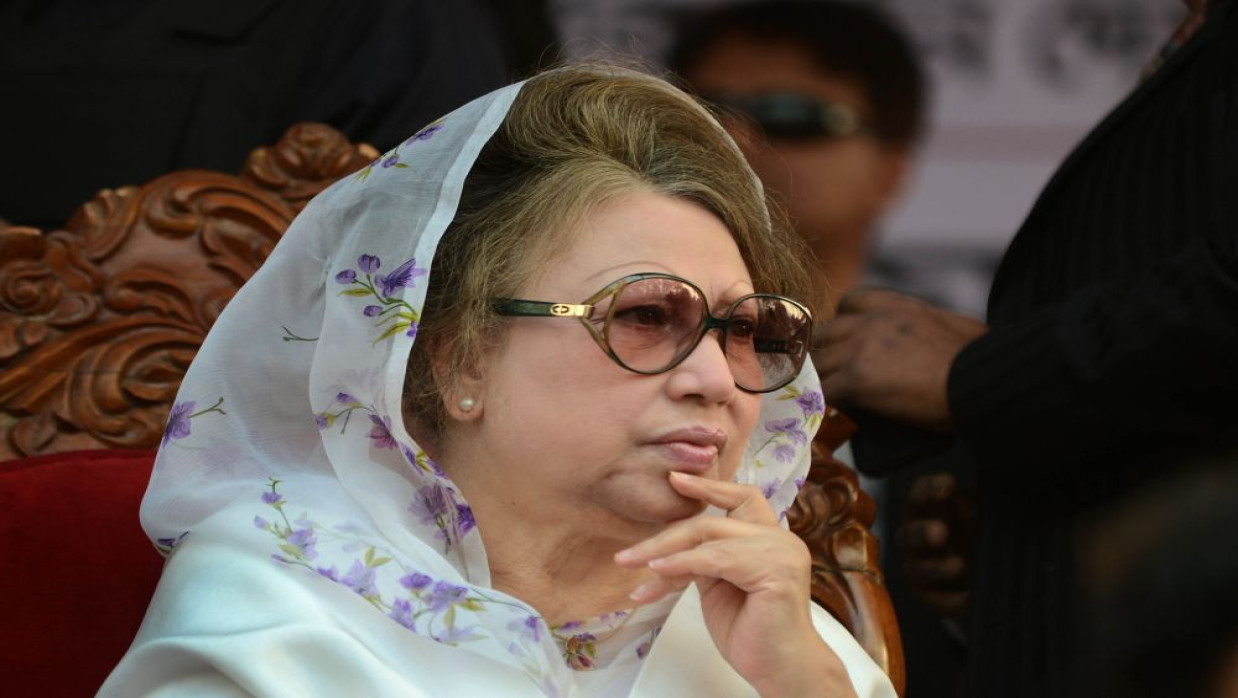
I am writing this piece as my humble tribute to the late President Ziaur Rahman and his family at a moment of profound sorrow, when his beloved wife, Begum Khaleda Zia—three-time Prime Minister of Bangladesh and the true flag bearer of his political legacy and a true patriot —is fighting for her life in hospital.
I pray to Allah (SWT) to shower Begum Khaleda Zia with His infinite mercy and grant her full shifa and a swift recovery.
Today, as the nation stands painfully divided, it is I believe , none other but Begum Zia , who still possesses the moral authority, and resilience and compassion to stop the incessant bleeding that Bangladesh continues to endure since long.
Begum Zia built on the foundations laid by her husband General Ziaur Rahman and committed herself to progress Bangladesh at multiple levels, inclusively.
Ziaur Rahman
Let me begin with my experience of Ziaur Rahman.
I first met President Zia in November 1973, then Major General Ziaur Rahman BU, after my return from Belgrade, where I had undergone eighteen months long treatment for the bullet injuries which I sustained in May, 1972 while fighting a renegade insurgent group. At the time, Gen. Zia was serving as the Deputy Chief of Army Staff (DCS), Bangladesh Army.
Gen. Zia received me warmly and offered me a cup of coffee. Sitting before the living legend of our Liberation War—the declarer of our Independence—I felt deeply honoured, humbled, and overwhelmed. One could feel his presence that filled the room. I was wearing my artificial limb. After enquiring about my health, he did most of the talking. While speaking, he looked at me with a deep, searching gaze that carried sympathy, affection, and perhaps a subtle recognition of my sacrifice.
In a calm but deep voice, he said, “Doula, while we have every admiration for your courage and valour, you must accept that there will be a cap on your career. If you wish to leave the army and pursue another path, the Army will ensure you are comfortable outside.”
Summoning my courage, I responded instantly, without second thought:
“Sir, I lost my leg in uniform, and I would rather remain in uniform.”
I think this reply surprised him. He extended his hand, clasped mine firmly, and said, “The Army will be proud to have you in our midst.”
I was posted to Army Headquarters as a staff officer, and our paths crossed frequently. He would always ask about my wellbeing. When my artificial limb broke down and I returned to using crutches, he would occasionally pat my shoulder and say, “I’m trying to do something for you.” It was a consoling gesture, though not patronising. I understood his limitations as DCS. Even so, I always thanked him for his concern.
The year 1975 witnessed monumental changes of the course of our history . The country was passing through turbulent times—the assassination of Bangabandhu on August 15, followed by Khandker Mushtaq’s taking over as the President, Gen. Zia’s appointment as Chief of Army Staff, the abortive coup by Brig. Khaled Musharraf on November 03, and the historic events of 7th November, that not only restored him as the army chief, but also catapulted him to the forefront as the lone saviour and leader of the nation, as per the New York Times, “A collapsing nation on its feet.”
Indeed, were someone of Zia’s stature, popularity, courage and vision not there at that critical juncture, the nation would inevitably have descended into an internal strife including a civil war.
On that fateful day of November 7, 1975, I carried out, putting my life on the line, certain instructions from General Zia, for which I believe I earned a permanent place in his heart.
I got married on November 27, 1975. Sometime in November 1976, my late course mate Major Zillur—ADC to General Zia—called and told me that the Chief wanted to see me. When I arrived, General Zia looked up and asked, without preamble, “Where is your application?”
Confused, I hesitated. “Sir… application? I don’t understand.”
He replied softly, “Submit your application for treatment abroad.”
He then called Brigadier Nurul Islam, the Adjutant General, and instructed him to process my papers.
In March 1977, I reported to the Ministry of Foreign Affairs and was posted to East Berlin within a week. By that time, General Zia had assumed the presidency.
During my home leave in June 1979, I sought an appointment with the Hon’ble President. Despite being only a 2nd Secretary, I was granted an audience within three days. The meeting took place at his residence in the Cantonment. He enquired about my treatment and asked if I was happy with the treatment. I answered honestly that I was not.
“Where would you like to go?” he asked.
I promptly replied, “Either Washington or Tokyo.”
He told me to bring the application to Bangabhaban – president’s official residence and secretariat - and upon arrival at the Bangobhaban, the following day, Gen, Sadeq, his Military Secretary ushered me to the President’s Chamber. He glanced through my application, personally endorsed it and even called the Foreign Minister, addressing him respectfully as “Sir,” requesting him to look into my case. However, despite his clear wishes, I was posted to Rome in May 1981. Before I could complete my move, the heartbreaking news of his assassination shattered the nation.
Begum Khaleda Zia
I had often seen Begum Zia from a distance—always elegant, dignified, and poised. After my marriage in November 1975, my wife and I paid her a courtesy visit in early 1976. She praised my wife’s courage and devotion and called our union a remarkable love story.
Next time, I met Begum Zia was in 1982 during home leave from Rome, after a year her husband was brutally murdered in a coup. The house felt hauntingly quiet in the aftermath of tragedy. She greeted us warmly. I asked about her sons, and they soon joined us. I expressed my profound gratitude to President Zia for shaping the direction of my life and told her how I wept upon hearing of his assassination.
I also told her that a heavy responsibility now lay upon her shoulders. Her eyes seemed blank and filled with grief, weighed down by the immense loss and suffering she had endured. Colonel Oli Ahmed joined during our conversation. As we left with heavy hearts, I told her, “Madam, you will always be in our hearts and prayers.”
After returning to the Foreign Ministry in 1986, I saw her frequently in state and diplomatic events. She was then leading the BNP and spearheading alongside Sheikh Hasina, a courageous nationwide movement against General Ershad’s autocratic rule.
Begum Zia endured immense hardship—incarcerations, harassment, and endless obstacles but she kept her head high and her gaze fixed on her mission. For example, in 1988, Sheikh Hasina, in her characteristic conspiratorial manoeuvre, abandoned the opposition alliance and aligned with Ershad in a stage-managed election. Begum Zia, as we know, stood firm—steadfast in her principles, unwavering in her resolve. She earned, through sacrifice and grit, the title of “the uncompromising leader.”
Eventually Begum Zia’s unwavering commitment and resolve defeated the autocrat, people triumphed, and Ershad was forced to resign on December 06,1990.
Under the caretaker government of Justice Shahabuddin Ahmed, elections were held on February 27, 1991. The BNP, led by Begum Zia, emerged as the largest party, though short of an absolute majority. After much political drama, she became the first female Prime Minister of Bangladesh, carving her name permanently into the nation’s political history.
In 1995, I returned to the Foreign Ministry as Director General (Americas & Pacific). The country was in political turmoil, with Sheikh Hasina relentlessly trying to destabilise the government through hartals and sabotage. Many senior American officials visited Dhaka during this period and called on the Prime Minister. As the Director General, of the Americas & Pacific desk, it was my routine responsibility to brief the PM ahead of the meeting and also be present at the meetings to take note.
Begum Zia conducted meetings with the foreign dignitaries with regal composure—listening attentively and responding with clarity. If unsure of a matter, she would ask the Principal Secretary, Foreign Secretary or me to respond. Foreign interlocutors always left with a sense of fulfilment and admiration.
In 1998, I was posted as High Commissioner to Sri Lanka. In 2002, during Begum Zia’s second term, I was appointed Ambassador to Vietnam. In 2004, after Foreign Minister Morshed Khan’s visit to Hanoi, he told me the Prime Minister had approved my posting as High Commissioner to Australia—a gesture of trust which I deeply appreciated.
However, soon after joining Canberra, a false allegation was conveyed to her—that I was favouring Bangladesh Awami League (BAL), the party led by Sheikh Hasina over the Bangladesh Nationalist Party (BNP) which Begum Zia led..
During my visit to Dhaka in 2005, our State Minister for Foreign Affairs informed me that the PM was upset with me because of my alleged close contacts with the BAL supporters in Australia, and ignoring the BNP supporters. I sought an audience with her, which was granted immediately. Her readiness to see me ,gave me a signal that she still has an open mind for me. Upon entering her room, she initially received me sternly, but after listening carefully to my explanation, she understood the truth and shifted the conversation to bilateral relations.
Our longstanding rapport and mutual trust, I believe, saved my career.
Within two years, I was instructed to move to Tokyo as Ambassador—another reward, conveyed to me directly by Foreign Minister Morshed Khan.
Soon after I took up the Tokyo assignment, at a meeting in Dhaka, Begum Zia greeted me with warmth and said she had full confidence that I would strengthen Bangladesh–Japan relations. I carried those words like a guiding mantra throughout my tenure in Japan—arguably the crowning chapter of my nearly 35-year diplomatic career.
Tarique Rahman
I cannot resist the temptation to recollect a few small memories involving Mr. Tarique Rahman, the eldest son of the Zia family. My younger brother Badrul and Tarique studied together in Class VIII at Adamjee High School & College. They had a lively circle of friends, all proudly riding their Chinese bicycles around Shahid Badiuzzaman Road, where my modest house was located. Every now and then, the boys would arrive at our place asking for drinks. That is how I came to know Tarique—and how he came to know me.
He travelled to Japan in 2006, just a few days before I assumed my duties there as Ambassador. A few weeks after I joined our mission in Tokyo, the Foreign Minister of Japan visited Bangladesh, and I was instructed by the ministry to be in Dhaka during the visit. On learning that I was in town, Mr. Tarique Rahman asked to see me.
When I entered his office, I greeted him with, “Assalamu Alaikum, sir,” uncertain of how to address him in his elevated position. Perhaps I was also testing the waters of how much he had changed. He immediately stopped me and said, “Uncle, please don’t address me as ‘sir’.” His words put me at ease, and we continued our conversation—exchanging thoughts on Japan and his impressions from his recent visit.
Since 2007, Mr. Tarek Rahman has endured a painful saga of physical, mental, and political persecution—ironically at the hands of the very institutions his father helped build. The Hasina regime spared no stone unturned to portray him as a monster, a killer, and a man of unrestrained corruption. Yet, he preserved his sanity and dignity, held firm in his convictions, and continued to lead his party from abroad with his mother’s blessing and guidance, despite repeated attempts by the adversaries to foment a mother–son rift.
Today, as he stands on the threshold of assuming the mantle of national leadership, his supporters—and millions across the country—await his homecoming, undoubtedly a momentous event in our national journey. The nation will soon witness how he steers the affairs of the state, should he be entrusted with that responsibility.
As I conclude, I once again beseech Allah (SWT) to grant our dear leader, Begum Khaleda Zia, complete healing and return her to us—so that she may once again help navigate our troubled nation out of these stormy waters.

0 Comments
LEAVE A COMMENT
Your email address will not be published