

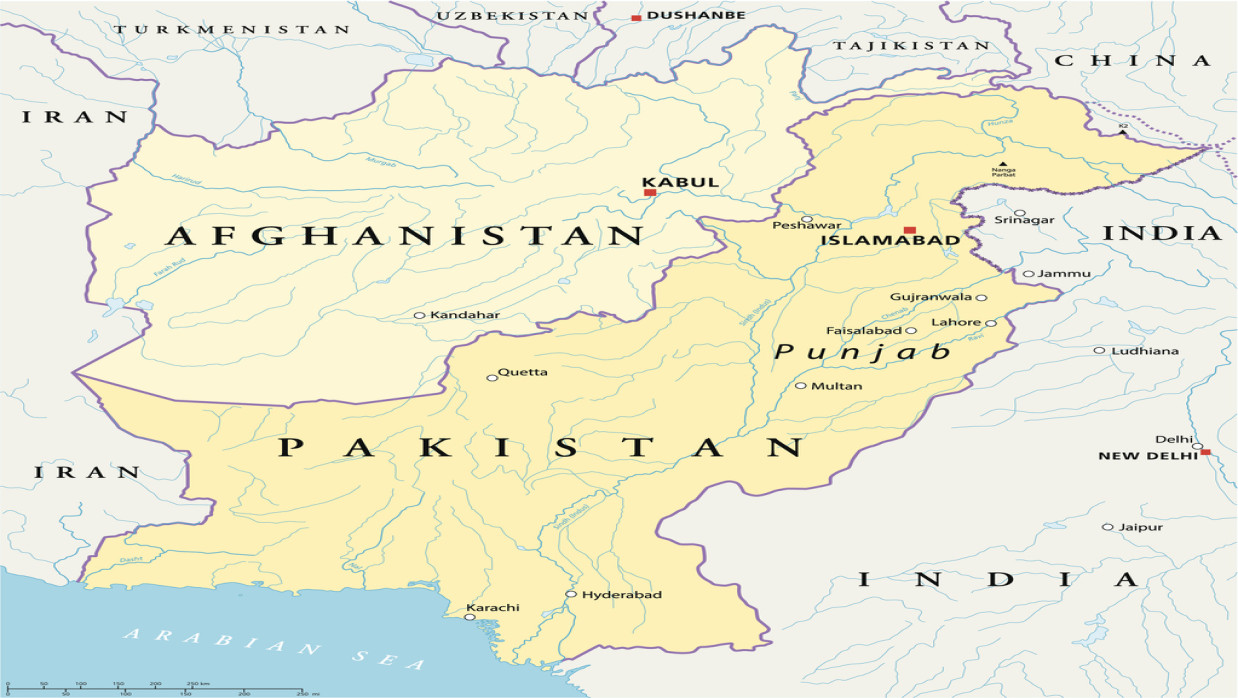
Afghanistan has always been a troublemaker for Pakistan since the inception of the latter country. From casting a negative vote for the admission of the newly born state of Pakistan into the UNO in 1947 to the recent issue of Tehrik-i-Taliban Pakistan (TTP), the ruling elite of Kabul always tries to exploit the faultline of Pakistan for its advantage. Some pro-Afghan elements within and outside of the country have accused Islamabad’s policy of involving Afghan affairs of a hostile attitude of Afghanistan’s ruling elite towards Pakistan; however, even before the Soviet Union’s invasion of Afghanistan (1979), Kabul left no stone unturned to undermine the national unity and sovereignty of Pakistan.
The ruling elite of Pakistan has always had a wishful thinking towards Afghanistan since the Afghan Jihad, having a pro-friendly government in Kabul. And for the accomplishment of that strategic goal, Pakistan joined hands with the USA in Afghan Jihad, allowing Afghan refugees, drugs, and gun culture, and consuming the decade of the 1980s in fighting others’ wars. The same pattern occurred in the 1990s; Pakistan consumed energy brokering arrangements among warlords in the hope of establishing a sphere of influence in Afghanistan. Fast forward, Pakistan’s backing of Afghanistan’s Taliban 1.0 came with the same logic of having a pro-Pakistan government in Afghanistan.
And the same dubious logic of supporting the Taliban continues to evolve in two decades of 21st century. What do we get in exchange? Our long-standing allies USA, often call out Pakistan for playing a double game, causing reputational damage. Not to mention 80,000 human casualties of the War on Terror on the side of Pakistan, along with $150 billion economic loss, and erosion of the diplomatic influence and soft power of the country.
And finally, when the Afghan Taliban took over Kubal in August 2021, both civil and military leadership felt exuberance because of getting a pro-friendly government in Kabul. Again, wrong here, the idea of strategic depth in Kabul was to avoid “two front” war scenarios with New Delhi and Kabul. That idea looks pretty good on paper, but hard to implement due to the ground realities of the nexus between Kabul and New Delhi.
Unsurprisingly, the Afghan Taliban and TTP are two sides of the same coin due to identical ideological goals, worldwide, race, and religious affinity. Since the fall of Kubal in the hands of Afghan Taliban 2.0, various UNO and intelligence reports unequivocally reflected that the Taliban is providing haven, funding, logistic and technical support, and weapons to fighters of TTP, resulting in a spike in terrorism surge in Pakistan. For instance, Pakistan’s Khyber Pakhtunkhwa( KpK) and Baluchistan provinces have experienced around 65 pc of rise in terrorist attacks, especially targeting military, paramilitary, and police forces in the context of undermining the state’s apparatus of law enforcement.
Being a responsible nuclear state, Pakistan has demanded hundreds of times before that the Afghan Taliban break the ties with TTP and uphold the Doha Accords for not providing any haven to terrorist outfits. However, every time Islamabad felt disappointment because refusal of the Afghan Taliban to take any again against TTP.
Out of growing frustration, Pakistan conducted a series of airstrikes on the hideout of TTP deep inside Afghanistan on the pretext of international law. Surprisingly, exploiting the anti-Pakistan sentiments in Afghanistan, the Afghan Taliban opened fire against Pakistan on the pretext of gaining legitimacy in Afghanistan. Resultantly, we have witnessed a regular exchange of fire between Afghanistan and Pakistan, aggravating trust issues and loss of millions of dollars in trade.
For the time being, Pakistan has used diplomatic channels like Qatar, Turkey, and KSA to galvanize pressure on the Afghan Taliban to give up terrorism and the issue of supporting TTP; however, none of the diplomatic efforts have brought any meaningful contribution.
Furthermore, recent growing ties between New Delhi and Kabul also embolden the Afghan Taliban, reducing its dependency on Pakistan. Various security analysts have observed that New Delhi tries to warm its relations with the Afghan Taliban for pushing the idea of two hot borders with Pakistan and gearing up for potential Operation Sindhoor 2.0 against Pakistan. Against that background, New Delhi is reestablishing its diplomatic and strategic influence in Taliban-ruled Afghanistan through means of financial assistance.
Here again, Pakistan is facing two hot borders and growing political turbulence at home. First, Pakistan must implement a carrot and stick policy with the Afghan Taliban. Relying on hard means like conducting an airstrike, imposing trade restrictions, and expelling Afghan refugees does not result in exacting pressure measures against the Taliban for giving up its support to TTP. Second, Pakistan must re-initiate diplomatic engagement and diplomacy with the Afghan Taliban and inform them that having good relations with Pakistan is more important than supporting TTP. Third, a regional approach is needed on the issue of peaceful and stable Afghanistan, so both China and Russia- rather than Qatar, Turkey, and KSA- could bring a real game changer here for exerting pressure on the Afghan Taliban for course correction. Fourth, Pakistan must refrain from issuing such public statements that malign the Afghan people and their society because they bring nothing but further anti-Pakistan elements in Afghanistan. Fifth, Pakistan must refrain from involving internal affairs of Afghanistan. For instance, Pakistan should not have a problem with growing Kabul-Delhi ties if they do not harm the national interest and sovereignty of Pakistan.
And most importantly, to eradicate the menace of terrorism, Pakistan must put its house in order. The issue of extremism, sectarianism, social injustice, and low socio-economic indicators aggravate the beast of terrorism. Just blaming Afghanistan’s government for its support of TTP, without addressing the underlying internal factors for harboring a terrorist mindset, is not the right approach for dealing with the issue of internal security of the country.
Therefore, sticking hard approach with the Afghan Taliban solely does not bring meaningful results. The best interest in both countries remains engaging with each other on multiple fronts, from trade to cultural ties. And it is only possible with consensus on both sides to resolve the pertinent issues- TTP, trade, border management, and refugees- on the table rather than displacing firepower on a weekly basis, as this region cannot afford another long war.


0 Comments
LEAVE A COMMENT
Your email address will not be published