

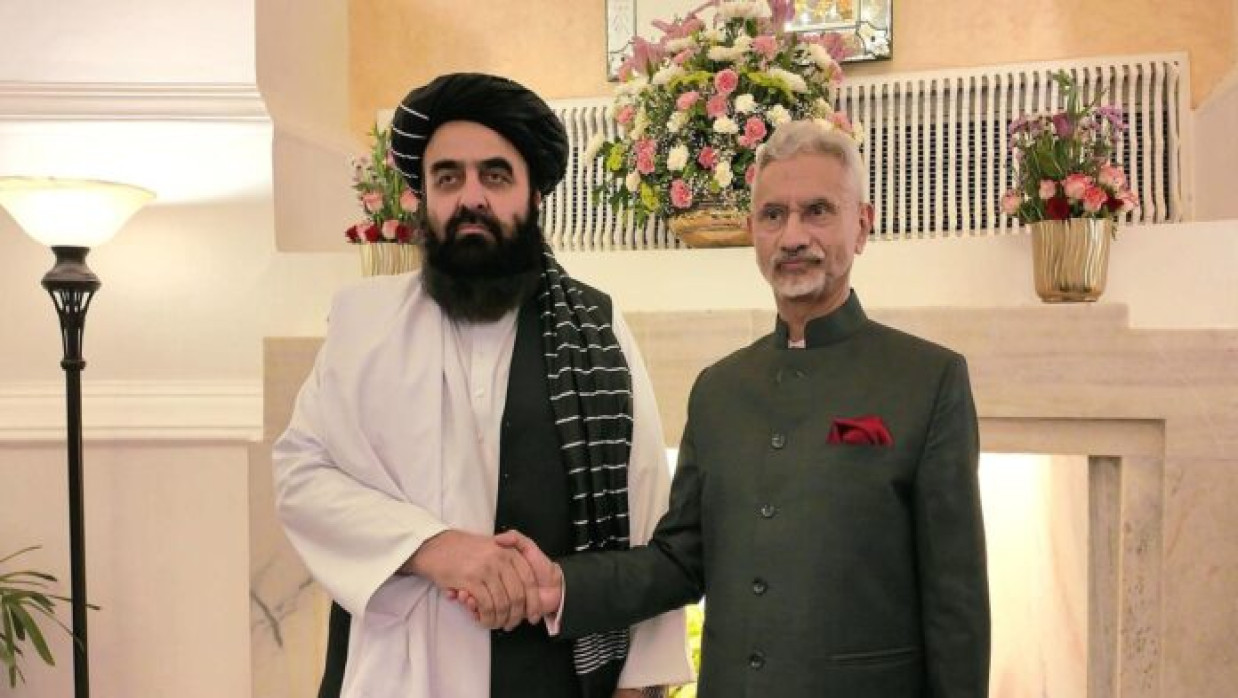
India’s diplomatic corridors are abuzz following External Affairs Minister Dr. S. Jaishankar’s recent meeting with Afghan Foreign Minister Mawlawi Amir Khan Muttaqi in New Delhi. The October 10 dialogue marks a significant moment in India’s post-2021 Afghanistan strategy — a cautious attempt to rebuild ties with Kabul after years of isolation that followed the Taliban’s return to power. But behind the polished optics of “historical and cultural ties” lies a deeper geopolitical calculation: New Delhi’s struggle to reclaim its lost influence in a region where it has increasingly become a marginal player.
The symbolism of the meeting cannot be ignored. For India, it was more than a diplomatic courtesy; it was a declaration of intent — a bid to re-enter an Afghan political landscape now firmly oriented toward regional powers such as China, Pakistan, Iran, and Russia. However, beneath the surface of cordiality, the move also reveals India’s insecurities about its waning clout across South Asia.
India’s External Affairs Ministry framed the meeting as a reaffirmation of the “deep-rooted historical and cultural ties” between the peoples of India and Afghanistan. Yet, regional observers view this as an old playbook move — one that seeks to dress up hard strategic interests in the language of friendship and heritage. For years, India’s presence in Afghanistan was tied to its pursuit of strategic depth — a policy aimed at limiting Pakistan’s influence by cultivating a foothold in Kabul. This policy found tangible form in infrastructure projects, scholarships, and aid programs, most notably the Salma Dam, rebranded as the “India-Afghanistan Friendship Dam.” Yet, the façade of altruism masked deeper motives. Many Afghans, particularly local communities in Herat, had questioned the project’s long-term sustainability and its political symbolism as a tool for Indian soft power projection.
Since the Taliban’s return, India’s diplomatic narrative has shifted — but not its ambitions. The re-engagement with Muttaqi is a calculated move to ensure that India is not left out of future geopolitical arrangements in Afghanistan, especially as the region becomes increasingly shaped by China’s Belt and Road Initiative (BRI) and Pakistan’s facilitative diplomacy.
The larger geopolitical environment makes India’s outreach even more precarious. Since 2021, regional diplomacy on Afghanistan has been dominated by the Moscow Format, Doha Process, and Beijing’s regional initiatives — all of which include Pakistan, China, Iran, and Russia as active stakeholders. India, notably, has been absent or minimally represented in these forums, largely due to its refusal to engage directly with the Taliban until recently. In contrast, Pakistan has maintained open and pragmatic channels of communication with Kabul, focusing on border security, counterterrorism, and trade facilitation. China, too, has integrated Afghanistan into its Belt and Road vision, initiating trilateral dialogues involving Islamabad and Kabul aimed at stability and connectivity. India’s absence from these dialogues has cost it both political relevance and strategic leverage. The Jaishankar–Muttaqi meeting, therefore, appears less as a diplomatic triumph and more as an attempt to catch up — a reactive step rather than a proactive strategy.
India’s invocation of development projects and humanitarian assistance during the talks highlights another layer of its soft-power projection. From the Salma Dam to the Afghan Parliament building, India has often cited these projects as symbols of friendship. But these ventures now stand as remnants of an era when India’s presence was welcomed under the US-led coalition umbrella. Today, without the Western military or political cover, New Delhi faces a reality check. Its earlier model of engagement — built on symbolism rather than sustainability — holds little relevance in a Taliban-governed Afghanistan that prizes sovereignty and regional self-reliance. Moreover, while India seeks to resume trade and transit linkages via Iran’s Chabahar Port, its geopolitical maneuvering remains constrained by its fragile ties with both Tehran and Moscow, as well as its deep alignment with the United States. In contrast, Pakistan and China’s corridor-based cooperation offers Afghanistan tangible economic prospects that India cannot match through isolated projects.
India’s outreach to Afghanistan represents less a vision for peace and more a desperate bid to reassert itself in a region that has moved on. While Jaishankar’s diplomatic gesture may appear as a step toward normalization, it also exposes India’s underlying anxiety about losing influence to Pakistan and China. For Afghanistan, pragmatism will dictate its partnerships — and in that calculus, India’s strategic rhetoric will hold little sway unless backed by genuine cooperation rooted in respect, not rivalry. The meeting in New Delhi may mark the beginning of India’s renewed dialogue, but it also reflects an unmistakable truth: South Asia’s power balance has shifted — and India is scrambling to catch up.


0 Comments
LEAVE A COMMENT
Your email address will not be published