


 ON 6 JUNE 2018, Indian police raided the homes of numerous human-rights activists and lawyers, arresting five individuals. Among them were the activist and journalist Sudhir Dhawale, taken from his home in Mumbai; the activist Mahesh Raut, the lawyer Surendra Gadling and the academic Shoma Sen, all arrested in the town of Nagpur; and the activist Rona Wilson, picked up from his home in Delhi.
This was the first round of arrests in what would come to be known as the Bhima Koregaon, or “BK” case. Between 2018 and 2020, 16 individuals were taken into custody. Besides the first five, the others include the Delhi University professor Hany Babu, the journalist Gautam Navlakha, the poet Varavara Rao, the trade unionist Vernon Gonsalves, the scholar Anand Teltumbde, the activist Sudha Bharadwaj and the lawyer Arun Ferreira. Three members of the Kabir Kala Manch, a Pune-based cultural troupe known for its protest music and street plays against casteism, religious fundamentalism and state oppression – Jyoti Raghoba Jagtap, Sagar Tatyaram Gorkhe and Ramesh Murlidhar Gaichor – were also arrested. The Jesuit priest and activist Stan Swamy, arrested in 2019, died in custody at the age of 84 on 5 July 2021.
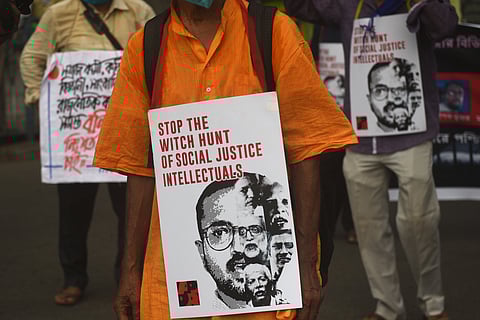
All of these individuals have worked for the uplift of Adivasis, India’s marginalised indigenous communities, as well as Dalits, historically oppressed under the caste system. Police accused them of being sympathisers or members of the banned Communist Party of India (Maoist), of inciting violence at an event earlier that year in the village of Koregaon Bhima, and of plotting to assassinate Narendra Modi, India’s prime minister since 2014, in order to foment an uprising against his government. The accusations were based on documents allegedly recovered from laptops and other devices belonging to those accused; technical experts have challenged this evidence, indicating that it may have been planted. International organisations such as Human Rights Watch and Amnesty International have described the arrests as politically motivated.
Though hundreds of news articles and opinion pieces have been written on the Bhima Koregaon case, the British anthropologist Alpa Shah’s The Incarcerations: Bhima Koregaon and the Search for Democracy in India is the first comprehensive study of it. Early in the book, Shah writes, “The BK case is a bellwether for the collapse of democracy because, for the first time in Indian history, there is a multi-pronged coordinated nationwide persecution of these custodians of democracy.” Using as a case study the legal proceedings against the BK-16, as the accused are now known, Shah argues that the case “exposes the brutal state-sponsored abuse of democratic rights taking place across India with complete impunity.”
‘The Incarcerations: Bhima Koregaon and the Search for Democracy in India’ by Alpa Shah (HarperCollins India, March 2024)(HarperCollins India, March 2024)
The Bhima Koregaon case has, indeed, become one of the most chilling indicators of democracy’s decline in India since Modi and his Hindu nationalist Bharatiya Janata Party (BJP) came to national power. At its core, The Incarcerations is not just about the 16 activists but also about the state machinery that put them behind bars, part of a system where law and politics merge to stifle dissent. Shah’s account, both forensic and empathetic, cuts through the fog of narratives to show how the making of the idea of “Urban Naxals” – the Hindu Right’s favourite term for the BK-16 and any number of other opponents, likening them to the left-wing Naxalite radicals who have battled the state for long years in rural India – has become a symbol of the silencing of critics in Modi’s India, of how the ruling dispensation is turning activists and scholars into supposed enemies of the state. Her book asks a pressing question: What does the fate of the BK-16 tell us about the country’s uneasy relationship with dissent and the fate of Indian democracy itself?
Shah’s earlier work makes her arguably the best person to take up this study. For her 2018 book Nightmarch: Among India's Revolutionary Guerrillas, Shah conducted ethnographic fieldwork among Maoist insurgents in the forests and hills of central India. The title was inspired by “an unexpected seven-night trek with a Naxalite guerrilla platoon” amid anti-insurgency operations by the Indian armed forces. The book became, in her own words, “a reflection on economic growth, rising inequality, dispossession, and conflict at the heart of contemporary India.”
In The Incarcerations, Shah finds that these conflicts have spilled out of the forest corridors of central India and spread across the rest of the country. She writes, “The story of the BK case shows that the battleground of democracy is not only elections, but it is institutions as well – the police, the universities, the judiciary, the media – across the state-corporation nexus, and its civil society itself.”
BEFORE ANALYSING how successfully Shah exposes these conflicts, it is essential to understand the historical and social context of the Bhima Koregaon case. On 1 January 1818, the armies of the British East India Company and the Marathas – a Marathi-speaking power that ruled large parts of the Subcontinent in the 18th century – faced each other on the outskirts of Koregaon Bhima, in what is now the western Indian state of Maharashtra. The Maratha army, led by Peshwa Baji Rao II, numbered over 25,000, while the East India Company force, comprising British officers and Indian soldiers, totalled only about 800. Under Captain Francis Staunton, the East India Company troops held their ground for over 12 hours against an assault by a 2000-strong Maratha unit. The Marathas eventually withdrew, fearing the arrival of a larger British force.
This brief but significant battle was part of the Third Anglo Maratha War, which stretched from 1817 to 1819 and ended in the defeat of the Maratha confederacy under the Peshwa. As a result, the British consolidated their rule over much of western, central and southern India. To commemorate the bravery of their soldiers – 275 of whom were counted as killed, wounded or missing – the British later erected an obelisk at Koregaon. Among the names inscribed on it, 22 bear the suffix “nac” or “nak”, a marker used exclusively by members of the Dalit Mahar caste.
On 1 January 1927, the Dalit leader B R Ambedkar visited the obelisk at Koregaon Bhima – an act that transformed the site into a place of pilgrimage for Dalits across India. The village now hosts an annual commemoration of the battle. Ambedkar later invoked the battle at the first Roundtable Conference of Indian nationalist leaders in London, in 1931. The historian Shraddha Kumbhojkar observes that the obelisk generates “conflicting memories”. Those who commemorate the Peshwa, she writes in her 2015 essay ‘Politics, caste and the remembrance of the Raj’, “either choose to ignore the Koregaon battle, or create a pseudomnesia of Peshwa victory.” For the Mahars and other Dalit communities, whom many Marathas regarded as “untouchables”, the site serves as “historical evidence” of “the ability of the Untouchables to overthrow the high-caste oppression.”
However, the activist and Dalit Studies scholar Anand Teltumbde – himself one of the accused in the BK-16 case – argues in a 2018 article that the myths surrounding the Mahar victory at Koregaon can, in fact, be counterproductive. The narrative, he writes, “reinforces the identities it seeks to transcend.”
In recent years, Bhima Koregaon has again become a site of conflict and violence. In the run-up to the 2018 commemoration – marking the 200th anniversary of the battle – tensions flared between Dalits and dominant-caste Marathas. On 28 December 2017, a shrine to the Dalit icon Govind Mahar, near Koregaon, was desecrated – allegedly by right-wing Hindu groups. Three days later, on 31 December, Dalit activists organised the Elgar Parishad – roughly, a “loud declaration” – at Shaniwar Wada, the historical seat of the Maratha empire in Pune. The event, featuring retired Supreme Court judges, politicians and performers from the Kabir Kala Manch, pushed back against the rise of religious majoritarianism in India.
The next day, as thousands of Dalits began arriving for the Bhima Koregaon commemoration, a riot broke out. There are multiple versions of what might have triggered the violence. While some claim that Hindutva groups attacked the Dalits, others assert that provocative speeches by Dalit leaders led to the fracas. “The more I dug into the events, the murkier they got,” Shah writes. “In fact, it is hard to imagine a story that could change more as the days passed, or a story in which the telling of history became so central to the making of history.” Initially, a police case was filed against the Hindu right-wing activists Milind Ekbote and Sambhaji Bhide – the latter also a long-time member of the Rashtriya Swayamsevak Sangh, the parent organisation of the ruling BJP. Ekbote was arrested in March 2018 but was released on bail a month later.
The police also blamed the organisers of the Elgar Parishad for the violence at Koregaon Bhima, though little evidence has emerged to support this claim. Several people arrested in connection with the case – some of whom had no links to the commemorative gathering or were miles away from Koregaon at the time – continue to languish in prison. A judicial commission appointed to investigate the incident has yet to submit its report. The Maharashtra government, in August this year, granted the commission its eighteenth extension, until 31 October 2025. It continues with its probe even now.
Since the initial arrests, the BK-16 have been subjected to media trials led by India’s army of pro-government outlets, especially television channels. Early in her book, Shah recounts how Republic TV and its editor, Arnab Goswami, reported on the alleged plot to assassinate Modi, portraying Sudha Bharadwaj as its mastermind. Bharadwaj later filed a defamation suit against Republic TV and Goswami.
The media studies scholars Prashanth Bhat and Kalyani Chadha have shown how television channels like Republic TV have “fixated on promoting religious majoritarianism, defending the policies of the Modi government, and advocating hyper-nationalism,” while stifling dissenting voices. According to Shah, coverage of the Bhima Koregaon case followed a similar playbook.
Shah undertakes the essential task of disentangling facts from the swirl of misinformation and propaganda surrounding the case. Drawing on interviews with local journalists, activists and witnesses, as well as newspaper archives, she constructs a clear chronology of events. Though she did not interview any Hindu right-wing activists, her account is well substantiated. Amid unreliable media reportage and the long-delayed judicial investigation, The Incarcerations stands as perhaps the most credible reconstruction of events available to date. Establishing such factual ground, free from political and media distortion, is crucial before one can fully assess the implications of the BK-16 case for Indian democracy.
SOON AFTER the arrests of Sudha Bharadwaj, Gautam Navlakha, Arun Ferreira, Vernon Gonsalves and Varavara Rao in October 2018, a hashtag started trending on Twitter (now X) – #MeTooUrbanNaxal. Several social media users used the hashtag to condemn the arrests and express solidarity with the activists. Around the same time, the playwright and actor Girish Karnad appeared at a public event in Bengaluru wearing a placard that read “Me Too Urban Naxal”.
The phrase “Urban Naxal” was reportedly coined by the filmmaker Vivek Agnihotri in a May 2017 article he wrote for the right-wing magazine Swarajya. He claimed that Urban Naxals were “invisible enemies of India” – radicalised, city-based left-wing intellectuals who provide ideological and logistical support to armed ultra-left Maoist insurgents.
The first “Naxals”, or “Naxalites”, rose up against the state in a China-inspired 1967 insurgency that started in the village of Naxalbari, in northern Bengal. In its early years – before being brutally suppressed by the state – the Naxalite movement drew support from significant sections of urban intellectuals and students, particularly in Kolkata and Delhi. By the mid-1970s, the movement had splintered into numerous, often antagonistic, factions concentrated in central and eastern India. These disparate groups eventually coalesced in the early 2000s to form the Communist Party of India (Maoist), which went on to carry out a series of attacks against Indian state forces.
The government responded with an all-out offensive against the Maoists, dubbed “Operation Green Hunt”. In October 2009, the Indian National Congress’s Manmohan Singh, then the prime minister, described Maoism as “the greatest internal security threat” to India. That same year, Human Rights Watch warned both government forces and Maoists against repeating past abuses targeting civilians. Numerous investigations into the insurgency – see Sudeep Chakravarti’s Red Sun: Travels in Naxalite Country, Arundhati Roy’s Walking with the Comrades and Shah’s own Nightmarch – reveal grave excesses by both sides.
Alpa Shah on the Bhima Koregaon case and India’s democratic decline: State of Southasia #22
But is there really an urban wing of this largely forest-based Maoist movement? The political scientist Anshuman Behera writes that debates on the “urban Maoist” largely fall into two camps: one that insists such actors exist and are working against the Indian state, and another that dismisses this as a manufactured narrative meant to target dissenters and legitimate critics of the government. Behera argues that while the existence of city-based sympathisers of the Maoists cannot be ruled out entirely, successive Indian governments – including under the Congress, before the BJP came to power – have used the spectre of the Urban Naxal in some form as “an instrument of effective rhetoric” to serve political ends.
Whether or not Urban Naxals pose a real threat to the Indian state, what is often lost in the rhetorical duel is any consideration of the actual human beings tagged as such. As scholars have shown, “labelling” of this kind functions as a convenient tool to delegitimise political opponents and silence critics.
In his 2023 paper ‘Rethinking Political Polarization’, the political scientist Andreas Schedler argues that the present global crisis of democracy is best understood through the lens of polarisation, a process in which antagonistic camps brand each other with labels that erode trust and make dialogue impossible. A similar logic operates in the stigmatisation of those branded “Urban Naxals”: by classifying them as enemies of the state or traitors to the nation, the state and its allies can neutralise legitimate dissent and discredit rational critique.
Shah performs the essential task of excavating the lives of the BK-16 from the clouds of stigma that surrounds them. The first three parts of The Incarcerations, each running to several hundred pages, are effectively mini biographies of Sudha Bharadwaj, Stan Swamy and Anand Teltumbde. Shah traces how all three dedicated their lives to the uplift of India’s marginalised Dalit and Adivasi communities – often at great personal cost.
The most striking and widely publicised example of such sacrifice is Bharadwaj’s decision to renounce her US citizenship. After graduating from the Indian Institute of Technology, Kanpur – one of the country’s most prestigious universities – she briefly lived and studied in the United States, before returning to India to work with trade unions and marginalised communities in the state of Chhattisgarh.
“Sudha’s decision to give up her US citizenship was noteworthy,” Shah writes. “Everyone she had studied with dreamt of emigrating to the US and securing a Green Card.” In a country where millions aspire to emigrate, her decision was a rare reversal of that dream. The gesture affirmed her deep commitment to India. To label her “anti-national” – another term frequently deployed against the opponents of the Hindu Right, including imagined Urban Naxals – is therefore deeply ironic.
Shah offers only brief sketches, across a few chapters, of the remaining accused among the BK-16. Their portraits lack the depth and nuance afforded to the stories of Bharadwaj, Swamy and Teltumbde. This represents a relative gap in the book’s otherwise meticulous narrative – the lesser-known figures among the BK-16, whose stories remain on the margins, might have benefitted from closer attention. At the same time, this leaves space for future inquiry, inviting both academic and journalistic researchers to build upon Shah’s work.
IT IS IMPOSSIBLE to discuss the BK-16 case without addressing the state’s use and alleged abuse of technology – particularly malware and spyware. Before Rona Wilson’s arrest in June 2018, in the first round of detentions in the case, the police seized a laptop and a hard disk from his one-room flat in Delhi. Among the files and communication allegedly recovered was a letter addressed to one “Comrade Prakash”, which investigators claimed revealed a plot to assassinate the prime minister. It identified, by name, several of the BK-16 accused. The alleged letter was subsequently leaked by the investigating agencies to pro-government media outlets, further stigmatising the accused.
Shah makes short work of dismantling the credibility of this letter, drawing on her own experience of working closely with Maoists groups. “The Maoists were obsessed with secrecy. It was paramount to protect themselves and those close to them. … Even I had to have an alias when I was conducting my anthropological research between 2008–2010 amidst the Maoist guerrilla armies.” A textual analysis of the letter, a copy of which Shah reproduces in the book, also reveals its inconsistencies. Experts who examined it have observed that it “had the hallmarks of mischievous fabrication” and would not “stand up to judicial scrutiny.” But this raises a larger question: how did such a letter come to be found on Wilson’s laptop in the first place?
Defence lawyers of the accused enlisted the US-based digital forensics firm Arsenal Consulting to verify the police’s claims. A series of reports published by the firm suggested that the incriminating documents found on Wilson’s laptop may have been planted months before the incidents at Koregaon Bhima through the use of malware. Further investigations by Citizen Lab Canada, an internet and security research centre at the University of Toronto, revealed that the phones of Teltumbde and several other activists were targeted by the notorious Israel-manufactured spyware Pegasus in early 2019.

Caging the canary
Subsequent probes by Amnesty International showed that activists had received malware-laced emails and links in September and October 2019, while a 2021 investigation by The Guardian also revealed that Pegasus had been used to target Indian journalists, opposition leaders and activists. Though the Indian government has denied purchasing Pegasus, a 2022 investigation by the New York Times reported that the spyware was part of a USD 2-billion defence deal between India and Israel signed in 2017. The Supreme Court of India has since ordered an inquiry into the matter.
Ronald J Deibert, the founder and director of Citizen Lab, succinctly captures the scale of the threat in his 2023 paper ‘The Autocrat in Your iPhone: How Mercenary Spyware Threatens Democracy’: “If elites in any country can use this technology to neutralize legitimate political opposition on any point on earth, silence dissent through targeted espionage, undermine independent journalism, and erode public accountability with impunity, then the values on which the liberal international order is built may soon be no more secure than the passwords on our phones.”
Through a combination of in-depth interviews and archival research, Shah exposes a frightening network of mercenary hackers – individuals and groups willing to work for the highest bidder. They can be deployed to survey and target political opponents, activists, journalists and other citizens, and their ability to plant incriminating evidence, as alleged in the BK-16 case, strikes at the heart of due process and the rule of law. What is even more troubling, Shah suggests, is the growing tendency of governments, even in democratic nations such as India, to allegedly employ such shadowy actors.
The most compelling section of this part of the book, at least for me, is Shah’s interview with Shivaji Bodkhe, the former joint commissioner of the Pune City Police. It is rare for senior Indian police officers to speak on the record, especially about cases still under investigation or trial. Bodkhe, who played a key role in the Bhima Koregaon inquiry, had retired from service by the time he spoke to Shah. In a candid exchange, he categorically denies allegations that the police or investigating agencies had planted evidence on the devices of the accused. “How can a person sitting in the US get access to the materials, evidence, articles?” he asks Shah, dismissing the findings of international forensic experts.
Despite their sharply contrasting views, Shah writes that she grew to “sympathise with the man” or at least to see the case “from his point of view.” Bodkhe, who had spent time in India’s hinterland engaged in anti-Maoist operations, remains convinced that his actions – whether against insurgents in the forests or their alleged sympathisers in the cities – were both ethically and legally justified. He even draws a distinction between socialism as an ideology and what he perceives as the violent extremism of the Maoists.
Though brief, the interview offers a rare insight into the mindset of those tasked with upholding the Indian state’s authority. Much as she does for the alleged Urban Naxals, Shah rescues the police officer from easy caricature – in his case the caricature of bureaucratic evil. In doing so, she opens up the possibility of dialogue – an act that feels all the more vital in an age of deepening polarisation.
SHAH’S BOOK was published in India in March 2024, just months before a crucial national election. The story it tells, however, remains incomplete. The BK-16 trial continues to move slowly through the courts. While Swamy died in custody in 2021, several of the accused have since been released on bail – among them Sudha Bharadwaj, Anand Teltumbde, Vernon Gonsalves, Arun Ferreira, Shoma Sen, Varavara Rao, Gautam Navlakha and, most recently, Rona Wilson and Sudhir Dhawale.
In October 2024, before their release on bail, Wilson and Dhawale joined five other co-accused in a hunger strike at Taloja Central Jail, on the outskirts of Mumbai. Their demand was basic: to be produced in court. This is a minimal right for any prisoner in India, which the accused had reportedly been denied for two months. They were finally presented in court on 24 October.
While the Supreme Court of India has repeatedly affirmed the right to bail as a fundamental safeguard, the reality within the country’s prisons tells a different story. Government data released earlier this year shows that in 2022 more than 63,000 undertrials had been detained for one to two years, and another 11,448 prisoners had been in jail for more than five years. India’s prisons are chronically overcrowded, often operating at 130 percent of their capacity. Unhygienic conditions, inadequate nutrition and medical care, as well as frequent violence between inmates and jail authorities are widely reported. As several observers have pointed out, in India’s legal system, the process is the punishment.

Prison writing sheds harsh light on our states and societies
The case of the BK-16 is further complicated by the fact that they are charged under the Unlawful Activities (Prevention) Act, 1967 – the draconian and dreaded UAPA. Designed to prevent acts that threaten India’s sovereignty and integrity, the UAPA has been amended several times to expand the state’s powers while severely limiting the rights of the accused. Those charged under it are routinely denied bail. Investigations show that the Indian security services are often trigger-happy in invoking the law. Between 2018 and 2020, 4690 people were arrested under the UAPA, but only three percent of them were convicted.
The lawyer Mihir Desai, who represents several of the BK-16, tells Shah: “In UAPA cases the trial takes about ten-twelve years.” Many of the accused BK-16 had in fact been working to reform the very law that would later be used against them – and to secure the release of many of those far less privileged than themselves who had been imprisoned under it. While Navlakha, Wilson, Ferreira and Gonsalves were writing and campaigning against the UAPA, Gadling and Bharadwaj were providing pro-bono legal aid, and Swamy had filed public-interest litigation in the eastern Indian state of Jharkhand challenging its misuse. “It seemed a cruel irony that those who were opposing the UAPA as draconian and undemocratic were now themselves incarcerated and made the victims of that law,” Shah writes. “Or perhaps it was not ironic at all.”
The work done by the BK-16, and their eventual fate, may already be slipping out of news cycles and public memory. But Shah’s book, a remarkable feat of research and moral commitment, stands as a bulwark against amnesia. There is now a rich and growing body of work by journalists, activists, poets, novelists and academics chronicling India’s democratic backsliding. The Incarcerations is an essential addition to this literature. Through the story of the BK-16, Shah captures the vast and impenetrable silence that seems to have settled over the country. Yet this is not only a story of despair; it is also, unmistakably, one of hope.
Around the book’s midpoint, Shah narrates with great empathy the days leading up to the arrest of Navlakha in early 2020. “Sabha [Navlakha’s wife] and Gautam opened their house in the evenings, while they could, for friends to say goodbye,” she writes. One of these friends later tells Shah: “People were coming and going. There was singing, talking and laughter. Everyone wanted to see Gautam.” When it became evident that he would be arrested, Navlakha issued a statement thanking his friends for their support and vowing to fight the accusations in court. He ended it with the famous lines from the Canadian songwriter Leonard Cohen’s ‘Anthem’: “There is a crack, a crack in everything / That’s how light gets in.”
“As I raced to finish this book, burnt the midnight oil, Gautam’s evocation of Leonard Cohen stayed with me,” Shah writes, before riffing on the rest of the song’s lyrics. “Is that what I was trying to do too? Ring the bells, the bells that can still ring? Had I found the cracks?” By rigorously chronicling the story of these prisoners of conscience, Shah has indeed exposed the cracks of India’s besieged democracy, shining light where it is badly needed.
The article was published in the himalmag
0 Comments
LEAVE A COMMENT
Your email address will not be published