

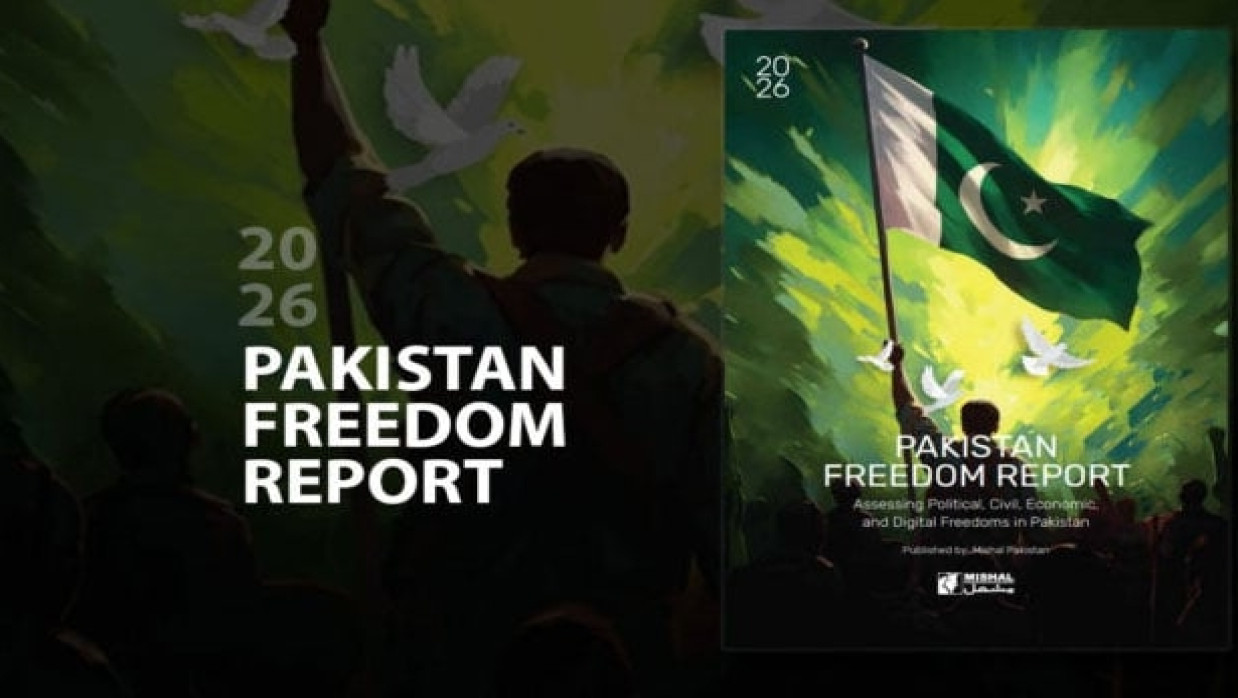
Pakistan’s launch of the State of Freedom Report Pakistan 2026, really kind of marks a real turning point for governance talks and public policy in Pakistan. For the first time, Pakistan now has a homegrown, evidence-based yardstick that tries to measure freedom not only from constitutional promises, but also from how people actually feel things in their daily lives, day to day. That gap matters, a lot. Legal rights on paper are absolutely essential, yet their actual worth only shows up in everyday routines: do citizens feel heard, do institutions respond with fairness, is economic opportunity within reach, is information dependable and are people confident they can meaningfully take part in national decisions.
This report, built by Mishal Pakistan, together with the Country Partner Institute of the World Economic Forum in Pakistan, was presented at the Institute of Strategic Studies Islamabad, in partnership with the China-Pakistan Study Centre. Its significance is in the way it moves public discussion past catchy slogans, and pure speculation. Pakistan has often been assessed via external measures, global reports and international rank lists. Those evaluations do have some importance, but they do not always capture the wider scene of Pakistan’s constitutional structure, how institutions have developed, the social fabric, and citizen perceptions. With a national benchmark Pakistan can review itself using its own evidence, while still leaving space for international comparison, you know, in a practical way.
The State of Freedom Report looks at six main dimensions, political freedom, civil liberties, rule of law, and access to justice, economic freedom, digital freedom and access to information, and social inclusion, gender and public trust. This kind of wide framework is kinda needed because freedom is not something you can reduce to just one category. A citizen might have legal rights but still not really have economic security. A voter may take part in elections but still feel powerless in everyday governance. A young person can be on digital platforms but remain exposed to misinformation, censorship, cyber threats, or maybe unequal opportunities. And a woman may have constitutional protection, yet keep running into structural barriers in the labour market. The report’s strength is that it actually treats freedom as a multidimensional public experience, not just a single idea.
The findings give a mixed but still important view. On the positive side, 77% of respondents think citizens are free to pick their profession and occupation, while 75% think businesses can run without undue government interference. The same share also said they had positive views about women’s opportunities and empowerment. Those signals show that many Pakistanis understand social and economic openness, especially related to work, enterprise and women’s participation. Likewise, 65% reported positive perceptions of freedom of religion and religious protections.
However, the report also points out some serious pressure points. Like, around 62% of respondents say regular citizens have a pretty limited say when it comes to government decisions. That should worry policymakers, honestly. If people think they can’t in any way influence the choices that touch their daily lives, public trust starts to erode. Then governance turns into something that is done to people, not with people. Also, 58% expressed worry about financial steadiness and broader economic welfare, while 55% mentioned worries about getting information that is impartial, and not biased in any noticeable way. Taken together, these numbers suggest the freedom conversation in Pakistan isn’t something separate from inflation, jobs, media credibility, digital know-how and how responsive institutions actually.
The digital side feels especially important here. Pakistan now has more than 190 million cellular subscriptions, roughly 140–150 million broadband users, and nearly 70 million active social media users. Digital spaces have effectively become the main channel for public messaging, political arguments, commerce, and citizen voice. The survey indicates Facebook, WhatsApp, online news portals, X and television are among the biggest sources of information. Sure, this shift brings room for progress, but it also brings risk. Increased access can help citizens organize, broaden markets, and improve involvement. Yet at the same time, misinformation, hate speech, extremist material, cybercrime, and even platform steering can weaken social trust and disrupt public order.
The report says Pakistan turned in more than 15,391 content and account related requests to big global digital platforms during the reporting period, and roughly 45.8% of those ended with some kind of platform action. This brings up a pretty serious governance puzzle, like how to juggle digital liberty with lawful oversight, cybersecurity, and protection from online harm. A “free society” shouldn’t mean a lawless online place. Still, regulation has to stay transparent, proportionate and also answerable. That tough middle ground is probably going to shape Pakistan’s upcoming digital freedom story.
Then there’s the justice sector, which is really another thing that needs urgent focus. Over 2.2 million pending court cases, plus more than 102,000 prisoners, kinda signals deep structural pressure inside the legal system. Sure, access to justice is not just about courts exist ing, it is also about resolution that is timely, affordable and actually fair. When justice is delayed it erodes trust in the state, not just in paperwork. Legal reform, faster procedures, prison reform, and alternative dispute resolution should be treated as freedom and rights questions, rather than just administrative chores.
The report also, kind of rightly highlights future risks like climate change water scarcity, cybersecurity threats, youth unemployment, rapid urbanization misinformation, and economic inequality. These pressures will basically shape how citizens experience freedom in the years ahead. A nation dealing with water stress or job insecurity or too much urban pressure can’t build durable public trust just through constitutional language alone. It needs forward planning, and the finding that 69% of respondents support national planning beyond five years is a pretty clear public signal.
The State of Freedom Report should not be treated as some ceremonial publication. Its real weight, honestly, will depend on whether policymakers actually use it as a governance instrument. It should feed legislative debate, drive institutional reform, guide digital policy, justice-sector planning, support women’s empowerment initiatives and also the long-term development strategy. Pakistan’s constitutional foundations are strong, but the real test comes down to implementation. Freedom becomes meaningful when citizens experience dignity, opportunity, fairness, security and participation in practical terms, not in theory.
This first report set a kind of baseline. The next challenge is harder, like measuring progress in a honest way, year after year. If Pakistan can build a credible long-term monitoring for freedom framework, it can move away from reactive governance toward evidence-based reforms, and this would be the real achievement.

0 Comments
LEAVE A COMMENT
Your email address will not be published