

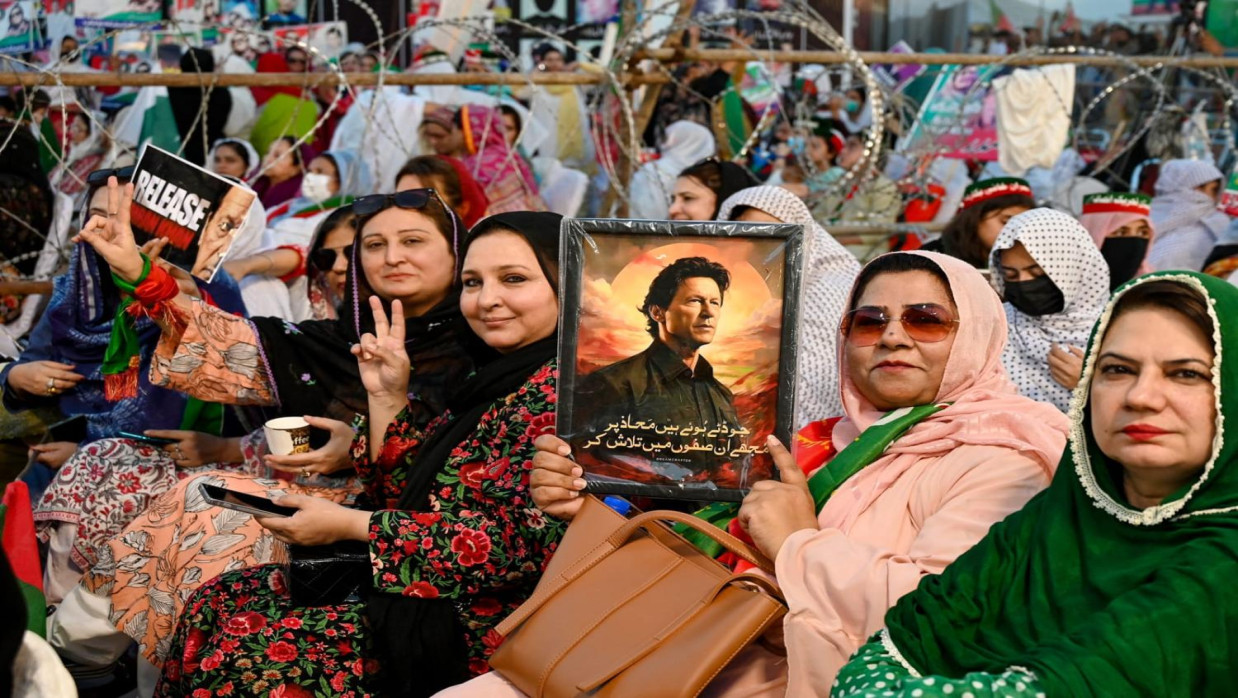
Former Australian captain Greg Chappell was one who has long experience working within Pakistan’s cricket system. Chappell has argued that sustained political repression damages not only governance but a country’s international credibility. He has warned that institutions – sporting or otherwise – cannot function properly when legitimacy is tarnished.
Khan has been imprisoned since his arrest in 2023, handed lengthy sentences on dubious charges. His transformation from an imperious fast bowler on the field to popular politician has drawn international attention to his plight. Earlier this week, Khan was allowed only a brief visit to a hospital, Pakistan Institute of Medical Sciences in Islamabad, from his cell in neighbouring garrison city if Rawalpindi, for his deteriorating eye infection.
But Chappell also wanted to go beyond being “a single lamp in the wilderness” and shine a proper spotlight, so helped bring together some of cricket’s biggest former stars.
The West Indies bowler Michael Holding – a rival from Khan’s playing days – has repeatedly linked Khan’s imprisonment to a broader pattern of democratic erosion, arguing that silencing political dissent under legal cover corrodes public faith in democratic systems.
India’s Sunil Gavaskar and Kapil Dev joined the appeal for basic principles of due process and judicial dignity.
What distinguishes Khan’s case is not simply his fall, but his refusal to accept political extinction.
That such arguments are being advanced by sporting figures rather than governments is telling. For Pakistan, where cricket functions as cultural glue, international validation and a rare source of collective pride, the interventions carried resonance — at least among the public, if not the state — that few foreign governments have managed to achieve. That towering figures of the game felt compelled to speak at all underscores both the depth of Pakistan’s democratic crisis and the silence that has surrounded it.
Cricket has long been Pakistan’s most effective form of soft power, a space where the country is admired rather than scrutinised. But celebrity advocacy, however powerful symbolically, has clear limits. It can amplify attention and legitimise concern, but it cannot reorder power in a system designed to withstand reputational pressure. The renewed focus on Khan’s plight has not altered the institutional reality that now defines his captivity.

That reality is inseparable from Khan’s own political journey. His ascent to power was not forged in opposition to Pakistan’s military establishment, but with its tacit support. He was seen as a civilian leader capable of commanding popular legitimacy without fundamentally challenging entrenched power structures. His rise occurred in a political environment shaped by the security apparatus, including influential figures within the intelligence establishment, that marginalised traditional parties and cleared space for an alternative. This was neither novel nor accidental; it reflected a familiar Pakistani pattern of managed civilian empowerment.
The bargain unravelled when Khan attempted to renegotiate its terms. As his popularity deepened, he increasingly invoked electoral mandate to assert civilian authority and question the military’s role as ultimate political arbiter. In mobilising mass politics against a system built on controlled consensus, he crossed a red line. His removal from office was followed by arrests, legal cases and systematic political exclusion, culminating in prolonged imprisonment. He became, in effect, a prisoner of a strategy that first elevated him and then destroyed him.
What distinguishes Khan’s case is not simply his fall, but his refusal to accept political extinction. From prison, he has continued to fight for survival by shifting the contest from the streets to parliament. Central to this strategy has been his backing of veteran Pashtun leader Mehmood Khan Achakzai as leader of the opposition, an effort to unify fragmented opposition forces and reclaim institutional legitimacy. By elevating a figure whose democratic credentials long predate his own political rise, Khan has sought to frame the struggle as constitutional rather than personal.
This move is deliberate. Achakzai’s long-standing opposition to military interference allows Khan to anchor his cause within a broader democratic tradition. Together with allied parties, the opposition argues that the October 2024 elections delivered a popular mandate that has been denied recognition through legal disqualification, party fragmentation and administrative control. The demand is not only for Khan’s release, but for his return to parliament in line with that mandate – a shift from individual injustice to institutional legitimacy.
Pakistan’s political system has repeatedly shown its capacity to absorb pressure without conceding authority. But the symbolism matters. Reclaiming parliament as a site of democratic meaning challenges the idea that elections are merely procedural exercises rather than expressions of popular will. It also complicates efforts to portray Khan’s imprisonment as an isolated legal matter rather than part of a wider contraction of political space.
That contraction is increasingly difficult to ignore. Courts are widely perceived as instruments of political management. Media freedom has eroded through censorship, intimidation and economic coercion. Electoral competition persists in form but not in substance. These trends predate Khan, but his treatment has made them unmistakable, particularly to younger Pakistanis who invested heavily in electoral politics as a pathway to change.
For Australia, the prominence of Australian cricketers among Khan’s supporters raises an unavoidable question. Is concern about democratic erosion in Pakistan now to be expressed only through private individuals, or does it warrant official engagement? Australia maintains longstanding ties with Pakistan across defence, education, migration and sport, and presents itself as a middle power committed to democratic resilience in the Indo-Pacific.
Australia cannot determine Pakistan’s political outcomes, nor should it attempt to arbitrate them. But it does have agency in how it responds. Consistent, calibrated public language on due process and political participation matters, particularly when coordinated with partners. Sporting diplomacy can complement this engagement, but it cannot substitute for it.
When governments retreat behind private advocacy, they risk signalling that democratic principles are optional rather than integral.
The article appeared in the lowyinstitute

0 Comments
LEAVE A COMMENT
Your email address will not be published