

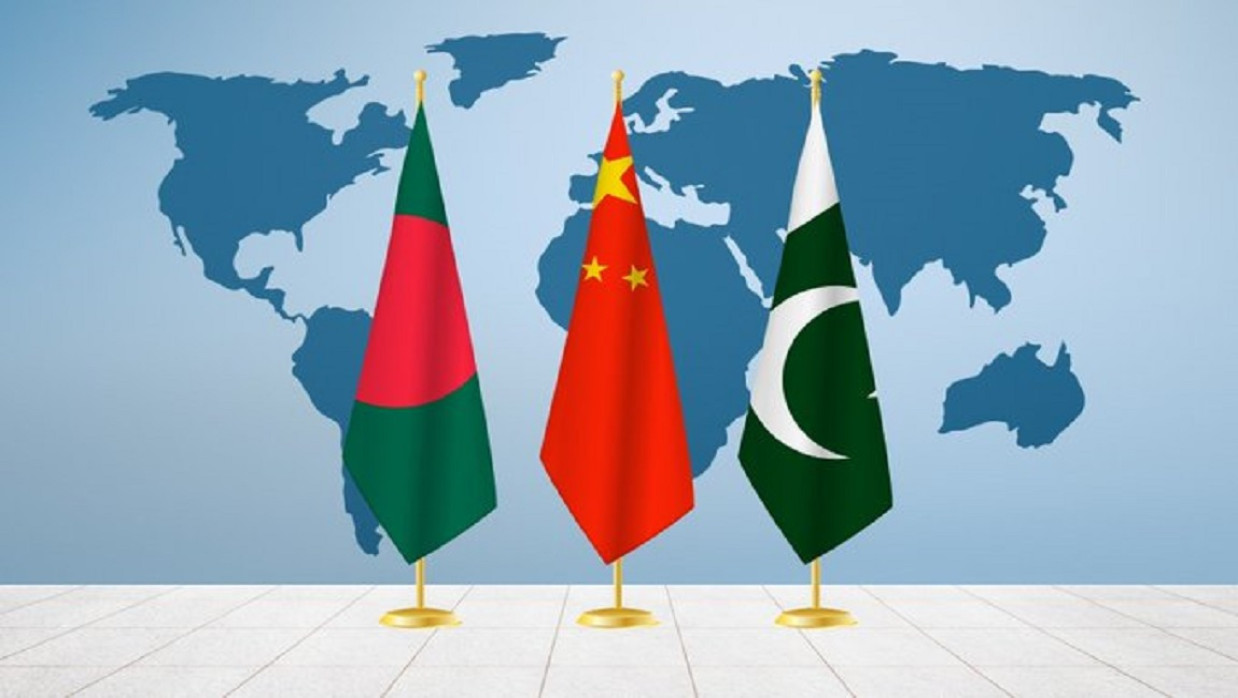
On 10th December 2025, Bangladesh foreign affairs adviser Md Touhid Hossain stated that it is “Strategically possible” for Dhaka to join a trilateral regional grouping with Pakistan and China that exclude India. His statement indicates willingness of Bangladesh to establish a strategic alliance with Pakistan and explore an alternative regional bloc to counterbalance India’s growing influence. In June 2025, China, Pakistan and Bangladesh held a trilateral Vice Foreign Minister/Foreign Secretary meeting in Kunming. At that meeting, the three countries agreed to enhance cooperation in multiple areas trade, investment, maritime affairs, health, education, and more. A working group was agreed to follow up on implementation of cooperation projects.
Moreover, 0n 5th December 2025, Pakistan’s Deputy Prime Minister & Foreign Minister Ishaq Dar stated that the trilateral initiative might be "expanded and duplicated," thus enabling it to become wider regional grouping encompassing more than just the three countries. Islamabad is indirectly presenting the new platform as a replacement for the long-stalled SAARC excluding India. This is substantial move that might come ahead of India. After the May 2025 standoff, Pakistan has already been the world's central focus. However, Pakistan’s foreign policy is centered on collaboration, connectivity, and common interests while the establishment of a new bloc with China’s backing that is focused on South Asia will provide not only economic objectives but also a mutual security against the rise of Hindutva in India.
On 27th October 2025, the two countries, Pakistan, and Bangladesh, conducted their 9th Joint Economic Commission (JEC) meeting, which was the first one after more than 20 years. They, therefore, opened the door for collaborations in almost all areas, such as trade, investment, transport, agriculture, education, and healthcare. Pakistan also proposed a formal maritime cooperation framework between the two countries, which would include their national shipping companies, to make their collaboration in shipping, ports, maritime safety, and so on deeper. An MoU on Halal trade was signed between the Halal Authority of Pakistan and the Standards and Testing Institute of Bangladesh; travel (sea/air) and logistic facilitation were also mentioned as possible topics of discussion; using the ports of Pakistan as gateways for Bangladeshi exports.
Therefore, a strategic collaboration is increasing between the long-time partners that will pave the way for more concrete vision. A new chapter in the dynamics of South Asia is characterized by the rapprochement of Pakistan, Bangladesh, and China, which are now approaching the same infrastructure of cooperation centered on development, connectivity, and collective growth. The trilateral activities of 2025, which include the first-ever Pakistan–Bangladesh–China dialogue and the resumption of bilateral dealings, have clearly shown that the three nations consider cooperation as a necessity for their strategy rather than only a diplomatic measure. This partnership in the region, which has been known for its rivalry and mistrust, as well as for ineffective multilateral forums because of India's obstinacy and hegemonic behavior, is an indication that alternative routes to stability and prosperity are not only feasible but already taking shape under the umbrella of Pakistan.
Moreover, this cooperation is mainly driven by a strong economic reason. China supplies the money, technology, and industry; Pakistan shares its location, ports, and CPEC infrastructure; Bangladesh provides its production capability, skilled workforce, and the routes of the Bay of Bengal for maritime trade. The three nations will be able to create a smooth South-West Asian value chain that covers the entire spectrum of innovation, IT, high-tech manufacturing, green energy, agriculture and export-oriented industries. However, Their Joint Economic Commission and trilateral consultations point toward an integrated economic corridor where investment, logistics and industrial cooperation reinforce each other, creating an economic bloc with the potential to reshape regional trade patterns. Bangladesh and Pakistan are also important destinations for Western tech companies and have potential to provide relatively cheap skilled labour. This situation has the potential to cause the transfer of technology, as well as the building up of the intellectual capital needed for quick industrialization of both parties involved.
Furthermore, the cooperative vision extends to maritime connectivity, environmental protection and climate resilience, in addition to market concerns. Proposed maritime frameworks between Pakistan and Bangladesh complemented by China’s port development experience can establish secure, efficient and environmentally responsible sea routes linking Gwadar, Karachi, Chattogram and Mongla. Pakistan has potential for net security provider for maritime routes and secure shipping.
South Asia is the region where climate vulnerabilities still have the greatest impact and trilateral cooperation on clean energy, coastal protection, disaster-response and infrastructure can become the flagship model of collective environmental stewardship through such cooperation. Strategic synchronization that comes from maritime coordination, logistics security and technological collaboration, even without formal defense alliances, makes the whole area benefit from the stability dividends which can be beyond the region.
Finally, the diplomatic engagement of the three countries is not limited to agreements and communiques but rather expresses a progressive political concept that Pakistan, Bangladesh and China can develop a regional machinery based on the development and partnership instead of conflict. Pakistani leadership has already framed the initiative as a model that can be expanded and replicated, while Bangladesh sees economic opportunity and China recognises the value of cooperative regional connectivity. If sustained, this partnership has the potential to evolve into a cohesive platform for prosperity, technology-driven growth, maritime security and environmentally responsible development offering South Asia a much-needed alternative narrative of collaboration over confrontation.
Bangladesh is still recovering from the July revolution. Elections are scheduled in February 2026 that may cause change in leadership in Bangladesh. Until the current leadership of Bangladesh secures electoral mandate, there will remain uncertainty to what extent Pakistan and Bangladesh form strategic partnership. However, after the elections, a more powerful union can be formed which may include mutual strategic agreements as a means of support. Besides, the countries of Nepal and Bhutan will no longer be able to connect with Pakistan and Bangladesh in a long-term strategic partnership to counter India’s influence but they will become possible partners in terms of economic cooperation. The same is true for Sri Lanka and Maldives, who will be more likely to build a triangle with Pakistan. However, the trilateral alliance can be strategically protected under the Chinese security umbrella.
Subsequently, Pakistan and Bangladesh may face a criticism from the western world, particularly the US, regarding their stronger security alliance under the cover of China. Consequently, this would result in a gradual decline of both economic and military assistance. The two countries will have to reassure international powers that the alliance is the result of a common interest of both nations for the welfare of the people and that it is not against any other country. A western state might have more influence over Bangladesh to get India-Bangladesh relations normalized and this could be a non-issue for Pakistan, Bangladesh, and China trilateral cooperation.
In short, Pakistan has potential to build a good strategic relation with a smaller South Asian state and can provide them platform where they can be treated as an equal and sovereign partner. Pakistan’s supported grouping with Bangladesh and China at the center will be a platform to declare itself a newly emerging middle power with more economic and diplomatic influence. Pakistan, therefore, must quickly advocate for a solid partnership of strategic alliance.

0 Comments
LEAVE A COMMENT
Your email address will not be published