

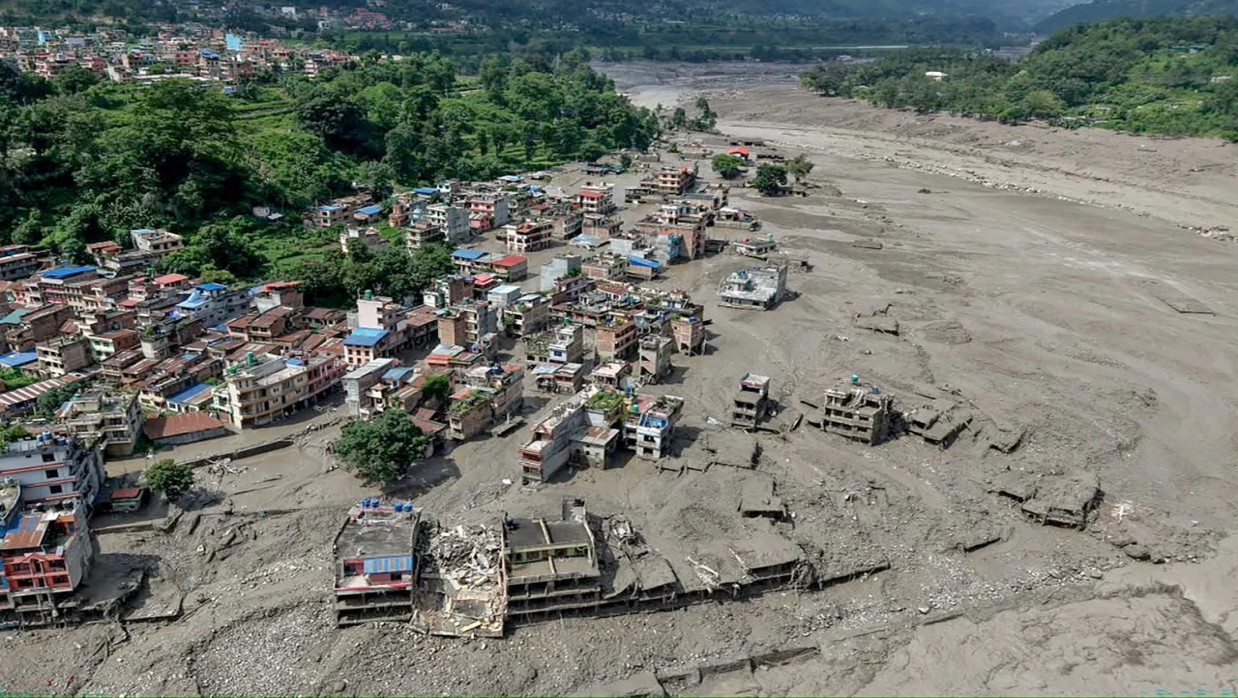
The devastating floods that struck Nepal on 26 August 2026 have evolved from a humanitarian catastrophe into a test of regional cooperation, climate diplomacy and cross-border disaster management. An ice-rock and glacial collapse near Nepal’s border with China sent a wall of water, mud, boulders and debris through the Bhote Koshi-Trishuli river system. Nepal’s Department of Hydrology and Meteorology (DHM) reported that ice and debris temporarily blocked the river approximately 20 kilometres upstream of the Miteri Bridge, creating a natural lake that subsequently burst and intensified downstream flooding. By 8 September, approximately 1,399 people had reportedly died across Nepal and China’s Tibet region, while more than 5,400 remained missing.
The disaster also highlights a wider climate inequality. According to data shared by the World Bank, Nepal contributes only around 0.1 percent of global greenhouse-gas emissions, yet remains highly vulnerable to climate-induced floods, landslides and glacial hazards. Climate change has therefore evolved into a global concern that transcends national boundaries and requires collective attention, shared responsibility and sustained international cooperation. However, instead of encouraging regional cooperation, the humanitarian disaster was quickly politicised, with some actors using the crisis as a pretext to level unverified accusations against neighbouring states and malign their image before the scientific causes of the flooding had been established.
Cross-Border Disaster Inflicted Heavy Losses on Nepal and China
The scale of destruction across Nepal and China has been unprecedented. A preliminary Rapid Damage and Needs Assessment (RDNA) found that approximately 7,570 houses, affecting 32,933 people, and 48 government offices had been affected in Nepal. Around 55 kilometres of roads, 37 motorable bridges, 68 suspension bridges, 1,806 hectares of agricultural land and 13 hydropower projects were also damaged, affecting about 783 megawatts of hydropower capacity. A separate official estimate put direct losses at approximately USD 2.56 billion. China also suffered significant destruction in Gyirong in Tibet, including at the China-Nepal border crossing used for trade and the Kailash Mansarovar pilgrimage. Reuters reported on 6 September that 43 people had been confirmed dead and 519 remained missing on the Chinese side. The five-storey Chinese customs building and other infrastructure at the once-busy Gyirong land port were swept away or buried under mud and debris. The disaster therefore struck not only human settlements, energy, transport and trade networks in Nepal, but also inflicted substantial human and material losses in China, underscoring its character as a truly cross-border catastrophe.
Incorrect Attribution Deepened Political Suspicion
The cause of the disaster nevertheless became politically charged almost immediately. On 27 August, India-based NDTV questioned whether the collapse of a temporary natural debris dam near the China-Nepal border had contributed to the flooding and whether an earlier warning from China could have reduced downstream losses. The report initially described the flash flood as having “originated in Tibet”. On the same day, another Indian media outlet, India Today, in a report titled “Ticking Chinese Bomb Near India”, linked the Nepal floods with wider Indian concerns over China’s Medog Hydropower Station on the Yarlung Tsangpo. Similarly, The Times of India also reported on 5 September that the disaster had renewed Indian concerns regarding the Medog project, hydrological data-sharing and downstream water security.
Uncertainty was also reflected in early US media reports and assessments. On 28 August, The Washington Post cited Nepalese police referring to a “burst water dam on the Tibet side of the border”, although the location and nature of the reported structure remained unclear. China-focused interpretations also appeared in a commentary published in The Hill, arguing that infrastructure development in Tibet may have intensified downstream impacts. However, the article itself acknowledged that the ice-rock avalanche originated from the Nepalese side. Available scientific assessments have not established that Chinese hydropower or other infrastructure triggered the disaster, making such attribution premature, unverifiable and incorrect.
This framing by Indian and sections of the US media assessments politicised the disaster before its scientific causes had been established. On 28 August, the United States Geological Survey (USGS) assessed that the catastrophe was likely triggered by rapid slope failure involving a glacier in Langtang National Park in Nepal, near the Chinese border. The resulting debris flow and flooding travelled nearly 100 kilometres and generated seismic energy equivalent to a magnitude 5.2 earthquake. USGS also stated that it remained unclear whether the initial failure was a landslide incorporating part of a glacier or a glacial collapse. Nevertheless, the USGS assessment directly contradicted earlier speculations that the catastrophe had originated from the failure of a Chinese dam or other Chinese infrastructure. This subsequent scientific evidence therefore significantly undermined the China-centric framing adopted by certain media outlets in the US and India. This irresponsible conduct during sensitive humanitarian crisis reinforced the need to establish verifiable and reliable mechanism to find causes of cross-border disasters through scientific assessment.
Beijing strongly rejected allegations that it had failed to warn Nepal or that a natural geological dam on the Chinese side had caused the disaster. On 3 September, China’s Ministry of Foreign Affairs stated that the China Meteorological Administration had established direct contact with Nepal’s Department of Hydrology and Meteorology and was sharing meteorological information in real-time, while China’s Ministry of Water Resources continued to provide hydrological monitoring, early-warning and forecasting information. On 27 August, the Ministry had also warned Nepal that a newly formed barrier lake near the confluence of the Chhochen Khola and Purepu Tsangpo rivers faced a high risk of breaching. These exchanges do not remove the need for stronger transparency and institutionalised early-warning mechanisms,
Collaborative Disaster Relief Across Regional and International Actors
China, meanwhile, responded to the disaster on its own territory while also extending substantial humanitarian and financial assistance to Nepal. Beijing provided USD 2 million in emergency cash, while the Red Cross Society of China contributed an additional USD 200,000. Chinese rescue personnel, relief supplies and technical support were also deployed. Foreign Minister Wang Yi described the incident as the most serious cross-border disaster between China and Nepal in recent years and emphasised the need for a coordinated response. Significantly, Beijing’s response remained centred on rescue, relief, information-sharing and joint disaster management rather than turning the crisis into a wider political dispute. In this respect, China’s approach demonstrated how regional powers can protect their interests while keeping humanitarian cooperation at the center of diplomacy.
Subsequently, India also dispatched approximately 95 tonnes of relief supplies and deployed 54 rescue, forensic and medical specialists. When Nepal’s Foreign Minister Shisir Khanal later called for climate compensation from major greenhouse-gas emitters, including India, China and the US, India’s Ministry of External Affairs described climate change as a common global challenge rather than engaging in attribution or counter-accusation.
The wider international response also reinforced this cooperative dimension. Pakistan dispatched approximately 100 tonnes of relief supplies, while the United Nations, European Union, World Bank, Asian Development Bank and Red Cross mobilised support. Nepalese authorities reported that the country had so far received assistance from more than two dozen states and multiple international organisations. Such assistance demonstrates that humanitarian crises can still create space for practical cooperation even where wider strategic differences persist.
From Peaceful Coexistence to Converging Diplomatic Visions
The cooperation witnessed during the Nepal floods did not emerge in a diplomatic vacuum. China and India have historically developed principles intended to manage differences while preserving space for cooperation. Most notably, the Five Principles of Peaceful Coexistence, also known as Panchsheel, were jointly articulated by China and India in 1954. These principles called for mutual respect for sovereignty and territorial integrity, mutual non-aggression, non-interference in each other’s internal affairs, equality and mutual benefit, and peaceful coexistence. They were intended to provide a foundation for relations between states with different political systems and national interests.
China has continued to place these principles at the center of its foreign policy approach. President Xi Jinping has further developed this logic through the concept of building a “Community with a Shared Future for Mankind.” The concept emphasises that growing global interdependence requires states to move beyond zero-sum competition and pursue common development, mutual benefit, peaceful coexistence and collective responses to transnational challenges. It also stresses sovereign equality, greater coordination in global governance and the need to address shared challenges through cooperation rather than confrontation. In this sense, the concept expands the traditional principles of peaceful coexistence towards a broader vision of international cooperation based on shared interests and responsibilities.
India has projected itself as a leading voice of the Global South through its “Voice of Global South” initiative. However, a gap between diplomatic rhetoric and regional practice remains visible, particularly when irresponsible commentary from sections of Indian media and officials deepens distrust during humanitarian crises. India’s role as a major regional power will depend on translating its stated foreign policy vision into practical cooperation with its neighbours. The recent Xi-Modi meeting offered a more constructive direction, with India reaffirming its independent foreign policy and both sides agreeing to approach relations strategically, expand mutually beneficial cooperation and treat each other as partners rather than rivals.
The Nepal floods demonstrate how these diplomatic principles can acquire practical relevance. Environmental and humanitarian threats across the Himalayas transcend national borders and cannot be addressed effectively through unilateral approaches. Greater cooperation in hydrological data-sharing, climate adaptation, disaster preparedness and early-warning mechanisms would therefore not only serve Nepal’s immediate interests, but also provide China and India with an opportunity to translate their respective diplomatic visions into practical and mutually beneficial regional cooperation.
Translating Diplomatic Consensus into Practical Cooperation
During President Xi Jinping’s visit to New Delhi for the 18th BRICS Summit on 12-13 September 2026, he placed China-India relations within a broader vision of cooperation among emerging economies and the Global South. Addressing the BRICS Summit, President Xi called on member states to jointly shoulder greater international responsibility and strengthen cooperation in development, peace and security, exchanges among civilizations and global governance. He emphasised innovation-driven development, common and sustainable security, greater representation of developing countries in global governance and stronger communication and dialogue to manage differences. President Xi further argued that BRICS countries should seek common ground while properly handling disagreements and work together towards a more just and equitable international order and a community with a shared future for humanity.
These broader principles were also reflected in President Xi’s bilateral meeting with Prime Minister Narendra Modi on 12 September. President Xi outlined four priorities for the future of China-India relations. (i) maintaining an objective and rational strategic perception of each other; (ii) pursuing win-win cooperation and common development; (iii) managing differences through mutual respect and understanding; (iv) and strengthening coordination in multilateral institutions. Significantly, President Xi stated that China and India should view each other as partners rather than rivals and as development opportunities rather than threats. Prime Minister Modi similarly emphasised mutual respect, mutual sensitivity and mutual interest, while both leaders agreed to expand common ground, strengthen economic and people-to-people exchanges and prevent differences from becoming disputes.
The convergence in these statements provides a positive basis for the future direction of China-India relations. Both sides increasingly recognise that stable bilateral relations, mutually beneficial cooperation and effective management of differences serve not only their respective national interests, but also the interests of the wider Global South. The challenge will be to translate this emerging diplomatic consensus into sustained cooperation in areas where interests clearly converge, including climate adaptation, transboundary water management, disaster preparedness and regional development. The Nepal floods demonstrate that such cooperation is not merely desirable, but increasingly necessary for building a more stable, resilient and mutually beneficial regional order.
Conclusion
China and India therefore have an important opportunity to translate their growing convergence of diplomatic principles into practical cooperation. The Five Principles of Peaceful Coexistence, China’s vision of building a Community with a Shared Future for Mankind and India’s emphasis on mutual respect, mutual sensitivity, mutual interest and cooperation among the Global South provide substantial common ground for advancing a more stable and mutually beneficial relationship. The next step should be the concrete implementation of these principles through sustained cooperation in areas such as disaster management, early warning, climate adaptation, transboundary water governance and regional development. At the same time, sections of Indian media should exercise greater responsibility and refrain from publishing speculative narratives that may unnecessarily foster antagonism or deepen mistrust between the two countries, particularly during humanitarian emergencies. A more constructive media environment, combined with sustained political dialogue and practical cooperation, can help China and India cultivate an atmosphere of peace, friendship and mutual confidence. Such an approach would not only strengthen bilateral relations, but also contribute to greater stability, development and shared prosperity across the Himalayan region and the wider Global South.

0 Comments
LEAVE A COMMENT
Your email address will not be published