

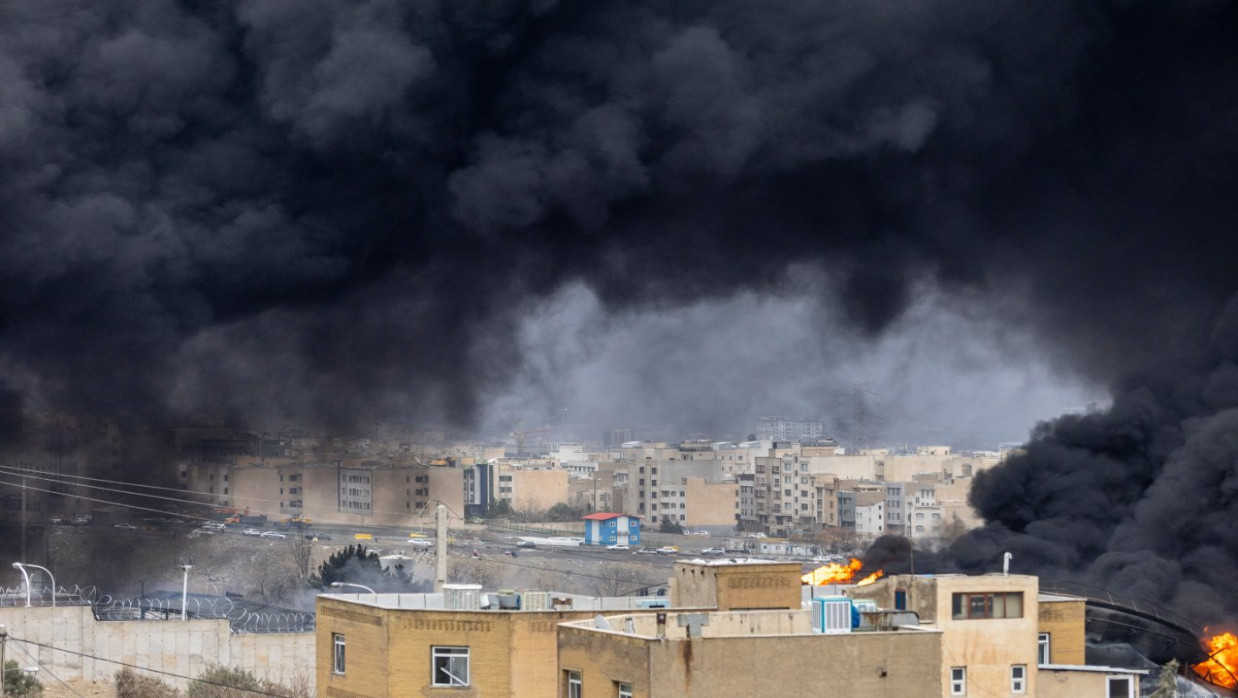
Continuation of the United States-Israel-Iran war only suggests that chances of it spelling an easy victory for President Donald Trump and his allies may be viewed as having been stifled. Rather its continuity can from no longer be viewed as exercise of strong strategies by US-Israel against Iran. The hard fact that it is continuing and has failed to “crush” Iran swiftly, as apparently expected by Trump and Benjamin Netanyahu is visible to all. What cannot also be missed is that this is not simply United States’ war against Iran but that Trump (along with his son-in-law) appear to have given a little too much importance to Netanyahu’s design to target Iran. Well, Iran has certainly been targeted and is facing the attacks continuously. As desired by two Trump-Netanyahu, Iranian Supreme Leader Ali Khamenei has been assassinated. However, the sense of “victory” and “celebration” felt because of this cannot be said to have hardly lasted. Khamenei’s assassination has not led to any uprising within Iran against his government. The interim government appears to have taken over smoothly without their being any visible or even symbolic sign of any internal disruption/chaos. Subsequently, Mojtaba Khamenei has been named as Iran’s new Supreme Leader. Trump and Netanyahu have been taken by not just surprise but probably shock at these developments.
The two, Trump and Netanyahu, had apparently assumed their role to be that of master strategists and an easy gamble. If in Trump’s calculation, war against Iran seemed as simple as was capture of Venezuelan President Nicolas Maduro, Netanyahu probably viewed it similar to frequent strikes against Palestinians, Lebanon and other areas. What probably was overlooked or deliberately not considered seriously that Iran’s “weakness/strength” cannot be equated with that of Lebanon and other areas, apparently considered easy targets by Netanyahu. This has to a degree been already marked by Iran’s strikes against Israel and US bases in the Gulf region.
Undeniably Iran’s decision to strike at US Embassy in Riyadh (Saudi Arabia), US bases, oil refineries, etc. in Bahrain, Kuwait, Oman, Qatar, UAE and other places has apparently raised several key questions. Of these, perhaps the most prominent is whether Iran has acted wisely or not? There is the view that this move is leading to it being isolated and losing their support. The scenario is a fairly complicated one. Undeniably, Iran has earned diplomatic criticism for having included these countries in its strikes as retaliation to war initiated against it by US and Israel. It’s being deliberated whether these countries would in response to their being hit by Iran choose to turn against it diplomatically and militarily, and choose to support US and Israel. If this happens, the entire region is likely to witness flames, chaos, turmoil and so forth.
Chances of this turn taking place may be viewed as extremely limited. Just as these countries are not pleased at being targeted by Iran, they may also be viewed as being fairly annoyed at being literally ignored by Trump. Yes, this refers their being against war, having urged diplomatic dialogue between US and Iran. In fact, it seemed that they were being given some importance as talks were held between the two sides in Geneva (Feb 26). But this was short-lived as just a couple of days later US-Israel strikes began against Iran (Feb 28). It is fairly well-known, Netanyahu was never in favor of United States’ peace/talks with Iran. These were disrupted last year with Israel launching a strike against Iran, US moved in and this led to 12-day war in June.
Notwithstanding their grievances against being hit by Iran, chances of Arab countries supporting US-Isreal against it may be viewed as limited. If Israel was not engaged in the war, the scenario would have been different. But as of now, they do not wish to be considered as an ally of Israel. Besides, as mentioned earlier, they are fairly agitated at their diplomatic stand having been ignored by Trump. They may exercise diplomatic moves so that Trump takes serious steps to end the war. As of now, he doesn’t seem inclined towards this. In less than a week, the war has certainly cautioned Arab countries of the degree to which they can trust United States on their own front. Besides, now, they are well aware of the need to enhance their own strength without banking too much on United States.
Paradoxically, Trump has perhaps not yet given much importance to his having taken the risk of alienating his Arab allies by yielding to Netanyahu’s desire of targeting Iran. Trump might have assumed that his western allies will not give a second thought to supporting US-Israel’s war against Iran. This is not really the case. This also implies diplomatic command presumed to be held by Trump over his once-committed supporters/allies appears to have lost its weight. Spain has categorically ruled out use of its military bases for United States’ strikes against Iraq. Spanish Prime Minister Pedra Sanchez has categorically stated, “No to war,” citing several reasons. Spain does not want to repeat mistakes of the past and be dragged into a war in Middle East as it was against Iraq to remove Saddam Hussain. He has said “no to violations of international law” and “no to illusion” that “world’s problems can be solved with bombs.”
Ironically, since he has assumed power for the second term, most moves of Trump have not been welcomed by his allies. These include his tariff-war, the Alaska Summit (with President Vladimir Putin), desire to annex Greenland, include Canada as 51st US state and now the US-Israel war against Iran. US-Israel began the war against Iran guided probably by the assumption that the latter was no match for them and would be swiftly done away with as desired by them. The fact that last year’s war lasted for 12 days in June should have probably cautioned them about crushing Iran not being as easy as they probably assumed it to be. Besides, the fact that nature of Iran’s response has contributed to adverse impact in Israel as well as neighboring countries cannot be ignored. Economically, practically the whole world can be expected to suffer from the war, not just for how long it lasts, but most probably for a substantial period even after the warring parties cease to be engaged in conflict. From no angle, this war is likely to add to diplomatic credentials of Trump and Netanyahu. The nature of its negative impact is going to strongly restrict it being viewed as a victory for any party in the field. Yes, Iran is least likely to win the war. But the longer the war lasts also exposes the weaknesses of strategies being exercised by US-Israel against Iran!

0 Comments
LEAVE A COMMENT
Your email address will not be published