

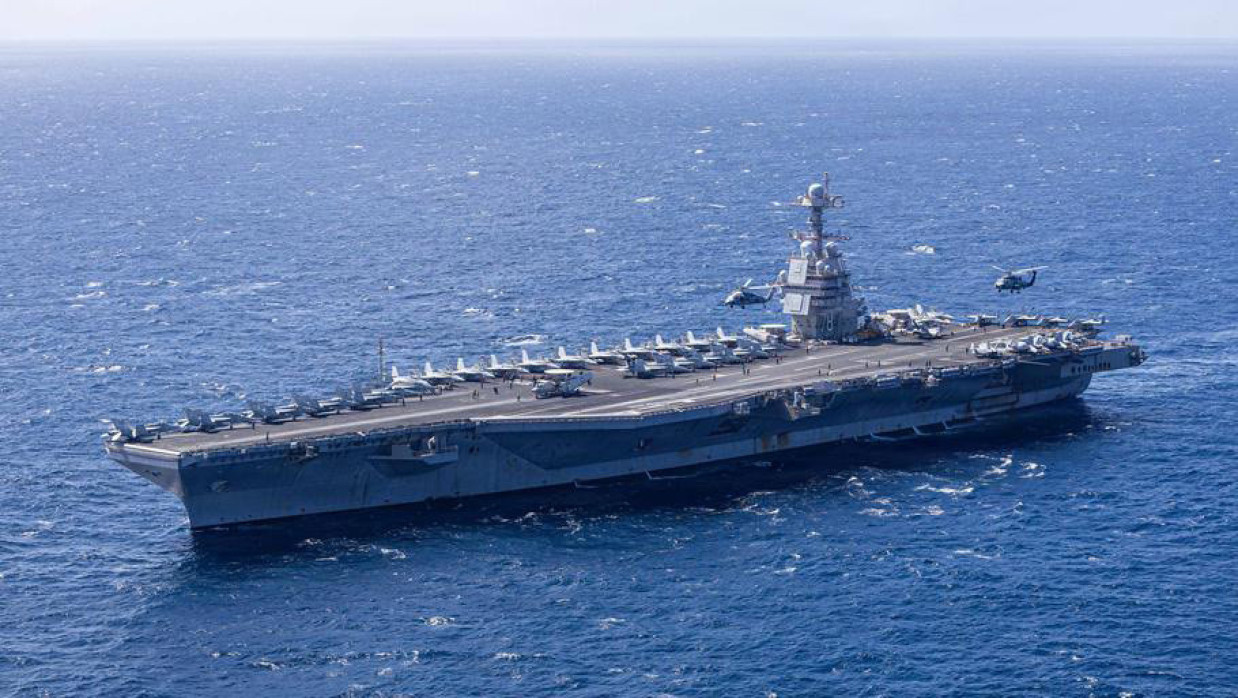
Tensions are mounting in the Persian Gulf once again. The U.S. is mobilizing military assets throughout the region at the largest count publicly known since the Iraq invasion of 2003. From aircraft carrier strike groups to bombers with long-range capabilities, missile defense systems, and logistical vessels, forces are shifting to positions within striking distance of Iran. But few in America are paying attention. There are ample distractions at home, and the horizon abroad grows dim quietly.
Hours before the U.S. increased its own presence in the Persian Gulf, Indian Prime Minister Narendra Modi was giving a speech in Jerusalem. He received a standing ovation from the Israeli Knesset. He posed for pictures in smiling embraces with Benjamin Netanyahu. The optics were clear. The timing was even clearer.
These two stories are connected. When we see the potential for a U.S.–Iran war brewing and Indian Prime Minister Narendra Modi pledging solidarity with Israel in the most public of ways, we have to start looking past questions of war and peace. We need to ask what kind of power everyone wants.
The Military Buildup and Trump’s Reluctance
President Donald Trump has said two things consistently: Iran should never get nuclear weapons, and he doesn’t want war; he wants to negotiate. “Endless wars” are what Trump brands himself against, chief among them the quagmire in Iraq that spanned two whole administrations and two decades.
Iran isn’t Iraq in 2003. It has 90 million people and a missile program capable of striking Israeli cities. War would be far more complicated on all fronts. Intel from open-source analysis suggests America’s supply of bombs is exhausted from years of fighting multiple conflicts. Its factories cannot churn out air-to-ground missiles like they used to. Washington could come out of a short, bloody war severely limited in its options to respond to actions in Taiwan or Eastern Europe for years to come.
Americans themselves may not even want a war with Iran. Recent polling shows only about a third of Americans support military action against Iran. But once troops are mobilized, they generate their own political inertia. The risk isn’t that Trump starts a war. It’s that someone else does, or that a series of events escalates out of control.
Netanyahu’s Calculus and the Iran Question
For Israeli Prime Minister Benjamin Netanyahu, Iran represents the ultimate strategic rival. For three decades, he has warned that Tehran is on the verge of acquiring nuclear weapons. Whether imminent or not, the Iranian threat has become central to Israeli political doctrine.
Israel’s strategic objective is clear: maintain regional military supremacy as the Middle East’s sole nuclear-armed power. Eliminating or crippling Iran’s capabilities would consolidate that dominance. It would also reshape the regional balance, weakening rival power centers from the Levant to the Gulf.
Some Israeli strategists openly discuss long-term visions that extend beyond security ambitions of expanded influence across fractured Arab states. The concept of a “Greater Israel,” once confined to ideological margins, has resurfaced in certain religious-nationalist circles.
The current U.S. ambassador to Israel, Mike Huckabee, has publicly expressed views sympathetic to expansive biblical interpretations of Israeli territorial destiny. While official U.S. policy remains formally committed to diplomatic solutions, the rhetoric in Washington has become increasingly aligned with hardline Israeli narratives.
Congress, Media, and the War Narrative
Trump might balk, but there are also hardcore interventionists in Congress. Senator Lindsey Graham has never met an Iranian military action he didn’t like. Hawkish media figures like Mark Levin spin up nuclear nightmare scenarios with the scantiest evidence.
And objective reporters of all ideological stripes tend to end up defending regime change at some point. The examples of humanitarian rationales for war in Vietnam, Iraq, and Libya offer object lessons about how the humanitarian case and nuclear scaremongering can lead to war.
If we did end up going to war with Iran, however, it would not look anything like those wars. Iran has a significant arsenal of ballistic missiles that it could use to overwhelm defenses in the region. Israeli cities would be under bombardment. American forces in Iraq, Syria, and the Gulf would be targeted. War could threaten the Strait of Hormuz, through which much of the world’s energy supplies flow, sparking oil price shocks and global recession.
The Western economy isn’t in great shape to begin with. Oil prices worldwide would skyrocket. Europe would face an influx of refugees if Iran collapsed. Saudi Arabia and other Gulf states could face upheaval.
Modi’s Jerusalem Moment
Against that fiery backdrop, Narendra Modi’s speech to Israel’s parliament couldn’t have been more notable.
The optics were powerful: A standing ovation. Selfies with politicians. Even the Speaker’s Medal, which he is the only world leader to receive.
Modi cozied up to Netanyahu at a moment when Western leaders have stayed away from Israel over its continuing crackdown and looming war crimes investigations.
For years, India quietly shifted its approach to Israel. New Delhi went from championing Palestinian statehood and acting as a non-aligned country to becoming Israel’s largest defense customer. India buys billions of dollars' worth of Israeli military hardware every year. Missile defense shields, drone factories, and intelligence coordination now closely link the two countries.
But timing is everything, too.
A Strategic Triangle: Washington, Jerusalem, and New Delhi
Israel’s relationship with Washington remains central, yet tensions occasionally surface beneath the surface of the alliance. If Israel were to strike Iran unilaterally, the United States could be dragged into conflict regardless of presidential hesitation.
Here enters India.
Israel has signaled interest in deeper strategic alignment with India as part of a broader geopolitical realignment. India’s growing military and technological capacity make it an attractive partner. Modi’s visit may signal Israel’s hedging strategy: diversifying alliances in anticipation of an uncertain American future.
For Modi, the gains are defense contracts, intelligence sharing, and entry into American power corridors. Indian political analysts have also heard rumors that Modi’s access to previous Washington powerbrokers came via figures close to Israel’s political elite. Whether true or not, the fact that such rumors exist speaks to a general belief: Access to Israel can lead to access to America.
Some will read Modi’s love-fest as cozying up to the warmongers in Washington. Or a savvy way to keep everyone kissing his ring.
The Catastrophic Scenario
War would have consequences far beyond Iran and Israel. Iran would attack oil targets in the Gulf, American bases, and Israeli cities. Missile defenses would struggle to cope with prolonged salvos. Oil markets would plunge, taking the world economy with them. China and Russia would quickly adjust their positions, whether diplomatically or materially.
While no one knows what would happen if the regime in Tehran were overthrown, Iran itself would likely fall into ethnic strife, refugee crises, and terror power vacuums. The Middle East, already shattered by wars in Iraq and Syria, would be thrown into further turmoil.
Israel would reach its objectives, but at a catastrophic cost to the region. Western economies, reliant on Gulf oil, would pay a heavy price.
Influence and Sovereignty
Critics also feel that Israel has too much influence over American foreign policy. It's common in hyperbolic political discussions to hear the phrase "Netanyahu runs Washington." The relationship remains strong and bipartisan, but also more divisive than ever. Trump is between a rock and a hard place. He wants to prevent an apocalyptic war but risks reelection repercussions from Congress, media hysteria, or perhaps Israeli unilateral military action. Being "backed against the wall" could result in either restraining Israel or cleaning up the damage.
The Broader Moral Question
It is true that Delhi has reasons of its own to be aligned with Jerusalem. But Israel’s moment comes at a reputational cost for India. India has millions of non-resident Indians living in the Gulf. India once claimed to lead the Global South because it could claim moral distance from great-power politics.
In acting as he is, Modi is signaling confidence in his country’s growing strength and a break with the past. He is also signaling that we now live in a world where India will put its interests first, even if it means crossing a red line that existed for most of our post-independence history.
Will there be war with Iran?
There will be if the Americans want there to be. And it’s not inevitable. Let’s not close down the diplomatic track yet. Iran is not a unitary actor; neither are we. Negotiation is hard, but still the best option.
History, however, reminds us that once these bullies send their boys in tanks rolling, it’s hard to stop them.
If there is war, it will not pass. It will define the future of the Middle East. It will crack global markets. It will stretch Western democracies to a breaking point. Israel might believe it has nothing to lose. India might think it has everything to gain by standing shoulder-to-shoulder with the U.S. But the world will lose.
Only after… in Jerusalem. Will we know whether the gathering of American forces in the Gulf and Mr. Modi’s warm embrace were connected moves or turns in a much larger game?

0 Comments
LEAVE A COMMENT
Your email address will not be published