

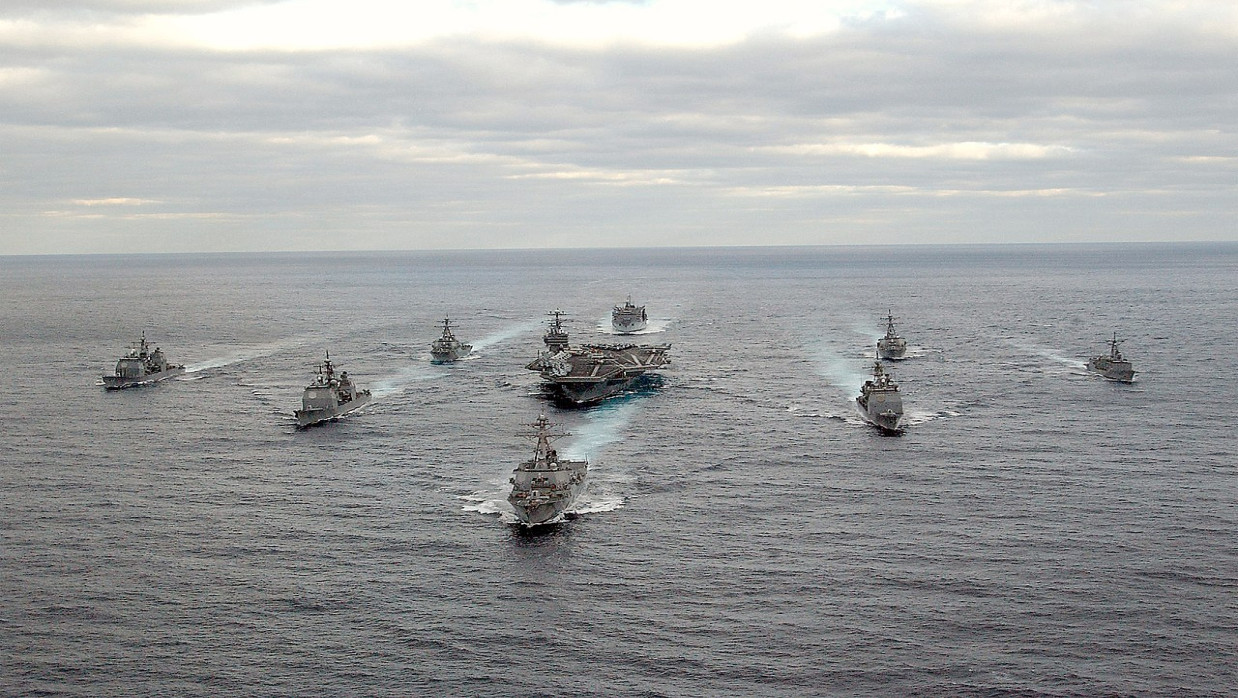
The United States, Israel, and Iran stand at a delicate crossroads between diplomacy and confrontation. Renewed indirect negotiations in Muscat and Geneva suggest that diplomacy is still alive, yet military deployments and rhetorical escalation reveal that the possibility of conflict remains real. Understanding why Washington is confronting Iran requires a careful assessment of strategic interests, domestic political pressures, and the evolving Middle Eastern geopolitical landscape. Equally important are the long-term consequences should diplomacy fail and war erupt.
Why Is the United States Confronting Iran?
One, because we can. Okay, not really. American foreign policy is determined by a variety of strategic, political, and security interests. The notion that everything US does is because of some nebulous pro-Israel/Zionist/Jewish lobby in this country is simply wrong.
Ok, now that the easy joke is out of the way.
Here are some reasons why the US picks on Iran:
The US sees Iran as a potential long-term strategic threat to its interests in the Middle East. Iran's nuclear program, ballistic missile program, and proxies throughout the region (Iraq, Syria, Yemen, Lebanon, etc.) don't contribute to the stability of the region and threaten our allies. Ever since the British ruled the region, the United States has sought to contain any hostile power in the Persian Gulf. Iran threatens that.
Israel sees Iran as a threat to its existence. Iran must not obtain nuclear weapons, and Israel will push us to keep pressure on Iran as best we can. Keep in mind that Israel isn't the only country with troops/stations/allies throughout the Gulf region. Iran threatens the Strait of Hormuz, which gives it leverage over the US.
The Strategic Stakes for Washington
First, from Washington’s point of view, even if Iran were only allowed to reach nuclear weaponization capability, there is no guarantee that others in the region will not seek the same capability. Saudi Arabia is the most obvious country that would seek nuclear weaponization capabilities should Iran be allowed to do so. Turkey and Egypt are other regional powers that could follow suit. Washington does not want a nuclear arms race in the Middle East, as that would further embolden states that have nuclear weapons and degrade America’s standing while making nonproliferation much more difficult throughout the world. Second is Iran’s closer alignment with China and Russia. While this relationship is more transactional than ideological, it still deepens ties between China, Russia, and Iran. A growing and emboldened Iran tied to China and Russia is something Washington wants to avoid, as it would challenge America’s position of primacy in Eurasia and the Middle East. Therefore, the Iran standoff is a combination of deterrence, entanglement, and great power competition, not simply a single domestic or ideological concern.
Scenario One: Successful Negotiations
Description: Negotiations result in an acceptable agreement to both sides.
Best Case: The final deal is modeled after previous nuclear agreements. Iran limits its uranium enrichment and allows inspectors back into the country in exchange for limited sanctions relief. Iran could also agree to limits on missile development and production.
Neither side would emerge happy, but it would prevent escalation for the medium term and reward Trump and Zarif with domestic victories. Sanctions relief would help the struggling Iranian economy rebound and bring investment back into the country. Iranian oil would resume steady flows, giving the regime valuable capital. This would also allow Trump to claim victory and avoid another foreign war.
Worst Case: The deal falls apart after cheating accusations. The deep mistrust between Iran and the U.S. would never fully disappear. Iran previously withdrew from the agreement and restarted nuclear development. Israel and Gulf countries would also view any agreement with suspicion and remain on the lookout for cheating.
Success would lead to Iran gradually returning to the international community as its economy recovered. There would always be friction with the United States, but the Iran we know today would continue on largely unimpeded. Iran could become a regional power and would unlikely become friendly with the United States, but it would be less volatile.
Scenario Two: War
Description: Talks break down, and military action is used.
Best Case: Any Iranian military action is limited to retaliation after the conflict begins. Once the initial bombing campaign is over, Iran undertakes no further regional aggression. Here, the United States and Israel attain overwhelming air superiority and rapidly degrade Iranian military capacity.
Iran has limited options to seriously challenge American forces. Iran could attack U.S. bases in Iraq with missiles. Iran-backed militias would likely attack U.S. forces in Iraq and Syria. Iran would likely try to close the Strait of Hormuz, but such action would further cut off Iran from international trade.
Worst Case: Expect the other side of the best case. Iran ramps up its aggression, and the intensity of attacks increases. Proxies are sent into Israel and across the region to strike at U.S. interests. The war would escalate, and other countries would intervene across the region.
The long-term outlook after the war would likely be bleak for everyone involved.
- Expect Iran to survive. Given that Iraq and Libya had sizable American military footholds prior to UN operations, regime collapse is unlikely. At best, Iran’s government would come out weakened, causing hardship for the Iranian people.
- There is a chance that Iran could collapse in on itself if war is heavy and prolonged. The weakening economy, increasing ethnic tensions, and civil unrest would only continue to grow. Iran’s ethnic groups could begin demanding more autonomy or independence (Iranians make up approximately 51% of Iran’s total population). Baluch minorities in Eastern Iran and bordering Pakistan could attempt to secede.
- Iran will never be a vassal state of the United States. It is a proud nation with a resilient history. Even if Iran’s government were toppled, it is unlikely that America could peacefully stabilize the region.
- Everyone loses if a war erupts between Iran and the United States. The Middle East would destabilize further, hurting American allies in the Gulf and Israel. China and Russia would look to take advantage of the situation to further their own interests. There would be global energy shocks as Iran and the Gulf states are significant oil producers.
Conclusion
The sources of US-Iranian confrontation are strategic competition, regional security, and Iran's nuclear issue, and have nothing to do with achieving political goals alone. Diplomacy is always the best option, at minimal cost, that can create opportunities to reduce tensions and avoid catastrophic outcomes. However, lack of trust, competing goals, and domestic compulsions do not allow ruling out war between Iran and the US. If diplomacy works, we may witness years of unstable calm in the Middle East. If diplomacy fails and war breaks out, it is unlikely to result in a revolutionary transformation that leads to Tehran toadying up to Washington. More likely results would be a battered Iran with an emboldened regime or a more unstable Middle East.


0 Comments
LEAVE A COMMENT
Your email address will not be published