

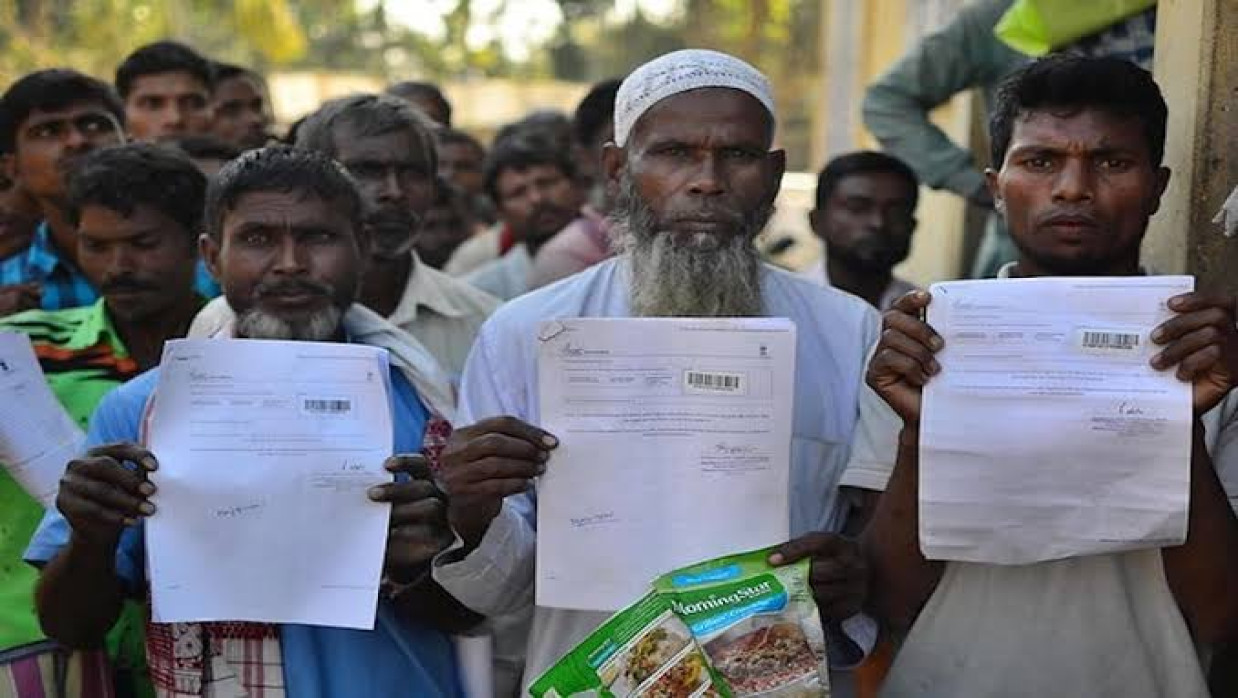
Periodic mass revisions of electoral rolls and renewed demands for citizenship verification are raising fears of disenfranchisement among India’s most marginalized groups. India boasts one of the world's largest commitments to universal franchise. Every Indian adult has an equal right to elect the nation’s lawmakers, no matter their religion, caste, gender, language, education, income, or social status. India’s elections are based on universal adult suffrage per Article 326 of the Constitution. However, exercising that right universally depends on a nation’s electoral laws and voter registration procedures.
Ensuring eligible citizens are included on electoral rolls gives that right meaning. A fierce debate over revising voter lists, along with renewed calls for a nationwide citizens’ registry, has raised an important question: could efforts to maintain and clean up government records unintentionally (or purposefully) strip citizens of their right to political representation?
The Debate Over Voter List Revisions
Opposition parties, rights groups and voting access activists have alleged that millions of Indian citizens were deleted from voter lists across several states. Claims about the total number of deleted voters have ranged into the hundreds of millions, though the Election Commission has not verified that 120 million eligible voters were removed from the rolls.
The Election Commission has yet to publish a nationwide report specifying how many voters were added or dropped from voter rolls. The absence of detailed data has increased suspicion among critics. Each year, electoral rolls are adjusted to account for deceased voters, those who have moved and registered to vote in a new location, and duplicate voter registrations. Keeping rolls current is important. But with a population of more than 1.4 billion, even small discrepancies can mean millions of people.
The critical issue is not whether electoral rolls should be updated, but whether the process provides adequate notice, verification and opportunity for appeal before a citizen’s name is removed.
Reports from Bihar, West Bengal and other states have generated particular concern. The Election Commission has maintained that revision exercises include mechanisms through which eligible citizens may file claims and objections. It also states that a person omitted from the roll may seek registration through Form 6. Yet these remedies assume that the affected individual knows about the deletion, possesses the required documentation, and has sufficient time and ability to navigate the administrative process.
Those assumptions do not apply equally to every Indian.
Unequal Burdens of Documentation
People most vulnerable to erroneous exclusion are often least equipped to correct it. Migrant laborers, daily-wage workers, homeless citizens and residents of informal settlements may change addresses frequently. Poor and illiterate voters can struggle to understand notices or complete application procedures. Dalits, Adivasis and religious minorities may encounter additional social and institutional barriers.
Women bear the brunt of this problem uniquely. Marriage often involves changing both address and surname or house number. This could cause a woman to disappear from the rolls in the place where she once lived, without being added to the rolls in her new residence. Older women and those in rural areas may also lack a birth certificate or school leaving certificate, or have no documents with uniform names and dates.
Technology can make rolls more efficient, but will reinforce existing biases if deployed improperly. Algorithms tasked with digitally matching identities could falsely flag citizens whose names show variation across documents. Name variation may stem from transliteration between Indian scripts and English. Software that helps databases “deduplicate” could wrongly merge two citizens into one record, while interlinking identity systems can create bureaucratic errors that citizens struggle to trace or refute.
The Election Commission has maintained that Aadhaar submissions for electoral roll purposes are voluntary and that no person can be removed from the rolls just for failing to supply one. That commitment should be closely guarded.
Citizenship vs Voting
The renewed push for a National Register of Citizens further complicates matters. While an electoral roll specifies who can vote in a particular constituency, an NRC is supposed to record who is a citizen. The two serve different functions and are governed by different laws, and should not be confused.
Still, both rely extensively on paperwork and executive discretion. Mistakes in either registry can be devastating.
The NRC in Assam was conducted under the Supreme Court's watch. Its updated registry, published in August 2019, left out over 1.9 million claimants. Omissions did not automatically render someone a foreigner. Individuals could (and do) challenge the order through due process of law. But the list has been embroiled in political and legal disputes ever since, and the Registrar General of India has stopped short of publishing it as the final state register required to trigger a national NRC.
Former Assam NRC State Coordinator Hitesh Dev Sarma has submitted a plea to the Supreme Court calling for a fresh, time-bound, complete statewide reverification of Assam’s overclaims that ineligible people have been included in the register while eligible people have been left out. The claims have not been verified. Supreme Court asked the Center and the Assam government to respond to pleas filed over pending issues related to Assam’s NRC last month, in August 2026.
The Comptroller and Auditor General recently released a report highlighting procedural and financial irregularities in Assam’s NRC update. From suspicious payment trends to incomplete developmental audit of the Verification software to dubious payments made to the system integrator, the Audit finds flaws at multiple levels. The courts will rule on larger legal questions around India’s National Register of Citizens. But until then, this shows that such exercises must meet the highest auditing standards when people’s rights are on the line.
Operations in Manipur
Communities in Manipur fear that a similar pattern of exclusion could emerge if an NRC exercise is undertaken in the state. Manipur has endured prolonged ethnic violence between the Meitei and Kuki-Zo communities since May 2023. Civil-society organizations and political parties supporting an NRC have demanded that the register be updated before the 2027 Census and any subsequent delimitation of constituencies. They argue that unauthorized migration—particularly from Myanmar amid its continuing civil war could alter the state’s demographic composition and political balance.
Numerous Kuki-Zo organizations have rejected this purported order on grounds that a citizenship updating exercise conducted in the middle of widespread displacement and soaring ethnic tensions risks leaving their community vulnerable. The apprehensions raised are certainly valid. Hundreds of thousands of people in Manipur have fled their homes since violence broke out in May 2023. Documents like identity cards, land deeds, and much else may not be easily producible by families who’ve been forced to flee with whatever they could carry, and whose homes may have since been damaged, destroyed, or otherwise rendered inaccessible. Insisting on documentary evidence of citizenship right now would mean further victimizing those affected.
Not a census; an NRC is different. Delimitation isn’t the electoral roll either. All 3 decide who gets to live in this country, who votes, who represents you in government. Blur them, and you turn lines on papers into weapons of ethnic rivalry.
In India’s fractured northeast, transparency is the best safeguard against such a scenario.
Baselines
First, India could benefit from stronger baselines around its electoral rolls. How many citizens are currently missing from rolls? What barriers do Registrars encounter while trying to bring latent voters to the rolls? While not perfect, publicly available deletion data could help answer those questions.
India will need to change its electoral rolls. We have proof that people are trying to manipulate the electoral rolls by adding voters where they're not eligible to live. However, revision isn't deletion. Sweeping away the “ineligible” entries won't magically cleanse India.
Offering Dropout Data
Prior to deleting names from the electoral rolls, authorities should: a) afford reasonable notice and a published explanation of the grounds for deletion to affected persons, and b) provide an inexpensive mechanism to challenge such deletions. The Election Commission should publish deletion statistics in bulk, by constituency, gender and such other information as is permissible by law. If community organizations suspect that certain groups are being disproportionately impacted, they should be allowed to independently verify these claims. In sensitive areas, the SRC should consider special measures to protect the voting rights of displaced communities.
Administering elections is not merely a bureaucratic exercise; it directly affects citizens’ democratic rights. Deleting an eligible person’s name from the electoral roll silences that voter just as effectively as explicitly denying them the right to vote. India can and should maintain accurate electoral rolls while safeguarding every eligible citizen’s right to participate in elections.


0 Comments
LEAVE A COMMENT
Your email address will not be published