

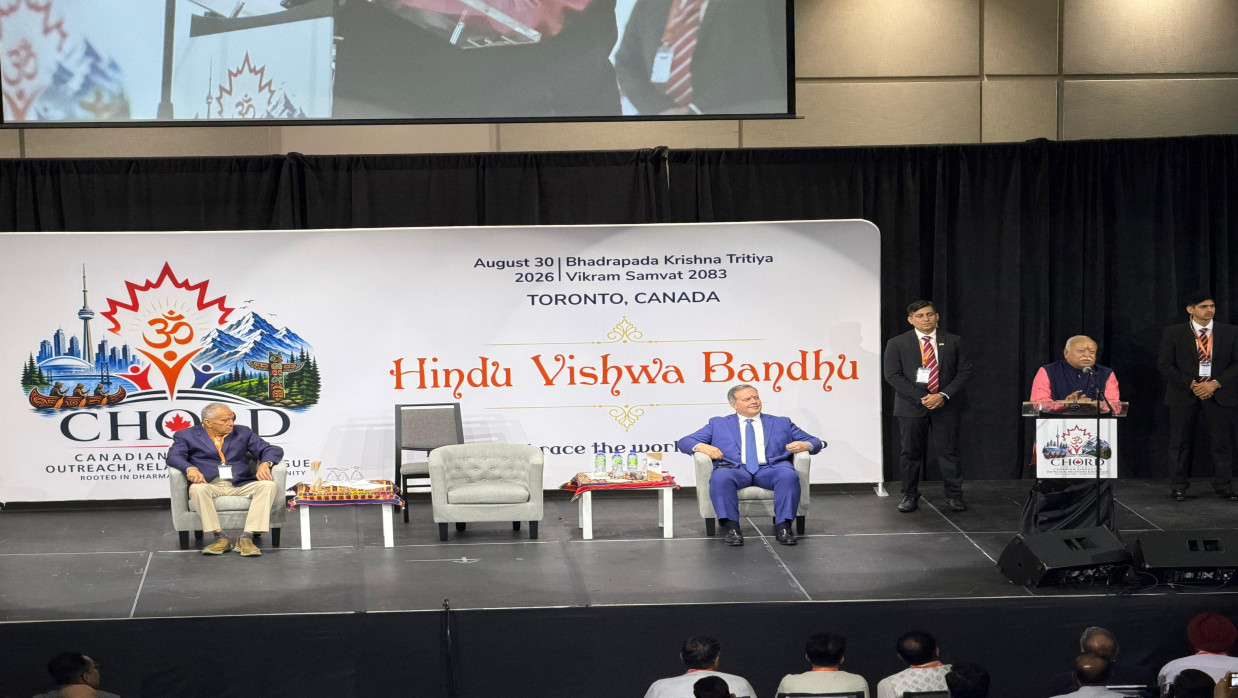
On August 29, 2026, Mohan Bhagwat, chief of the Rashtriya Swayamsevak Sangh (RSS), gave a speech at the “Universal Oneness Celebration,” held at Madison Square Garden in New York City. Bhagwat addressed thousands of people, including members of the Indian diaspora and leaders and practitioners of various faiths. Bhagwat described India as a civilization whose contribution to society is “unity in diversity,” rather than uniformity.
Bhagwat argued that diversity should be celebrated, respected, and accepted. He described the underlying unity of existence as an essential Indian civilizational principle and urged Indians abroad to honor their karmabhoomi, the land where they live and work, while retaining the values of their janmabhoomi, or birthplace.
It was an appealing message, deeply rooted in important currents of Indian philosophical thought.
But it also raises an unavoidable question: Does the pluralism Bhagwat articulates abroad correspond with the cultural nationalism the RSS promotes within India?
That question matters because Bhagwat has simultaneously advanced another proposition: that India is fundamentally a Hindu civilization and that, in a civilizational sense, everyone living in India can be described as Hindu.
The distinction may be philosophically meaningful to Bhagwat and the RSS. For many Muslims, Christians, Sikhs and other Indians, however, being told that their Indian identity ultimately falls within a Hindu civilizational category can appear less like inclusion than assimilation.
Vivekananda and the Older Tradition of Pluralism
The tension becomes clearer when Bhagwat’s position is compared with Swami Vivekananda, whom Hindu nationalists themselves frequently invoke.
Vivekananda’s celebrated appearance at the World’s Parliament of Religions in Chicago in 1893 presented Hindu civilization not merely as tolerant but as accepting of different routes to spiritual truth. His philosophy did not require Christianity to become culturally Hindu, Islam to surrender its religious identity, or Buddhism to subordinate itself to a larger political definition of Hindu civilization.
That distinction is critical.
India’s religious heritage has never been intellectually homogeneous. Vedanta, Buddhism, Jainism, Sikhism, Bhakti traditions, Sufism, materialist philosophies, and numerous regional traditions developed alongside one another, sometimes borrowing from each other and sometimes disagreeing profoundly.
India’s greatness therefore did not emerge from eliminating difference. It emerged, however imperfectly, from accommodating and surviving it.
Pluralism means more than saying that everyone ultimately belongs to one civilization. It requires allowing citizens to define themselves.
The Problem with “All Indians Are Hindus”
This is where Bhagwat’s conception of national identity becomes problematic.
In 2023, he declared that India was a “Hindu Rashtra” and said that “all Bharatiyas are Hindus and Hindus mean all Bharatiyas.” In February 2026, he returned to this theme, describing Hindu as an adjective expressing India’s civilizational character rather than merely a religious designation.
RSS apologists have claimed that this rhetoric is inclusive. They argue that, in this definition, Hindu refers to culture, civilization, and geography, not religious belief. By this definition, Muslims and Christians can practice their religion without fail and still be considered citizens of the Bharat civilization.
But the difficulty remains: Who has the authority to define another citizen’s identity?
A Muslim Indian may consider himself culturally Indian and religiously Muslim without regarding himself as Hindu in any sense. A Christian, Sikh, Buddhist, Jain or atheist citizen may similarly reject that terminology.
A genuinely pluralistic nation should not require these citizens to accept a majority-derived cultural label as the price of national belonging.
India’s Constitution offers a different framework. Article 25 guarantees freedom of conscience and the right freely to profess, practice, and propagate religion. The constitutional idea of India therefore begins with citizenship and individual conscience rather than compulsory religious or civilizational classification.
Pluralism Abroad and Majoritarian Anxiety at Home
This makes Bhagwat’s New York rhetoric particularly significant.
Before a diverse American audience, the RSS leader emphasized coexistence, mutual dependence, and respect for difference. He has also previously argued that a person who believes Muslims should not live in India cannot properly be considered Hindu—an important rejection of crude religious exclusion.
Yet critics of the RSS ask why the same expansive vocabulary has not always translated into an equally reassuring political environment for minorities inside India.
During the BJP era, India has witnessed recurring controversies involving religious-conversion laws, interfaith relationships, citizenship, mosque-temple disputes, cow protection, educational narratives and the public representation of Muslim history. Critics argue that these developments have contributed to an atmosphere in which some minorities increasingly feel required to demonstrate their patriotism or cultural compatibility with a majoritarian conception of India.
The government of India and RSS vigorously deny charges that their project is anti-minority. Hindu civilization, they argue, has been pluralistic, and their vision of nationalism allows citizens of all religions.
That rebuttal deserves some consideration. So the fight is not really between India lovers and haters. It is a struggle between contrasting visions of India.
Madison Square Garden and the Politics of Image
That contest followed Bhagwat to New York.
The Universal Oneness Celebration was organized with support from more than 250 partner organizations and attracted thousands of participants. But Bhagwat’s appearance also generated protests and political criticism. New York Mayor Zohran Mamdani publicly criticized what he regarded as the RSS’s exclusionary ideology, while civil-rights and interfaith critics questioned whether the organization’s record and ideology were compatible with the language of universal brotherhood presented at Madison Square Garden.
It should not be allowed to denigrate Hindus Americans who take pride in their cultural and religious traditions. Nor should legitimate criticism of Hindutva be turned into hatred of Hinduism itself. Such sentimentality would betray pluralist ideals the critics purport to uphold.
But Bhagwat’s international message deserves scrutiny precisely because its language is so attractive.
If diversity is truly fundamental to India’s civilization, that proposition must apply equally in New York, Delhi, Mumbai, Kashmir, Assam and Uttar Pradesh.
Pluralism Cannot Be Selective
India does not need to manufacture a pluralistic identity. It already possesses one.
Its history contains Hindus, Muslims, Buddhists, Sikhs, Christians, Jains, Parsis, Jews, atheists and innumerable philosophical traditions. Its civilization has survived precisely because no single generation succeeded in permanently reducing this extraordinary diversity to one authorized identity.
Bhagwat’s Madison Square Garden message therefore presents both an opportunity and a test.
If the RSS truly embraces the principle that diversity must be celebrated, respected and accepted, it should apply that principle without qualification within India. Muslims should not have to become culturally Hindu to establish their Indianness. Christians should not have to demonstrate civilizational conformity. Sikhs should not need another organization to define their identity. Hindus themselves should remain free to disagree with Hindutva.
The deepest Indian tradition is not uniformity but argument, accommodation and coexistence.
Vivekananda understood that India’s spiritual confidence did not require competing identities to disappear. Different streams could reach the same ocean while remaining different streams.
That is the challenge facing Mohan Bhagwat and the movement he leads. The eloquence of “universal oneness” will ultimately be judged not by the applause it receives at Madison Square Garden but by whether India’s minorities, dissenters and religious communities experience that same generosity at home.
Pluralism becomes meaningful only when it is extended most fully to those who refuse to become versions of ourselves.


0 Comments
LEAVE A COMMENT
Your email address will not be published