

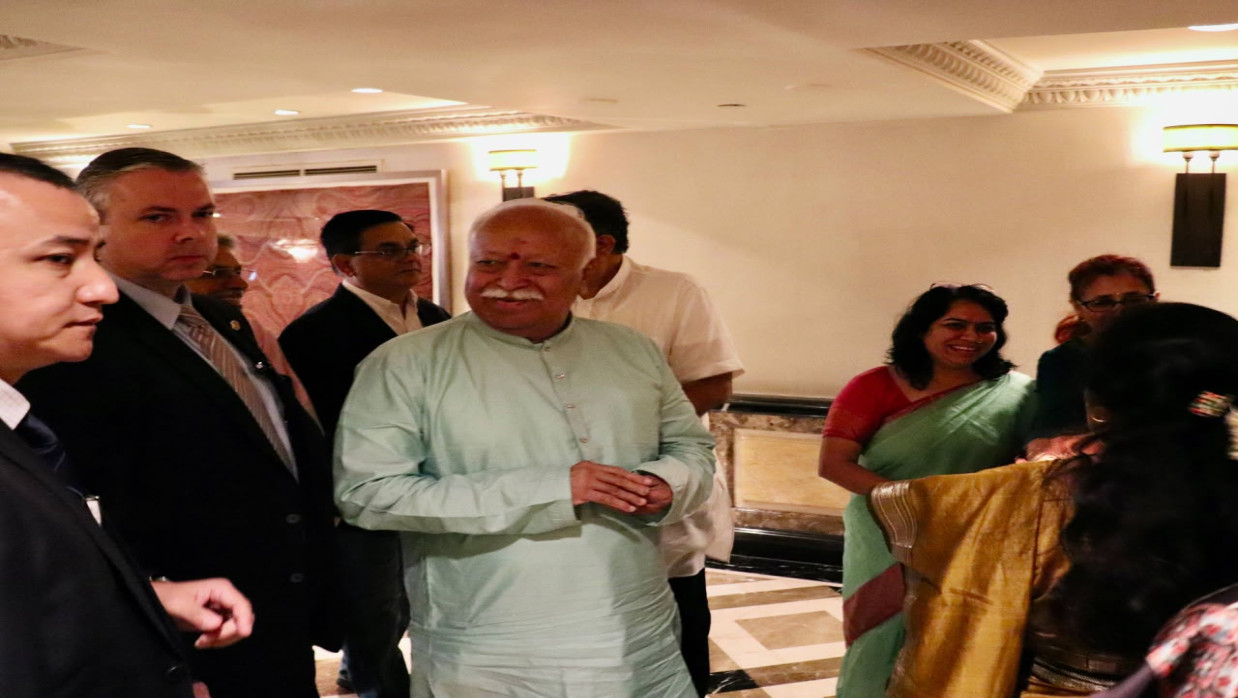
Rashtriya Swayamsevak Sangh chief Mohan Bhagwat’s visit to the United States has exposed a widening political and ideological division within the Indian-American community. Bhagwat is scheduled to address the “Universal Oneness Celebration” at Madison Square Garden in New York on August 29 as part of the RSS centenary-year outreach. Organizers describe the gathering as a celebration of shared heritage, harmony and interfaith unity. Its critics, however, regard Bhagwat’s appearance at one of America’s most prominent venues as an attempt to legitimize Hindu majoritarian politics abroad.
The controversy shows that the Indian diaspora can no longer be treated as a monolithic voting bloc. Indian Americans may have family and cultural ties with India, but are deeply divided on issues of secularism, rights of minorities, Narendra Modi’s government, and the influence of RSS in modern India.
Opposition from the Progressive Left
Several progressive politicians and civil-society activists have called upon New York Mayor Zohran Mamdani and Madison Square Garden management to prevent the event from proceeding. Former Seattle City Council member Kshama Sawant, who is seeking election to Congress as an independent socialist, has described Bhagwat as a leading representative of far-right Hindu nationalism.
Sunita Viswanath, executive director of Hindus for Human Rights, has echoed Viswanath's call to action against the event. Viswanath's attendance is noteworthy because it counters claims that criticizing the RSS equates to criticizing Hinduism. Hindus for Human Rights and other progressive Hindu organizations have stated that Hindu religious identity is not inherently at odds with pluralism, and that Hindutva need not be portrayed as speaking for all Hindus.
Asif Mahmood, vice chair of the U. S. Commission on International Religious Freedom, has also condemned the visit. The commission had claimed RSS militants have targeted minority communities with violence and intolerance. The RSS has denied these charges and stated it is a cultural organization working for unity in the nation.
Mamdani’s Delicate Position
Mayor Mamdani said he personally disagrees with the rally. Mayor Mamdani drew on his Indian background to describe how the RSS's vision of the world differed from the diverse and tolerant India he knew from his family. However, he noted that the city likely lacks legal grounds to cancel a private event. Mamdani's statement makes a valid point about the difference between voicing political objections and legal prohibition.
America's First Amendment rights to freedom of speech and association protect most hateful organizations and speakers. In that sense, the best democratic answer might just be to picket, investigate, and talk.
Trumpism and Diaspora Politics
The feud also reflects changing dynamics in Indian-American politics. For years, the community was often stereotyped as socially conservative, professionally accomplished, and increasingly favorable toward GOP economic stances. But Donald Trump's "America First" campaign, anti-immigration attacks, and racial divisiveness have galvanized Indian Americans around the Democratic Party and progressive issues.
At the same time, another section of the diaspora sees Modi and the RSS as symbols of Indian confidence, civilizational revival, and national strength. Some find no contradiction between supporting Trump in America and Hindu nationalism in India. Others believe that immigrant communities cannot credibly oppose racial and religious exclusion in the United States while supporting similar forms of majoritarianism in South Asia.
That's why Bhagwat's visit to New York is about more than celebrating India's diaspora. It's a battle over who can represent India overseas - and what kind of India they want to represent. The fight exposes a diaspora fractured not just by American party politics but by conflicting ideas of nationalism, religious identity, and democracy itself.


0 Comments
LEAVE A COMMENT
Your email address will not be published