

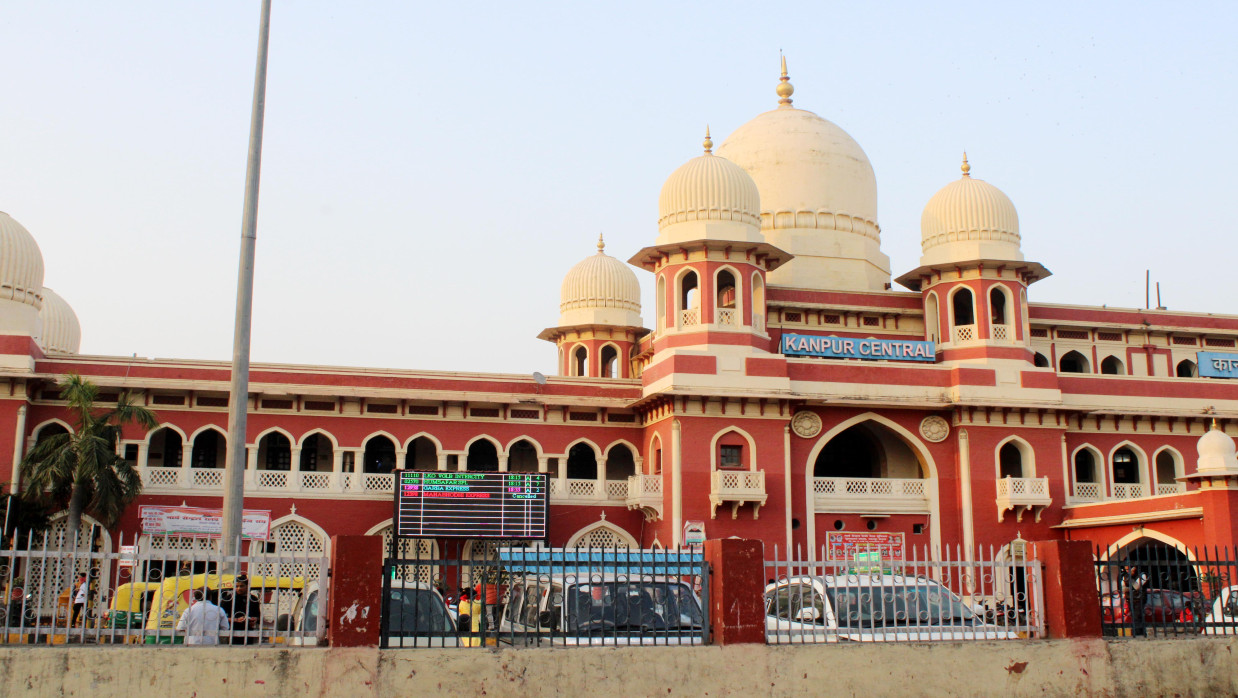
Kanpur is Uttar Pradesh's largest industrial city, yet its administrative history begins remarkably late compared to the antiquity of the sites that surround it. The city's name carries competing legends, and its urban form was assembled by a colonial army within four decades. Its economic identity moved from imperial garrison to textile powerhouse, and the city is now working to remediate a century of unregulated industrial growth. This article traces that arc, from the contested etymology of "Kanpur" through the 1857 siege to the environmental governance questions facing the city today, and closes with policy considerations relevant to other North Indian cities carrying similar colonial-industrial legacies.
Contested Origins
No single account explains the name Kanpur. One tradition derives it from Kanha, a name for Krishna, and credits Raja Hindu Singh Chandel of Sachendi with founding a settlement in the deity's honor; a related version attributes the founding to Maharaja Kanhdev of the Kanhpuriya Rajputs in the thirteenth century. A second tradition traces the name to Karna, the Mahabharata's tragic hero, holding that Duryodhana granted him the territory and that "Karnapur" softened over time into Kanpur. A third connects the name to the nearby Sufi shrine complex at Makanpur, associated with the fifteenth-century saint Badiuddin Zinda Shah Madar. None of these accounts rests on inscriptional or textual evidence contemporary with the events described; they survive as oral traditions recorded in nineteenth-century colonial gazetteers. What Company records do establish is that by the 1770s local usage rendered the settlement's name as Kanhpur, which British officials transliterated as Cawnpore, a spelling that held until the post-1947 reversion to Kanpur.
Older Ground: Jajmau and Bithoor
Kanpur city proper has no documented municipal record before the late medieval period, but two sites on its periphery carry much deeper histories. Jajmau, on a bluff above the Ganges at the city's eastern edge, holds the region's deepest archaeological sequence. Excavations conducted by the Archaeological Survey of India in 1956-58 and 1977-78 uncovered continuous occupation layers running from the Northern Black Polished Ware period through the Mauryan, Kushana, and Gupta periods, with the earliest painted pottery dated to the late second millennium BCE. Puranic tradition links the site to King Yayati. In 1358, under Firoz Shah Tughlaq, the site acquired the Sufi shrine of Makhdum Shah Ala-ul-Haq, followed by an Aurangzeb-era mosque in 1679.
Upstream, Bithoor carried a different kind of significance. Hindu tradition holds it as the site of Valmiki's ashram. Politically, it gained importance after 1818, when the East India Company designated it as the place of exile for the deposed Peshwa Baji Rao II. The Peshwa's court-in-exile at Bithoor later brought his adopted heir, Dhondu Pant, better known as Nana Sahib, into the political events of 1857. Between Jajmau and Bithoor, the area that became Kanpur remained a scatter of agrarian and weaving villages, mentioned only occasionally in late Mughal records.
Building a Garrison, 1765-1803
Kanpur's administrative emergence followed directly from British military strategy after the Battle of Buxar in 1764 and an engagement near Jajmau in May 1765, in which Company forces defeated Shuja-ud-Daula, the Nawab Wazir of Awadh. Recognizing the site's command of Gangetic trade routes and its proximity to Maratha territory, the Company stationed troops there through the 1770s, and by 1778 British officers had assumed control of a dozen surrounding villages to establish a permanent cantonment. Under the Treaty of 1801, Nawab Saadat Ali Khan ceded the Ceded Districts, including Kanpur, to the Company in exchange for military protection. On March 24, 1803, Kanpur was formally constituted as a British district, with Abraham Welland as its first Magistrate and Collector. In under four decades, an obscure Awadh village had become one of the largest military cantonments in British India, drawing the merchants, contractors, and laborers who would later build its industrial economy.
The Siege of 1857
By 1857 Cawnpore held over 3,000 native sepoys, several hundred European troops, and roughly 600 European civilians, under the command of Major General Hugh Wheeler. When native regiments revolted on June 5-6, Nana Sahib assumed leadership of the insurgent forces, and Wheeler withdrew the European population into a hastily built entrenchment. It held for three weeks under bombardment, heat, and disease until Wheeler accepted Nana Sahib's offer of safe passage to Allahabad on June 25.
On June 27, close to 900 people left the entrenchment for boats waiting at Satichaura Ghat, among them roughly 300 British soldiers and several hundred civilians. As the boats were loaded, rebel troops posted along the bank opened fire and set several boats alight with heated shot. Most of the European men, including Wheeler, were killed at the ghat or shot while trying to swim to safety. Around 125 women and children survived and were marched first to the Savada Kothi, then, joined by survivors of a separate killing at Fatehgarh, moved on July 3 to the Bibighar, a house in the town. Historians including Rudrangshu Mukherjee and Kim Wagner note that whether the initial gunfire at the ghat was a coordinated signal or a panic-driven skirmish remains unresolved, given the contradictory witness depositions collected after the city's recapture.
As Henry Havelock's relief column advanced from Allahabad, the rebel leadership debated the hostages' fate. Depositions gathered by Lieutenant Colonel G. W. Williams describe how, after word reached Cawnpore on July 15 that Havelock had defeated rebel forces at Aong and Pandu Nadi, Nana Sahib and his advisers, including Tantia Tope and Azimullah Khan, ordered the captives killed rather than let them fall back into British hands. Sepoys sent to carry out the order largely refused, and Hussaini Khanum, the woman placed in charge of the prisoners, brought in local butchers who killed most of the captives with swords over the following hour. A handful of women and children survived by hiding beneath the bodies. The next morning, laborers compelled to do the work threw the dead into a nearby well. Contemporary British estimates of the toll ran as high as 200, a figure that includes captives who had already died of cholera and dysentery during three weeks of confinement; modern historians including Mukherjee, Wagner, and Andrew Ward put the number killed on July 15 itself at close to 120.
News of the killings reached Havelock's and Neill's troops as they retook the city on July 17 and shaped the British campaign that followed. Colonel James Neill ordered captured rebels to lick a portion of the Bibighar's blood-stained floor before execution and had villages along the army's route burned on mere suspicion. When the news reached Britain weeks later, it dominated press coverage, hardened public opinion against any negotiated settlement, and was repeatedly invoked in Parliament as part of the case for the Government of India Act of 1858, which ended Company rule and transferred authority over India to the Crown.
Reassessing Nana Sahib
Nana Sahib remains one of the most contested figures of the period. Adopted by Baji Rao II in 1827, he was denied the continuation of his father's pension under the Doctrine of Lapse enforced by Governor-General Lord Dalhousie; the rejection of his appeal to the Company's Court of Directors in London, carried by his emissary Azimullah Khan in 1853, marked his political break with British authority. Colonial-era historiography cast him as the architect of premeditated massacre. Nationalist accounts later recast him as an early freedom fighter commanding a unified rebellion. More recent critical scholarship, including work by Mukherjee, Wagner, and Ward, points instead to a fragile and contested command structure, in which Tantia Tope held much of the operational military authority and Azimullah Khan supplied ideological direction, while Nana Sahib's own control over the rebel council was limited. On this reading, the Bibighar killings look less like a plan set at the outset of the siege than a decision driven by factional panic as Havelock's column closed in. Nana Sahib retreated into the Nepalese Tarai around 1859 and disappeared from the documentary record.
From Garrison to "Manchester of the East"
Before the 1860s, the local economy rested on handloom weaving, river trade, and small-scale tanning at Jajmau. The disruption of British military supply lines during 1857 pushed the colonial state toward local industrial manufacturing: Elgin Mills opened in 1862, the Government Harness and Saddlery Factory in 1867, the Cawnpore Woollen Mills, known as Lal Imli, in 1876, Muir Mills in 1882, and JK Cotton Mills, financed by Indian capital under Kamalapat Singhania, in 1928. Cheap migrant labor from eastern Uttar Pradesh, Bihar, and, in smaller numbers, Bengal built the workforce; many migrants belonged to Chamar, Kori, and Julaha communities with few opportunities in their home districts' agrarian economies. They settled in dense quarters such as Gwaltoli, close to the mills and distinct from both the old town and the colonial cantonment, and the city's industrial geography owes as much to this workforce as to the mills' owners.
That concentration of labor produced one of colonial India's most militant labor movements, historian Chitra Joshi has argued. Kanpur's first major strike, in 1919, was driven by wartime price rises that had eroded real wages. Unrest culminated in the general strike of May 1938, when close to 46,000 workers, women prominent among them, walked out after mill owners rejected a wage board's recommendations, giving the city its lasting nickname, "Lal Kanpur." Labor conflict continued after independence: in 1977, police fired on workers protesting delayed wages at Swadeshi Cotton Mills, killing twelve, an episode that led to the Uttar Pradesh Timely Payment of Wages Act of 1978.
Postwar equipment obsolescence, under-investment, and shifting trade patterns pushed the Government of India to nationalize loss-making mills under the Sick Textile Undertakings (Nationalisation) Act of 1974; the British India Corporation, which controlled Elgin Mills and Lal Imli, followed in 1981. Nationalization slowed but did not reverse the decline. Decentralized powerloom production in western and southern India undercut Kanpur's integrated mills, the end of the Multi-Fibre Arrangement reshaped global trade patterns, and union solidarity fractured along communal lines after 1992. By the late 1990s the Board for Industrial and Financial Reconstruction had declared Kanpur's nationalized units commercially unviable; Elgin Mills closed in 2001, and the remaining units followed in 2002.
The Environmental Reckoning
With the mills gone, leather processing concentrated at Jajmau became the city's dominant industry, and tannery discharge into the Ganges made Kanpur a central concern for environmental regulators. The National Green Tribunal and state pollution boards have forced tanneries to cut production or close seasonally during events such as the Kumbh Mela. Under the Namami Gange program, authorities intercepted the historically polluted Sisamau Nala between 2018 and 2024 and built new common effluent treatment plants. Federal production-linked incentive schemes for the leather sector now aim to shift Kanpur's tanneries toward higher-value, lower-pollution export production.
Policy Implications
Kanpur's trajectory offers three lessons for policymakers working on North India's older industrial cities. First, deindustrialization and environmental cleanup cannot be treated as separate problems: the tannery pollution crisis at Jajmau is a direct legacy of the same nineteenth-century industrial concentration that produced the city's labor movements, and remediation programs that ignore the livelihoods built around that industry risk repeating the social fractures of the 1990s mill closures. Second, infrastructure investment under programs such as Namami Gange needs sustained monitoring and enforcement capacity at the state level; the tannery cluster's history shows that formal regulatory mandates without consistent enforcement produced decades of discharge into the Ganges before real remediation began. Third, the production-linked incentive approach now being applied to Kanpur's leather sector, aiming to shift producers toward higher-value, lower-pollution output rather than simply penalizing existing capacity, offers a template that could extend to other Gangetic industrial towns facing similar trade-offs between employment and environmental compliance, among them Unnao and Kanpur Dehat.
Kanpur's history complicates any simple story of urban origins. It layers an ancient religious landscape at Jajmau and Bithoor beneath a colonial garrison built in under four decades, a contested 1857 siege whose command structure historians still debate, and an industrial economy whose rise, fall, and current environmental restructuring track the broader political economy of modern India. Understanding that layered history matters for the policy choices the city, and others like it, now face.


0 Comments
LEAVE A COMMENT
Your email address will not be published