

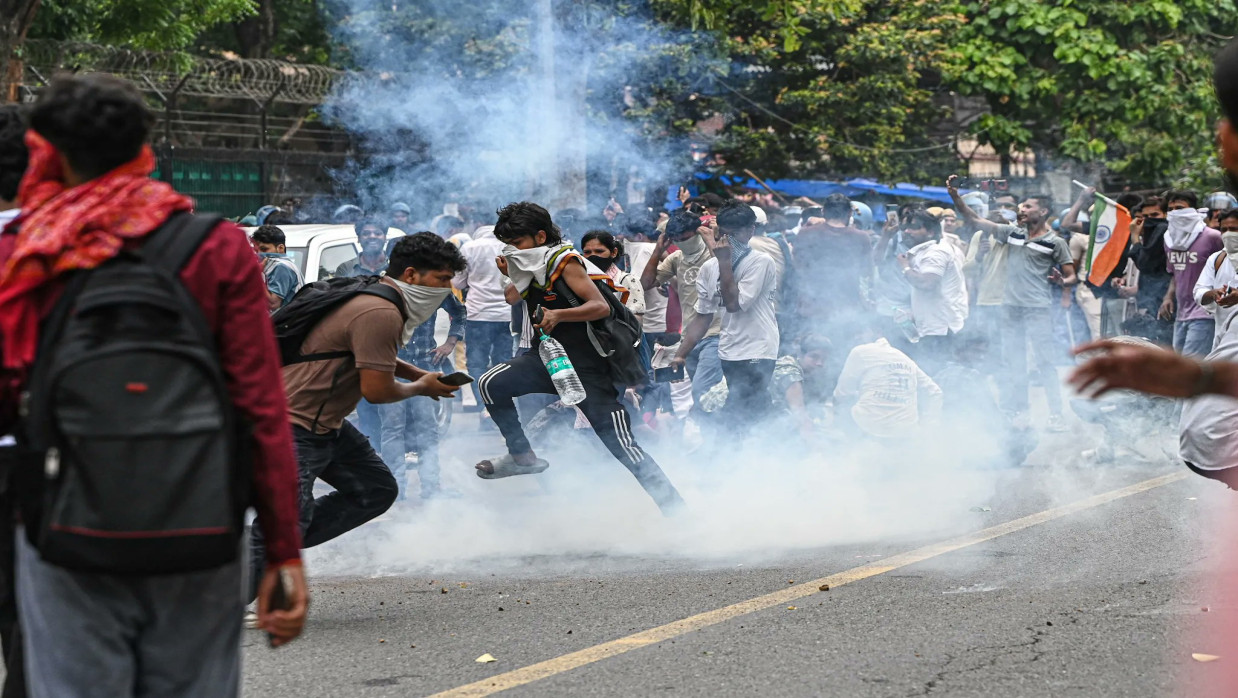
In recent weeks, Jantar Mantar, a large Mughal-era observatory near Parliament in New Delhi, has once again become the stage for India’s newest wave of dissent. The Cockroach Janta Party (CJP) — a satirical protest collective that has captured national attention and symbolizes Gen Z’s frustration with institutional failure — saw police forcibly remove educator-activist Sonam on the twenty-first day of his hunger strike, taking him to hospital against his will. CJP founder Abhijeet Dipke immediately began his own fast, as supporters prepared a march to Parliament demanding accountability for nationwide exam leaks and calling for the resignation of Education Minister Dharmendra Pradhan — with some even urging Prime Minister Narendra Modi to step down.
These scenes are only the latest chapter in a long tradition of public protest in India. From the freedom struggle of the early 20th century (1915–1947) to the Jayaprakash Narayan (JP) Movement of 1974–1975, from the anti-Emergency mobilizations of 1975–1977 to Anna Hazare’s anti-corruption campaign in 2011, India has repeatedly witnessed moments when citizens took to the streets to challenge authority and demand accountability. Yet in recent years, protests at Jantar Mantar — once a vibrant symbol of democratic expression — have repeatedly failed to achieve meaningful change.
The dramatic escalation this week reinforces that trajectory. During the CJP’s “Sansad Chalo” march, a 20-year-old woman was critically injured after colliding with a barricade during police action; nearly ninety students and dozens of police personnel were hurt, and more than twenty police vehicles were damaged. Despite hospital visits by Union Health Minister J.P. Nadda and a brief dialogue with CJP representatives, the state quickly reverted to its familiar script: dismantling protest infrastructure, filing FIRs under stringent provisions, and flooding the area with police and Rapid Action Force units. Protesters returned the next morning, but the government’s firm, centralized posture made clear that even large-scale youth mobilization would be absorbed without meaningful concession. The clashes thus offer a real-time demonstration of how protests at Jantar Mantar flare, shock, and then fade without altering the political landscape.
Whether led by wrestlers alleging sexual harassment, students protesting exam irregularities, farmers seeking policy reform, citizens opposing discriminatory laws, or the CJP staging its irreverent “cockroach politics” marches, the pattern remains strikingly consistent: protests ignite public attention, only to dissipate without shifting political power.
Why did these protests fail so miserably? And what could Gen Z — the most digitally connected, politically aware generation in India’s history — have done differently?
To answer these questions, we must examine the deeper structural forces shaping dissent in India today. The failure of the Jantar Mantar protests is not simply a matter of poor strategy or weak leadership. It reflects a profound transformation in India’s political ecosystem, where centralized power, media capture, institutional constraints, and social fragmentation have made it increasingly difficult for public protest to translate into political change.
But to understand why protest fails today, we must first revisit a historical comparison that is often invoked — Mahatma Gandhi’s Satyagraha. Many Gandhi supporters believe that nonviolent civil disobedience pressured the British Raj to “Quit India.” But the conditions that made Satyagraha effective in the early 20th century no longer exist. And under a Hindutva-driven government led by Narendra Modi, such tactics are even less likely to succeed.
- Satyagraha’s Historical Power — And Its Limits in Contemporary India
Gandhi’s Satyagraha is often romanticized as a moral force that compelled the British Raj to leave India. But historians note that Satyagraha succeeded because of specific historical conditions that do not exist today.
- The Raj was a foreign colonial power
The British Raj lacked democratic legitimacy. Its rule depended on maintaining the appearance of moral authority. When Gandhi exposed its brutality — through the Salt March, the Non-Cooperation Movement, and later the Quit India Movement — the Raj’s legitimacy eroded internationally. Today’s Indian government is domestically elected and enjoys strong nationalist support. It does not fear losing moral legitimacy in the same way a colonial power did.
- Global Pressure and Imperial Vulnerability
By the 1940s, the British Raj was operating in a dramatically altered global environment that made it uniquely susceptible to Gandhi’s Satyagraha. World War II had drained Britain’s economy, weakened its military capacity, and exposed the contradictions of fighting fascism abroad while maintaining colonial domination at home. Anti-colonial sentiment was rising worldwide, and the moral legitimacy of empire was already collapsing. The United States, despite its strategic alliance with Britain, was ideologically opposed to colonialism and increasingly vocal about the need for decolonization. The Soviet Union championed anti-imperial movements and supported national liberation struggles across Asia and Africa. Global media amplified Indian resistance, broadcasting Gandhi’s marches, fasts, and arrests to international audiences. His nonviolence resonated deeply with people around the world, who pressured Britain to change course.
In short, the Raj was not only facing external pressure; it was internally vulnerable. Its economy was shattered by war, its political authority was eroding, and its ability to sustain an empire was rapidly diminishing. Satyagraha did not defeat a confident colonial power — it accelerated the retreat of an empire already in decline.
Today’s India occupies a fundamentally different position. It is a major global economy, a strategic partner for many countries, and a key player in global supply chains. Nations that once pressured Britain to decolonize now seek trade, investment, and security cooperation with India. The current government is politically strong, economically stable, and ideologically unified. A state that is confident, centralized, and globally integrated is far less susceptible to moral pressure than a colonial power in retreat. International criticism is muted not because global institutions are indifferent to human rights, but because India’s geopolitical importance makes many governments reluctant to confront it openly.
- The Raj did not control mass media
British India had newspapers that openly criticized colonial rule. Gandhi’s message spread through Indian newspapers, international press, speeches, pamphlets, and mass gatherings. Today’s media environment is radically different. Large sections of Indian media are aligned with the ruling establishment due to corporate ownership patterns, political pressure, advertising dependence, and regulatory constraints. Critical voices exist, but they struggle to reach national audiences. Television channels often frame protests as disruptive or misguided. Social media, while offering alternative avenues, is saturated with misinformation and algorithmic amplification of sensational content rather than civic mobilization — a dynamic that disproportionately affects Gen Z’s political engagement.
- Mass Mobilization and Organizational Infrastructure
Gandhi’s Satyagraha succeeded not merely because of its moral force but because it mobilized millions across India through a vast and disciplined organizational network. His campaigns were never confined to symbolic protest sites; they unfolded through nationwide marches, boycotts, strikes, mass civil disobedience, and village-level mobilization that penetrated deeply into rural and urban life. These actions disrupted the functioning of the colonial state, making it increasingly difficult for the British Raj to govern effectively. Crucially, Gandhi’s ability to mobilize at such scale rested on the institutional backbone provided by the Indian National Congress. Despite internal differences, Congress offered leadership, organization, strategy, and negotiation channels. It maintained a nationwide network of volunteers, committees, and local leaders capable of coordinating actions across regions. Gandhi’s movements were not spontaneous eruptions; they were carefully planned campaigns supported by a robust political infrastructure.
By contrast, the Jantar Mantar protests are geographically limited and numerically small, confined to a narrow space in Delhi that is far removed from the lived realities of rural India. A protest of a few thousand people, no matter how passionate, cannot replicate the disruptive scale of Gandhi’s mobilization. Nor do contemporary youth-led movements possess the organizational scaffolding that once enabled Congress to translate moral conviction into coordinated national action. Gen Z protests are often spontaneous, decentralized, and leaderless. Without institutional support, they remain reactive rather than strategic, unable to sustain momentum or negotiate effectively with a powerful, centralized state. The absence of both mass mobilization and organizational infrastructure is a central reason why modern protests fail to achieve the political impact Gandhi’s campaigns once commanded.
The limits of fasting today
Fasting, which once served as a powerful moral lever against the British Raj, has lost much of its political efficacy in contemporary India. Gandhi’s fasts worked because they ignited mass mobilization and imposed political and moral costs on a colonial state already weakened by war and global pressure. Today, however, fasting without a broader movement becomes an act of solitary martyrdom. It inspires admiration but does not compel action. The modern state, insulated by centralized power and ideological cohesion, can simply wait out the fast, confident that no mass uprising will follow. Moral protest without organizational muscle no longer moves the machinery of power in a state that has learned to absorb symbolic dissent without conceding anything substantive.
Conclusion: Satyagraha cannot succeed under a Hindutva-driven state
The Hindutva movement — which shapes the current government’s ideological orientation — sees dissent not as moral persuasion but as political opposition. It is not vulnerable to moral pressure. It does not fear international criticism. It does not rely on maintaining moral legitimacy in the same way the Raj did. Thus, Gandhi’s tactics, while historically powerful, cannot be mechanically transplanted into today’s India.
- The New Political Environment: Why Protests No Longer Move the State
In earlier decades, mass protests could shake governments in India. The JP Movement helped topple a regime. The anti-Emergency mobilizations restored democracy. Anna Hazare’s fast forced Parliament to debate anti-corruption legislation. But today, the political environment is fundamentally different.
Power is concentrated in the executive, with strong influence over the bureaucracy, police, investigative agencies, large sections of the media, and increasingly the judiciary. This centralization means that protests — even large ones — rarely compel the government to negotiate.
Protesters are routinely labeled “anti-national,” “foreign-funded,” “urban Naxals,” “jihadi sympathizers,” or “agents of opposition parties,” a narrative strategy that pre-emptively delegitimizes dissent. Once protesters are framed as enemies of the Hindu nation, their demands become easier to dismiss.
Jantar Mantar is a fenced-in zone designed to contain dissent rather than amplify it. Surveillance, barricades, and police restrictions limit the scale and spontaneity of protests. Courts have been cautious in intervening decisively in cases involving civil liberties or state repression. Without judicial protection, protesters face greater risks and fewer avenues for redress.
The state’s new strategy: outlast, fragment, delegitimize
The present regime’s response to dissent illustrates this shift with remarkable consistency. The anti-CAA movement was met with police action, internet shutdowns, and prolonged refusal to engage with its central demands. The wrestlers’ agitation, protests over recruitment irregularities, the Agnipath demonstrations, and Sonam Wangchuk’s movement for Ladakh were variously ignored, delayed, or contained through preventive policing and sustained efforts to discredit the protesters. Across these movements, the state’s instinctive response has been less to negotiate than to outlast, fragment, or delegitimize opposition. This is not accidental; it is a deliberate strategy.
In this environment, a protest without massive numbers, sustained pressure, and broad alliances is doomed from the start.
III. The Problem of Size: Jantar Mantar Is Not Tahrir Square
Mass mobilization has always been central to the political effectiveness of protest movements. Research on civil resistance shows that movements typically need participation from at least 3.5 percent of the population before they can impose meaningful political costs on those in power or force a government to change course. Successful movements disrupt normal life — traffic, commerce, political routines, and media cycles — in ways that make it impossible for the state to ignore them. But Jantar Mantar protests rarely exceed a few thousand people. They remain confined to a small corner of Delhi, invisible to most of the country. Gen Z’s presence is visible online, but not on the streets where political pressure is actually generated. Without scale, protests cannot exert pressure.
The farmers’ movement: the exception that proves the rule
The year-long farmers’ movement stands as the principal exception, but even this reinforces the broader pattern. The government initially rejected demands for repeal, fortified protest sites with barricades and trenches, imposed internet shutdowns, employed force, and repeatedly portrayed the movement as infiltrated by extremists. The three farm laws were withdrawn only after more than a year of sustained resistance, considerable human suffering, and the approach of politically significant state elections. The retreat was a tactical recalibration, not an acknowledgment of the protesters’ moral claims. It demonstrated not the responsiveness of the state to dissent but the extraordinary scale required before political concessions become unavoidable.
- Media Capture and the Limits of Narrative Power
Mainstream media in India is largely aligned with the ruling establishment. Television networks, major newspapers, and digital platforms often echo government narratives, portraying protesters as disruptive, misguided, or politically motivated. Coverage of dissent is frequently minimized, distorted, or framed through a lens of suspicion. Social media, though seemingly democratic, amplifies sensationalism rather than civic mobilization, and algorithmic patterns often bury serious political content beneath entertainment, outrage, and misinformation. Without sustained media amplification, a protest cannot become a national conversation in a country as vast and diverse as India.
Yet media capture alone does not fully explain why India’s Gen Z struggles to build a mass movement. In other countries, even severe media suppression has not prevented uprisings from succeeding. To understand this contrast, we must examine how media credibility interacts with public sentiment and political legitimacy.
This question requires a separate, focused analysis, because the dynamics that enabled Tahrir Square in Egypt and the July Revolution in Bangladesh to succeed extend far beyond media conditions.
- Why Leaderless Movements Succeeded in Egypt and Bangladesh — But Not in India
The uprisings in Cairo’s Tahrir Square in 2011 and the youth-led July Revolution in Bangladesh in 2024 offer a striking contrast to India’s recent protest failures. Like India’s Gen Z, protesters in both countries lacked media support. State-aligned outlets initially ignored, mocked, or demonized them. Mubarak’s regime in Egypt went so far as to shut down the entire internet. Sheikh Hasina’s government in Bangladesh deployed propaganda, arrests, and digital surveillance to contain dissent. And yet, despite these obstacles, both movements succeeded in toppling deeply entrenched authoritarian rulers.
The key difference lies in how media suppression interacted with public sentiment. In Egypt and Bangladesh, state media had already lost credibility long before the uprisings. Citizens no longer trusted official narratives, and alternative channels — word of mouth, mosques, universities, neighborhood networks, and diaspora media — filled the vacuum. When state media denied the scale of protests, people simply went to the streets to see for themselves. The absence of trustworthy media paradoxically strengthened the uprisings by forcing citizens to rely on each other rather than on official channels.
In India, however, large segments of the public still trust mainstream media or at least consume it passively. As a result, the media’s delegitimization of protesters has real impact: it shapes perceptions, weakens solidarity, and discourages participation. When protests at Jantar Mantar are framed as fringe, chaotic, or politically motivated, many Indians accept that framing. Media capture does not merely suppress information; it manufactures consent, making it far harder for protests to break out of their symbolic confines.
Thus, while media capture is not the sole reason India’s Gen Z struggles, it is a crucial structural barrier. In Egypt and Bangladesh, media suppression delegitimized the regime; in India, media suppression delegitimizes the protesters.
This brings us to the deeper question of leadership. Neither Tahrir Square nor the July Revolution had a single charismatic leader, a unified party structure, or a formal organization. They were spontaneous uprisings driven by youth, students, and ordinary citizens — and yet they toppled two of the most entrenched authoritarian rulers in their regions. Understanding how they succeeded requires examining the nature of public grievance and the threshold of collective desperation.
- Egypt and Bangladesh reached a point of systemic rupture
In both countries, the public had endured years of economic hardship, police brutality, corruption, authoritarian excess, suppression of political opposition, and erosion of basic freedoms. By the time the uprisings began, public anger had reached a boiling point. The protests did not need formal leadership because the grievances were universal and overwhelming — a level of shared desperation absent in India’s fragmented protest landscape. Everyone knew why they were in the streets.
India’s Gen Z, by contrast, faces serious issues — unemployment, exam irregularities, rising authoritarianism, communal polarization — but these grievances are fragmented, not universal. Different groups protest different issues, and the protests rarely converge into a single national demand. Without a shared grievance that cuts across class, caste, religion, and region, leaderless mobilization cannot achieve critical mass.
- Egypt and Bangladesh had a clear, singular objective
A second crucial difference lies in the clarity of purpose. In both Egypt and Bangladesh, the uprisings coalesced around a single, unmistakable demand: the dictator must go. That simplicity created cohesion, allowing Islamists, liberals, students, workers, and professionals to unite under one banner despite their ideological differences.
India’s Gen Z protests, by contrast, rarely converge on a singular objective. They often confront multiple issues simultaneously — unemployment, exam irregularities, police brutality, minority rights, women’s safety, corruption, authoritarianism, communal violence, constitutional erosion. Each is important, but together they diffuse energy rather than concentrate it. Leaderless movements cannot sustain momentum when they face multiple villains, multiple narratives, and multiple demands that compete rather than converge. Successful movements require one clear goal, one clear adversary, one clear strategy, and one clear timeline — the very elements missing from India’s fragmented protest landscape.
- The security forces in Egypt and Bangladesh fractured
In both uprisings, segments of the police, military, or bureaucracy eventually refused to suppress protesters. This fracture was decisive. No protest can topple a regime if the coercive apparatus remains unified.
In India, the security apparatus remains cohesive, disciplined, and aligned with the ruling establishment. There is no institutional fracture that could create openings for mass mobilization.
- The public in Egypt and Bangladesh overcame fear
Fear is the greatest barrier to protest. In Egypt and Bangladesh, once the first wave of protesters occupied the streets, fear collapsed. People saw others resisting and joined in. The streets became spaces of solidarity rather than danger.
In India, fear remains a powerful deterrent. Arrests, surveillance, police action, and social stigma discourage participation. Without a critical mass to break the fear barrier, protests remain small and symbolic.
- India’s social fragmentation prevents unified uprisings
Egypt and Bangladesh are socially diverse, but their uprisings were driven by a shared national identity and a shared sense of injustice. India’s social fragmentation — caste, religion, region, language, class — makes unified uprisings far more difficult. Gen Z is united online but divided offline.
Seen together, these factors explain why leaderless uprisings succeeded in Egypt and Bangladesh but not in India. Media suppression delegitimized the regime in those countries; in India, media suppression delegitimizes the protesters.
This is why Tahrir Square and the July Revolution succeeded — and why Jantar Mantar did not.
- What Could Have Made the Movement Successful?
No youth movement succeeds alone. Gen Z needed alliances with farmers, trade unions, women’s groups, Dalit organizations, regional parties, student unions, and civil society networks. They needed coordinated protests in 50–100 cities, campus shutdowns, state-level marches, and decentralized committees. They needed a single, powerful, achievable demand — repeal of a discriminatory law, judicial inquiry into a major injustice, or restoration of constitutional protections.
They needed a leadership council that is diverse, credible, articulate, and able to negotiate. They needed daily press briefings, fact sheets, legal teams, media alliances, international outreach, data-driven messaging, and storytelling campaigns. They needed marshals, codes of conduct, de-escalation teams, and training in peaceful protest. They needed a long-term strategy of awareness, mobilization, escalation, negotiation, and institutionalization.
VII. The Crisis of Democratic Politics: When People Stop Believing Protest Works
Seen in this light, the tragedy of the Jantar Mantar protest is not simply that it failed to secure the resignation of one minister. It reflects a wider crisis of democratic politics. The moral conviction of protesters increasingly confronts a political order insulated from moral appeal, while those who might naturally join them have grown uncertain that protest remains an effective instrument of change. When people — especially the young — cease to believe that collective action can alter the course of events, they retreat into the private sphere — not because they no longer care, but because they no longer expect to make a difference. The widening gulf between public grievance and collective action is perhaps the most serious democratic challenge confronting India today.
VIII. The Bottom Line
The Jantar Mantar protests failed not because Gen Z lacked courage, but because they lacked scale, strategy, leadership, coalition-building, narrative control, and institutional support. They were fighting a powerful, centralized state with fragmented tools. But Gen Z’s potential remains enormous. If democracy is to be renewed, it will require new forms of organization, new languages of solidarity, and new strategies capable of confronting a state that has fundamentally altered the relationship between power and public dissent. Gen Z must be creative enough to defy the imagination of an increasingly arrogant regime and disciplined enough to build the structures that make creativity politically consequential. Nostalgia for inherited repertoires of protest is no longer sufficient; innovation is now a democratic necessity.
With organization, clarity, and alliances, Gen Z could still become the most transformative political force in India’s modern history.

0 Comments
LEAVE A COMMENT
Your email address will not be published