

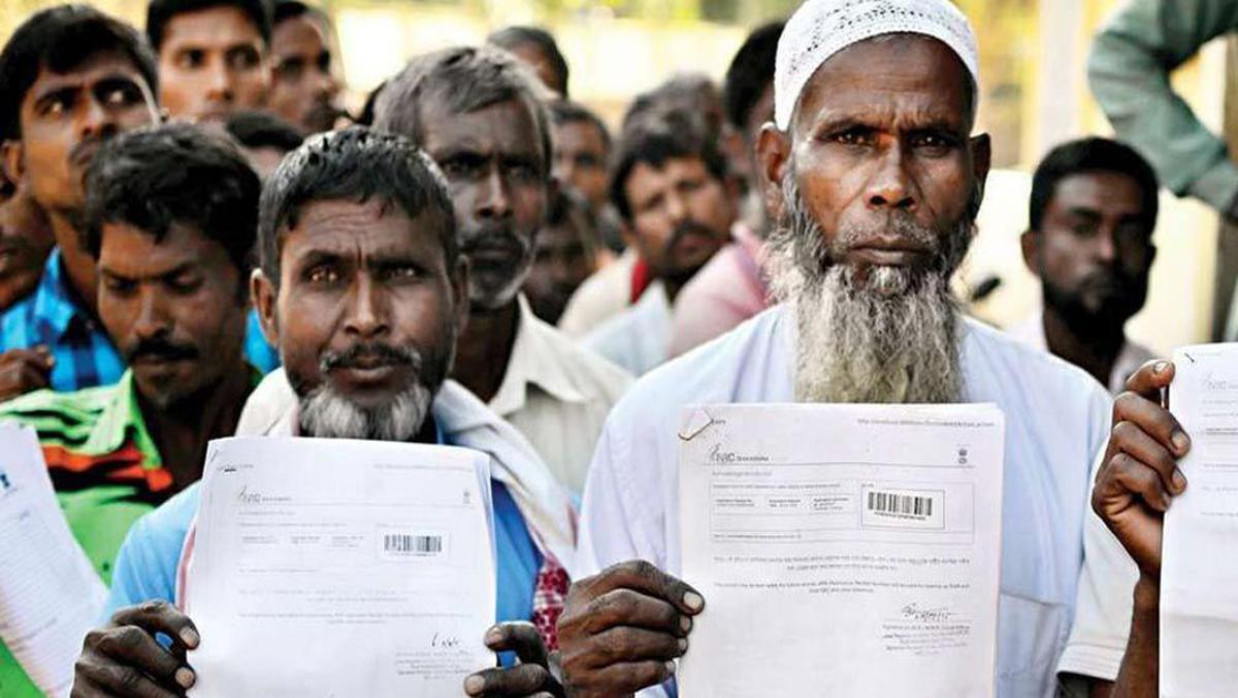
Increasingly, the functioning of the Indian State machinery in Assam has been attracting national and international attention amid debates over minority rights, fairness in electoral politics, and accountability in a democracy. Recent comments allegedly made by high-ranking politicians and moves towards making Assam’s electoral roll ‘error-free’ have worried activists, lawyers and opposition parties who fear that Muslims are being targeted in the north-eastern state. Opposition politicians claim that there is a dangerous trend in government authorities' political rhetoric and in the implementation of State practices that harm only one community. Government supporters argue that these steps are being taken to identify illegal immigrants and keep elections fair. If you support either party or find yourself in the middle, you can probably agree that democracy, constitutionality, and basic citizenship are all part of the conversation.
During his speech, Hemant Sarma, Chief Minister of Assam, was quoted as saying that “if they (Muslim laborers) don’t get two meals a day, maybe they will leave.” In other words, Opposition leaders are saying that the CM of Assam endorsed withholding full wages from migrant laborers as an attempt to push them out.
During his speech, Himanta Biswa Sarma was quoted as saying that "if they (Muslim laborers) don't get two meals a day, maybe they will leave." He made the remark while arguing that sustained economic and social pressure could encourage Bengali-speaking Muslim laborers, whom he associated with undocumented migration, to leave Assam voluntarily rather than through formal deportation. Along the same lines, he referred to paying Muslim laborers less than the prevailing wage, suggesting that if they demanded five rupees, they should be paid only four. He also spoke of creating an environment in which targeted communities would feel unwelcome and eventually choose to leave on their own, rather than relying solely on legal deportation measures. These remarks have generated significant controversy because critics contend that they appear to endorse economic discrimination, social exclusion, and collective punishment based on community identity.
Regardless of whether you view this as a political statement or as actual state policy, this kind of comment is considered inflammatory due to the fact that it singles out a religious community. In a democracy that follows the rule of law, government officials should stand up for the rights of all citizens and prevent policies that selectively harm certain groups from being enacted.
The fears mentioned above are compounded when seen through the prism of the electoral process itself. When constitutional experts and leaders of Opposition parties were asked about their main grouse against the provisions on citizenship, most complained that the Electoral Rolls have been authenticated through the Special Intensive Revision (SIR). Claiming this is an overhaul of India's time-tested voter list updation process, they state that electoral rolls have never been revised before. There were only regular updates to electoral rolls, which corrected mistakes and kept improving each time. The Election Commission (ECI) reportedly boasted that the electoral rolls have an accuracy rate of nearly 99 percent, as they have become finer with each revision since Independence.
According to critics, electoral rolls did not exist before SIR. Millions were made to prove their existence all over again within a few months. They allege that this revision especially hit poor, rural, and marginalized citizens who may not have the documents at hand, may not even know how to read or write, or who travel frequently to Government offices to update their documents each year. Some fear that Muslims and many others among these groups were hit disproportionately by this exercise.
Critics also ask how many people lost their names because they were ineligible to vote under the Constitution, and how many were removed due to paperwork issues. There has been no official data released on how many names were removed during this whole exercise.
Article 326 of the Constitution of India states: Elections to the House of the People and to the Legislative Assembly of each State shall be on the basis of adult suffrage. There is nothing in the Constitution that allows for selective delisting of voters. The Constitution allows the power to restrict the right to vote based on a law prescribing age, citizenship, or such other qualifications or disqualifications as unsoundness of mind, crime, or corrupt or illegal practice. Nothing permits deletion from electoral rolls except a revision of rolls in accordance with such law. Deletion of citizens' names, however, in large numbers and without following any due process or legal pretense in a discriminatory and selective manner, strikes at the basic Constitutional principles of equality, universal adult suffrage, and free and fair elections, the basic pillars of democracy in India. Unless done on a large scale in a discriminatory and political manner without any law backing it up,
Such large-scale disenfranchisement would certainly not have been constitutional. Advocates argued that voters' eligibility should have been verified using objective, evidence-based criteria, rather than a "state-driven managed process that targeted select groups."
Even legal battles over exclusion have surfaced. Critics argue that SC permitted the Special Intensive Revision without having a clear picture of the plight of millions of Indians who've potentially lost their voting rights. The data, methodology, and implications should've been balanced with due consideration to an inherent constitutional right to vote. Advocates of the Court's order counter that the EC has broad constitutional mandates to verify voting rolls.
Statements like these further Muslimify electoral processes and punish minorities for political gains. This further polarizes our society and creates alienation between communities. When minorities don't have faith in democratic processes, it weakens democracy. Democracy is inclusive and functions well when both the majority and minorities have faith in its institutions. Once a section of citizens feels targeted, it affects their faith in these institutions.
India prides itself on being the largest democracy. Our democracy is based on constitutional values like equality, secularism, and universal adult franchise. To protect these ideals, we cannot allow electoral reforms to be carried out in non-transparent manners and on flimsy or questionable evidence. Further, these reforms cannot target a particular section of society. Politicians, too, have a responsibility to keep a check on their speeches and must not indulge in using communal language that can instigate violence against communities.
The politics of competition is not what is happening in Assam today. Truth is at stake: the fine line between electoral reforms and fundamental rights of every Indian citizen. If India claims to be a true democracy, we cannot silence the voices of the oppressed. We must protect every Indian's right to vote freely, equally, and fearlessly.

0 Comments
LEAVE A COMMENT
Your email address will not be published