

Chietigj Bajpaee
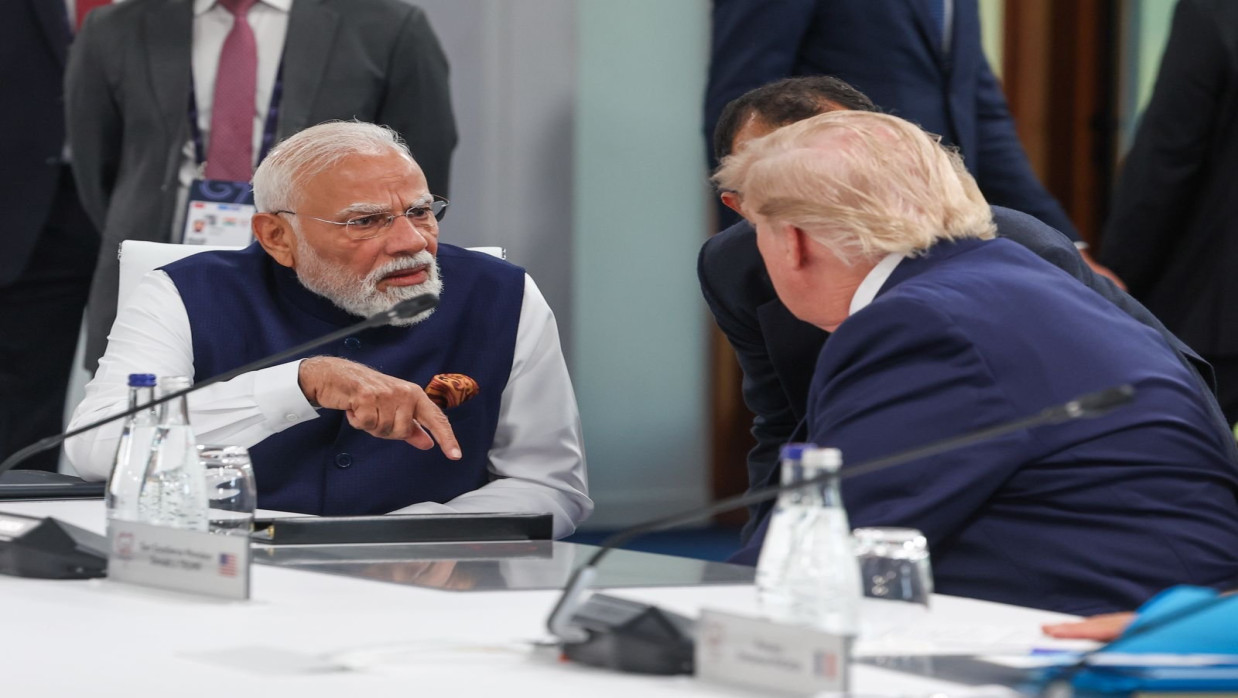
India’s Prime Minister Narendra Modi is a famed hugger of his international counterparts. So, when Modi met with President Donald Trump at the G7 Summit in France last week with a handshake and not an embrace(Opens in new window), it was as clear a signal as any that the India–US relationship has taken a hit.
The roots of the downturn with Washington can be found in New Delhi’s response to the four-day conflict between India and Pakistan in May 2025. While Islamabad was happy to give Trump his “win” by claiming that he brokered the ceasefire between both countries – going as far as nominating him for a Nobel Peace Prize – New Delhi stuck to its guns that the conflict ended without third-party involvement. This was in line with India’s long-standing principle of opposing third-party mediation on the Kashmir issue.
This became the “original sin” in the bilateral relationship. It was soon followed by the Trump administration’s imposition of higher tariffs on India, and then secondary sanctions for its purchase of Russian crude. Adding insult to injury is the deepening relationship between Islamabad and Washington, which has been fuelled by Pakistan’s mediation role during the Iran conflict.
India’s proclivity to make decisions based on high-handed principles over practical considerations predates the recent downturn in India–US relations. New Delhi has made a string of strategic misjudgements since India’s emergence as an independent nation-state in 1947 – and arguably even before that during the country’s independence struggle rooted in Gandhian principles of non-violence (Ahimsa) and truth (Satyagraha).
India needs a more pragmatic and less preachy foreign policy in a world where values no longer carry the same currency.
Shortly after gaining independence, India’s first Prime Minister Jawaharlal Nehru took its conflict with Pakistan to the United Nations, which led to the internationalisation of the Kashmir dispute. Throughout the Cold War, New Delhi propagated non-alignment and third-world solidarity, often to its own detriment. Nowhere was this more apparent than in China–India ties: while Nehru advocated for Communist China to get a permanent seat on the UN Security Council, he downplayed the looming China threat on India’s border, which culminated in the disastrous war of 1962.
India was a recipient of aid from both the United States and the Soviet Union, but its non-aligned stance was often a thorn in New Delhi’s engagement with the superpowers. It was only when India faced an existential threat during the 1962 war with China, and the 1971 war with Pakistan, that New Delhi lowered its self-imposed barrier to step up defence cooperation with Washington and Moscow, respectively.
Many attribute India’s idealistic foreign policy to Nehru’s leadership. However, this continued well beyond Nehru’s death in 1964. New Delhi’s position on the Israeli–Palestinian conflict is an example, with India’s staunch support for the Palestinian cause undermining New Delhi’s efforts to deepen relations with Israel. New Delhi’s similarly vocal condemnation of the military junta in Myanmar after it suppressed pro-democracy protests in 1988 and dismissed the results of the 1990 election undermined India’s relations with the regime and pushed it into the arms of China.
These shifts, however, have often come slowly or in response to a major shock.
The recent downturn in India–US relations showed that a streak of idealism has continued into the present day. New Delhi could have mirrored Pakistan by thanking Trump for his role in helping to de-escalate tensions between India and Pakistan in May 2025 but instead held firm on principle. New Delhi did eventually make a course correction by acknowledging Trump’s need for flattery. During their G7 meeting, Modi thanked(Opens in new window) Trump for bringing “new hope for peace and stability” to the Middle East, downplaying that instability was fuelled by the US–Israel attacks on Iran that commenced in February.
But the damage is done. Modi’s statement(Opens in new window) during the G7 Summit that the world was suffering from a shortage of trust was squarely aimed at the Trump administration’s actions. The Quad has lost momentum. The announcement by the US Department of War to drop(Opens in new window) “Indo” from its Indo-Pacific Command may be more symbolic(Opens in new window) than substantive but reflects a relative downgrade of India’s position in Washington’s Asia strategy. The relationship is facing several thorns, including delays(Opens in new window) in securing a bilateral trade agreement, the deaths(Opens in new window) of Indian seafarers from US strikes on commercial shipping in the Strait of Hormuz, and the expiry of a US sanctions waiver(Opens in new window) that gave India a temporary reprieve on its purchase of Russian oil. While much of this can be attributed to Trump’s erratic and at times irrational foreign policy, New Delhi has its fair share of blame.
Two lessons are obvious. One is that principle flows from power: The fact that India was singled out for its purchase of Russian crude while other countries that are also major buyers (notably China) were not targeted to the same degree was seen by New Delhi as a double-standard, but it also reflects India’s lack of strategic indispensability. The second is that India needs a more pragmatic and less preachy foreign policy in a world where values no longer carry the same currency.
The article appeared in the lowyinstitute
0 Comments
LEAVE A COMMENT
Your email address will not be published