

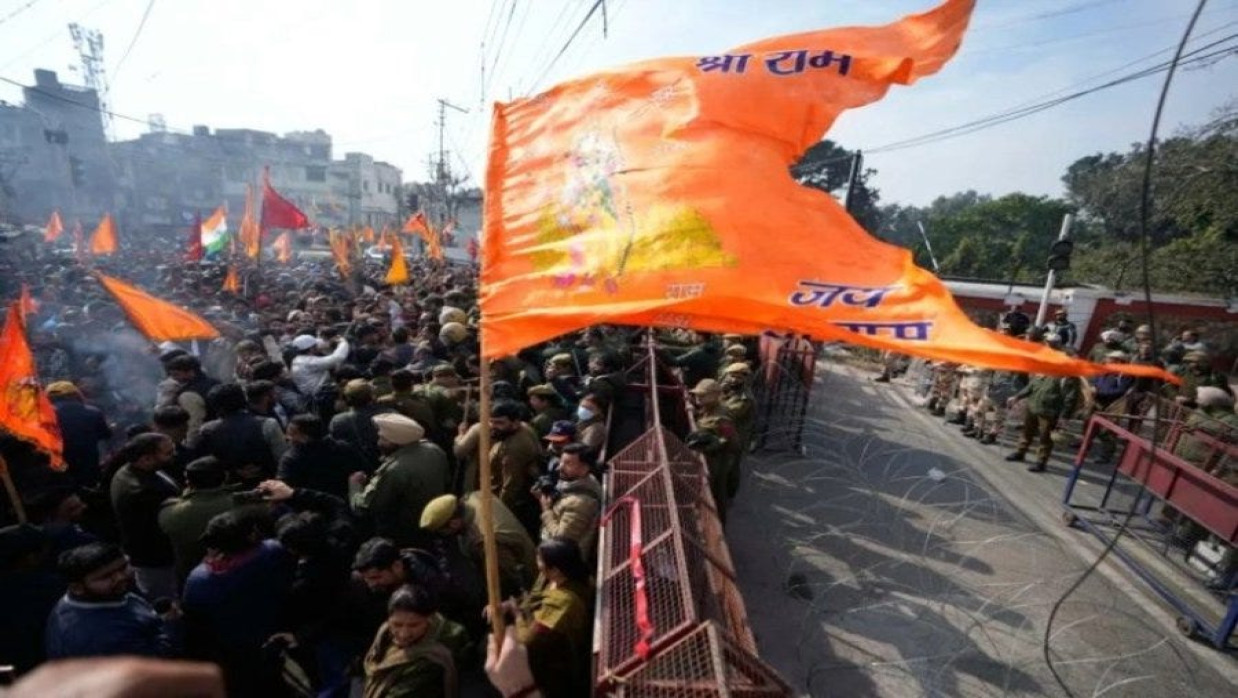
India has undergone significant political changes over the last thirty years. Hindu nationalism first gained steam in the 1990s with riots, marginalization of Muslims, Hindu majoritarian politics, and finally the destruction of the Babri Masjid in 1992. Narendra Modi’s BJP rode to victory on the back of Hindu nationalism, breaking away from the political consensus of post-independent India. The BJP began as a cultural movement before transitioning into political majoritarianism by remaking India in its image, seeking to define Indian citizenship, belonging, and nationalism in Hindu terms.
The destruction of Babri Masjid signified more than mob rule and arson. As Hindu nationalists rode the wave of support for the Ram Janmabhoomi movement, aided by organizations like RSS, they took Hindu nationalism from the margins to India’s central political arena. Decades later, Hindu nationalism, led by the BJP, has established significant control at the central level, seeking to remake institutions and information through media and national dialogue. Hindu nationalism operates on the idea that India is first and foremost a Hindu civilization, with minorities, particularly Muslims, treated as second-class citizens or outsiders.
Repression, Media Consolidation, and Shrinking Democratic Space
Restricting dissent is another major trend. In recent years, reporters, scholars, activists, and opposition leaders have faced increasing crackdowns through prosecutions, surveillance, and harassment. Measures ostensibly targeting terrorism and sedition have been used against government critics. Academic institutions have been politicized through ideological bullying and bureaucratic reshuffling.
The mass media have been consolidated into pro-government corporate conglomerates. Broadcast stations and print publications have been consolidated into holdings dominated by politically connected ultra-rich families. Investigative journalism has largely given way to heated nationalism, broadcasting hypocritical state propaganda, and demonizing critics. Independent media are covering some of these stories, but face enormous pressure as they struggle to break through on digital platforms.
Media consolidation is not new to India; most Western democracies have faced similar trends in recent years. The United States continues to grapple with increasing polarization in its media as the big three cable news networks cater to liberal and conservative audiences. Israel also faces similar issues with their government trying to limit the Supreme Court's power and silence critics. Checks and balances within democracy seem to be faltering everywhere.
The Normalization of Hate and Violence
In India, perhaps the most frightening trend is how ordinary violence and hate crimes against Muslims and other minorities are becoming normalized. Mob lynchings, hate speeches, and anti-Muslim citizenship laws have manufactured fear in our society. Last year’s draconian Citizenship Amendment Act (CAA) rightly received pushback from all corners of society for linking religion with the notion of belonging.
Fear-mongering works because dehumanization is effective politics. Painting minorities as threats to demographics, culture, and national security only makes way for rationalized violence against them. Calling people “anti-national” or “terror sympathizers” is a time-tested tactic used globally by autocratic populist forces to silence any sort of criticism against them.
Cultural Narratives: Bollywood and the Politics of Representation
Organizations built around culture are important to mass consciousness. Sections of Bollywood have churned out cinema that celebrates hyper-nationalism. Movies demonizing and stereotyping Muslims have also increased. They support the times we live in politically by justifying majoritarian fervor. Hollywood is guilty of pandering to nationalism, too, but it has also hosted cinema and TV shows deriding authoritarianism, questioning the might of the state. That's why resistance through creative expression matters. Artists can choose to either give voice to the powerful or ridicule them for their hypocrisies.
Kashmir and Gaza: Parallels of Occupation
Indian occupation of Kashmir saw further international backlash when Article 370 was revoked in 2019, followed by the lockdown of Kashmir. Kashmir remains militarized, with a communications blackout. People are unable to protest politically or exercise some basic human rights. India has been accused of apartheid for having democratic systems in place while suppressing the people of Kashmir. Comparisons have been made to Gaza and Palestine. Palestinians and Kashmiri Muslims are subjected to mass surveillance. Israel and India control Palestinian and Kashmiri airspace through military might. Both regions operate under the pretext of security. Human rights violations have been accused in both regions. The dehumanization of Palestinians and Kashmir Muslims has been on parallel trends. India has abandoned their support of Palestine and has been moving closer to Israel. They have collaborated on military and intelligence. Some believe the connection is deeper, reflecting each other's ideologies of ethnic majoritarianism and Hindutva.
The Global Authoritarian Playbook
Echoes of India’s playbook are visible around the world. These include the “authoritarian playbook” moves like attacks on universities, delegitimization of independent media, weaponization of citizenship laws, and the ushering in of policies that concentrate economic benefits among pliant elites. American democracy faced a similar stress test when insurrectionists breached the U.S. Capitol on Jan. 6. Even if that attack failed at the institutional level, the ideas that powered it continue to simmer. There is perhaps no better example of how media consolidation bolsters nationalist governments in both India and the United States than how shrinking the debate to mainstream outlets weakens democracy when legitimate questions are branded as anti-national.
Resistance, Realism, and Solidarity
But democracy dies slowly. Activists, students, writers, and organizers will continue organizing. It will take bravery and innovation, but dissent persists. And sometimes it demands very little of us. Today we dissent by listening and organizing in our communities, however we can.
It also demands realism. Resistance movements in India are divided. They will fight to win future elections, but they might lose. The same can be said of democracies around the world that are flirting with majoritarian politics. Authoritarianism isn’t one-size-fits-all. Each iteration wears the face of the country it’s happening in, but often uses similar strategies.
Our democracy is only as strong as we are; our Constitution is made of flesh and blood. Newsrooms and media companies will have to choose whether or not to allow ethno-nationalist propaganda spread across their platforms.
When it comes to upholding basic human rights, we have to stand in solidarity with our brothers and sisters in Kashmir, Gaza, Delhi, Washington, Tel Aviv, and New York. These are not binaries. Authoritarianism takes various forms worldwide. Freedom is a constant battle. It’s fragile. And we have lost bits and pieces of it before. But we have also fought back before and won.

0 Comments
LEAVE A COMMENT
Your email address will not be published