

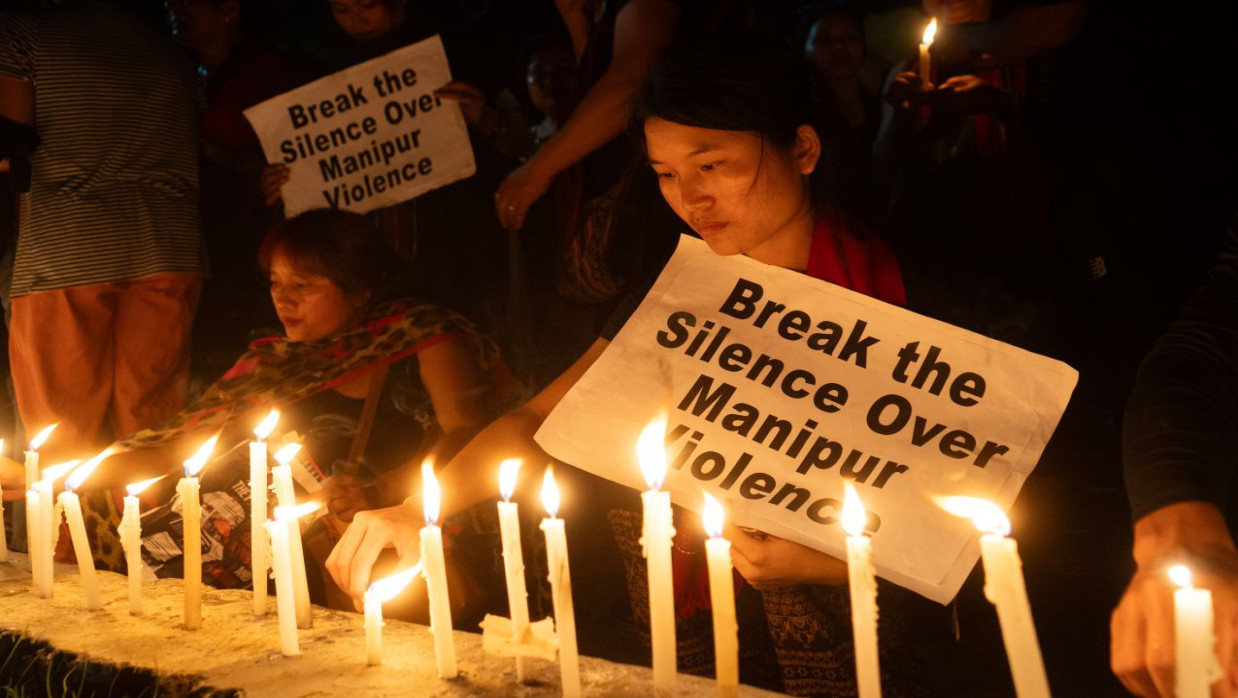
Nearly three years after ethnic violence first engulfed Manipur in May 2023, the crisis remains unresolved, festering beneath the veneer of administrative control. The protests that swept Manipur on 31 January 2026—by both Kuki-Zo groups demanding autonomy and Meitei groups insisting on territorial integrity—underscore a grim reality: President’s Rule has failed to heal a deeply fractured society. Instead, it has frozen a conflict whose root causes remain unaddressed, while the human cost continues to mount.
For the Kuki-Zo community, the conflict is no longer framed as sporadic ethnic unrest but as a sustained campaign of marginalization, violence, and dispossession. Comprising more than 30 indigenous tribes largely inhabiting Manipur’s hill districts—such as Churachandpur, Kangpokpi, and parts of Tengnoupal—the predominantly Christian Kuki-Zo population views the violence as an existential threat. Their demand for a separate administration, possibly in the form of a Union Territory, reflects not political ambition but a collapse of trust in the state’s ability to protect them.
The origins of the conflict lie in structural inequality. The Meitei community, largely Hindu and politically dominant, controls the Imphal Valley—only about 10 percent of Manipur’s land but home to over half its population and the seat of political power. In contrast, tribal communities occupy the hill districts, which make up nearly 90 percent of the state’s territory but remain politically and economically marginalized. Kuki-Zo groups argue that proposals to grant Scheduled Tribe status to Meiteis would fundamentally erode tribal protections, enabling land acquisition in the hills and accelerating demographic and cultural encroachment.
Violence erupted in May 2023 following peaceful tribal protests against such measures. What followed was catastrophic. According to Kuki-Zo organizations, Meitei mobs, allegedly mobilized in large numbers, carried out arson, killings, and sexual violence. More than 7,000 Kuki-Zo homes and over 350 churches were destroyed. Reports of women being gang-raped, paraded naked, and murdered shocked the conscience, yet accountability has remained elusive. By conservative estimates, over 260 people have been killed, with Kuki-Zo groups asserting that their community has borne a disproportionate share of the brutality.
The resignation of Chief Minister N. Biren Singh and the imposition of President’s Rule in February 2025 were expected to mark a turning point. Instead, violence persisted into 2026. While central forces were deployed and arms recovery drives initiated, Kuki-Zo groups argue that these measures focused more on suppressing their autonomy movement than addressing the underlying grievances. Policies such as the resumption of “free movement,” eviction drives in forest areas, and the framing of Kukis as “narco-terrorists” or “illegal infiltrators” further deepened alienation.
In response, Kuki-Zo resistance has evolved. What began as peaceful protest has, in many areas, transformed into armed self-defense. Village volunteers and revived militant groups now patrol hill areas, viewing themselves as the last line of protection amid perceived state failure. While Kuki-Zo leaders acknowledge instances of counter-violence, they frame these as defensive reactions to relentless aggression rather than instigation.
Meanwhile, Meitei groups have mounted their own mass mobilizations. The “Save Manipur” rally in Imphal on 31 January 2026 demanded the abrogation of ceasefire agreements with Kuki militant groups and rejected any form of territorial separation. For Meiteis displaced from border areas, autonomy demands are seen as a threat to Manipur’s unity. This zero-sum framing—autonomy versus integrity—has hardened positions on both sides.
What is striking is the silence at the highest political level. Critics argue that Prime Minister Narendra Modi’s reluctance to directly address the crisis has reinforced perceptions of indifference. Opposition parties, civil society, and international human rights organizations have repeatedly highlighted failures in governance, accountability, and reconciliation. Appeals to international bodies, including the UN High Commissioner for Human Rights, reflect the Kuki-Zo community’s belief that domestic remedies have been exhausted.
At its core, the Manipur crisis exposes the limits of securitized governance. President’s Rule may suppress immediate violence, but it cannot substitute for a political solution grounded in equity, justice, and mutual recognition. The Kuki-Zo demand for a separate administration is not merely a territorial claim; it is an indictment of a system they believe has consistently failed them.
Without credible investigations into atrocities, rehabilitation of over 60,000 displaced persons, recovery of looted weapons, and a political framework that addresses historic grievances, peace will remain elusive. The longer the status quo persists, the deeper the ethnic divide grows—raising the risk that Manipur’s conflict could spill beyond state borders. Manipur today is not simply a law-and-order problem; it is a test of India’s federal promise. Whether the state chooses dialogue over denial will determine whether this unhealed wound finally closes—or continues to bleed.

0 Comments
LEAVE A COMMENT
Your email address will not be published