

“Humanity-First” becomes the logic behind India’s preference for platforms, openness, and restraint, not a banner it waves.
A Shift Without a Shock
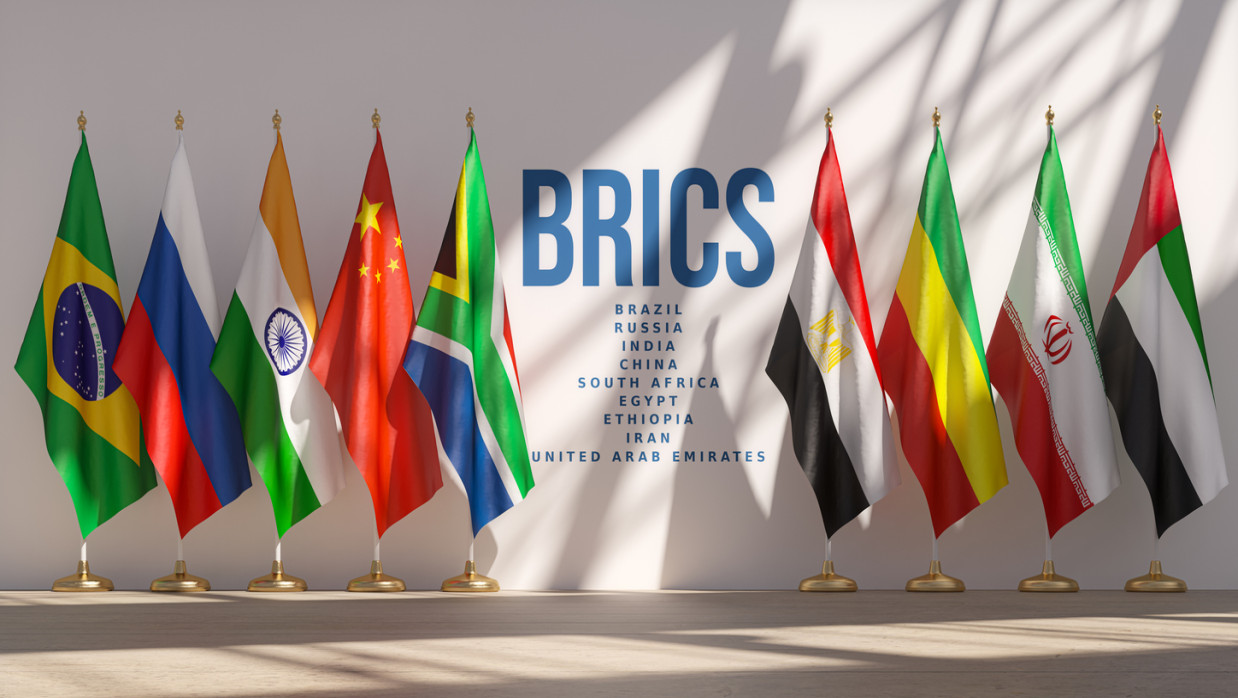
The expansion of BRICS into BRICS+, incorporating the UAE, Iran, Egypt, Ethiopia, and Indonesia, has unfolded without dramatic declarations or geopolitical theatre. There has been no manifesto, no military alignment, and no formal rupture with the West. Yet this understated evolution masks a deeper transformation. Bigger, bolder BRICS is quietly reshaping the world order toward a multipolar and partially de-Westernized system, through institutional accretion and agenda-setting rather than open confrontation.
For India, this shift is not peripheral. It is central to how New Delhi navigates a world where Western dominance is eroding unevenly, Chinese power is expanding asymmetrically, and strategic autonomy has become both harder to sustain and more valuable to preserve, particularly when that autonomy is framed not only as state freedom of action, but as the capacity to protect populations from systemic shocks. As of January 2026, with BRICS representing roughly 40 percent of global GDP (PPP), around 49.5% of the world’s population, and nearly 26% of global trade, the grouping has moved from symbolic shorthand to a primary arena of Indian statecraft. That evolution, however, also exposes a core tension: BRICS’ growing relevance derives less from unity of purpose than from the absence of viable alternatives for much of the Global South.
BRICS Expansion and the Reality of Power Redistribution
What began as a descriptive acronym has matured into a political platform reflecting long-standing imbalances in global governance. BRICS expansion brings together energy producers, regional hubs, demographic heavyweights, and fast-growing economies, increasingly mirroring the real distribution of population, resources, and growth rather than the post-1945 allocation of institutional power.
Yet expansion is not synonymous with coherence. The inclusion of major energy producers - UAE, Iran, and Russia in particular - strengthens the bloc’s collective leverage in global commodity markets, but it also introduces divergent threat perceptions, sanctions exposure, and geopolitical alignments. This duality underscores a recurring theme: BRICS’ strength lies in representativeness, while its weakness lies in coordination.
This matters because global institutions have failed to evolve at the same pace. Voting shares, leadership norms, and agenda-setting power in the IMF and World Bank remain disproportionately Western. BRICS expansion is therefore less a rejection of the existing system than a response to its inertia. Through the New Development Bank (NDB), and Contingent Reserve Arrangement (CRA), BRICS offers an alternative development-finance channel that emphasizes borrower ownership and reduced political conditionality, though its scale still lags behind legacy multilateral development banks. The member countries hope that these alternative financial institutions “can invigorate South-South cooperation and reduce dependence on traditional funding sources”.
The Indo-Pacific: From Theatre of Competition to Engine of Prosperity
The strategic relevance of BRICS must be understood through the Indo-Pacific, now the principal engine of global growth. Home to the world’s busiest sea lanes, densest supply chains, and fastest-growing consumer markets, the region’s defining feature is economic centrality rather than military rivalry.
BRICS expansion reinforces this reality by embedding South–South trade, finance, and digital connectivity more deeply into Indo-Pacific growth corridors. This article’s emphasis on the Indo-Pacific also serves as a corrective to Atlantic-centric analyses: future prosperity will be shaped less in transatlantic institutions and more across networked platforms spanning Asia, Africa, and the Middle East, where India occupies a uniquely central geographic and institutional position. However, a BRICS-led future in the Indo-Pacific will largely hinge on whether China and India can manage their rivalry while pursuing meaningful collective action.
India’s Role: Not a Participant, but a Constraint on Concentrated Power
For an Indian strategic audience, one truth must be stated plainly: India functions as the principal internal constraint on the concentration of power within BRICS.
Without India, BRICS risks drifting toward a China-centric architecture, one reflecting Beijing’s preferences for hierarchy, scale-driven influence, and bilateral leverage. India’s insistence on consensus, institutional pluralism, and non-ideological cooperation slows decision-making, but it also prevents capture, anchoring BRICS in outcomes that remain defensible not just to states, but to societies increasingly exposed to financial, technological, and health disruptions. This is not passive balancing; it is structural leadership exercised through process rather than dominance.
At the same time, it would be analytically incomplete to portray India as merely a veto player. India increasingly seeks to define what BRICS does, not just what it avoids doing, a shift most visible in the 2026 presidency.
Strategic Autonomy: Multi-Alignment by Design
India’s BRICS engagement is often mischaracterized as hedging. In reality, it reflects active strategic autonomy- using multiple, overlapping platforms to prevent over-dependence on any single power center.
India’s simultaneous presence in BRICS, the Quad, and the G20 is not a contradiction; it is a design feature of its foreign policy. Each forum serves a distinct function:
- In BRICS, India advances Global South interests and reforms global economic plumbing.
- In the Quad, it reinforces maritime openness and regional balance.
- In Western partnerships, it supports rules-based stability without surrendering autonomy.
This multi-alignment underpins India’s credibility as a bridge rather than a bloc leader, an identity that shapes its 2026 presidency.
The Strategic Test of 2026: Leadership Through Platforms, Not Hegemony
India’s 2026 BRICS presidency arrives at a moment when the bloc is simultaneously more consequential and more fragile. Expansion has amplified BRICS’ weight, but it has also magnified internal tensions. India will preside not over a cohesive alliance, but over a diverse coalition whose unity depends on functional outcomes rather than ideological alignment.
Prime Minister Narendra Modi himself set the tone for India’s 2026 BRICS presidency at the 17th BRICS Summit in Rio de Janeiro on July 7, 2025, stating that India would lead the forum with a people-centric approach guided by the spirit of “Humanity First.” Drawing on the inclusivity of India’s G20 presidency, he emphasized that the concerns of the Global South would remain central to the BRICS agenda.
Crucially, India’s 2026 presidency theme, launched by the External Affairs Minister Dr. S. Jaishankar - Building for Resilience, Innovation, Cooperation, and Sustainability, that claims to draw inspiration from the PM’s stated vision for BRICS, is not rhetorical. It reflects a conscious attempt to shift BRICS from declaratory politics toward platform governance, with Digital Public Infrastructure (DPI) and open-source systems at its core.
- Managing Expansion Without Agenda Dilution
India’s first challenge is to prevent expansion from hollowing out effectiveness. The risk is not fragmentation alone, but “agenda inflation”, too many priorities, too little delivery.
India’s response emphasizes:
- Preserving consensus on core economic and development issues while avoiding geopolitical overreach.
- Functional sub-groupings on energy transition, health, digital public goods, and disaster resilience, allowing progress without unanimity on security or ideology.
This pragmatic modularity reflects lessons drawn from India’s G20 presidency, now applied to BRICS.
- Digital Public Infrastructure as the Presidency’s Anchor
India’s most distinctive contribution lies in elevating Digital Public Infrastructure (DPI) from a national success story to a shared BRICS development model.
India’s DPI stack, or simply, “India Stack” - Aadhaar, UPI, DigiLocker, Account Aggregator, and open health and education platforms - demonstrates how population-scale digital systems can be built as:
- Public goods, not proprietary monopolies
- Interoperable and open-source, not vendor-locked
- Regulated but innovation-friendly, not extractive
During its presidency, India is positioning DPI as:
- A financial resilience tool, through interoperable payment systems and local-currency settlement that reduce exposure to external shocks without forcing de-dollarization.
- A state-capacity multiplier for BRICS members with limited fiscal space but high digital adoption potential.
- A counter-model to both Western privatized platforms and China’s state-centric digital export model.
Crucially, India frames DPI not as “Indian technology” but as open digital public goods- transferable, adaptable, and locally governed.
India’s articulation of a “Humanity-First” approach is most credible here, not as rhetoric, but as architecture. By treating identity, payments, and data rails as public infrastructure rather than extractive assets, India reframes development away from elite capture and toward population-scale inclusion. In BRICS, this approach offers a politically neutral answer to a shared problem: how to digitize at scale without surrendering sovereignty or social trust.
- Open Source as Power-Limiting, Not Value-Exporting
Closely linked to DPI is India’s push to normalize open-source governance within BRICS.
Open-source is not presented as ideology, but as strategic infrastructure:
- It lowers entry barriers for developing states.
- It prevents technological dependency on any single power.
- It enables collective auditing, trust, and sovereignty over data and systems.
Recently, at the 28th Conference of Speakers and Presiding Officers of the Commonwealth (CSPOC) 2026 in New Delhi, Prime Minister Narendra Modi stated that India is developing open-source technology platforms to help partner nations in the Global South build systems similar to those used in India.
By foregrounding open standards and shared codebases, India subtly constrains China’s scale advantage while avoiding direct confrontation, a recurring pattern in India’s BRICS strategy. Framed this way, open-source governance becomes a quiet expression of India’s people-centric logic, limiting the concentration of power not by norm enforcement, but by making domination structurally harder to sustain.
- Reforming the NDB and Delivering Tangible Outcomes
India’s presidency also prioritizes making the New Development Bank more credible and usable:
- Streamlining lending processes
- Mobilizing private capital
- Aligning NDB financing with DPI-enabled service delivery rather than only physical infrastructure
Symbolism alone will not sustain BRICS. India’s wager is that platforms that work will outlast declarations that divide.
- Currency Cooperation: Technical Pathways and Challenges for BRICS CBDCs
India’s central bank has suggested connecting the digital currencies of BRICS countries to enable smoother cross-border payments for trade and tourism, a move that could lessen dependence on the U.S. dollar. The proposal, slated for discussion at the 2026 BRICS summit, expands on earlier efforts, also a declaration made at the 2025 summit in Brazil, to promote interoperability between member nations’ payment systems.
As India takes over the BRICS presidency in 2026, the proposal to link member countries’ digital currencies reflects a strong technical thrust aligned with India’s advocacy of Digital Public Infrastructure (DPI) and open-source frameworks. At a technical level, the initiative would require interoperability between diverse central bank digital currency (CBDC) architectures, common messaging standards, secure cross-border settlement layers, and robust identity, authentication, and compliance mechanisms. Leveraging open-source protocols could help ensure transparency, scalability, and adaptability across varied national systems.
However, the proposal also faces significant technical and operational challenges. These include harmonising different regulatory and monetary frameworks, ensuring cybersecurity and data privacy across jurisdictions, managing real-time settlement risks, and addressing issues of governance, dispute resolution, and system resilience. Variations in technological maturity among BRICS members, along with concerns over sovereignty and control of digital currency infrastructure, further complicate implementation.
While efforts to develop secure and efficient payment mechanisms that bypass the dollar are likely to strengthen financial autonomy for BRICS nations, they are also bound to irritate the U.S.
Successfully navigating these challenges will be critical for translating India’s DPI-driven, open-source vision into a functional, trusted, and geopolitically significant BRICS-wide digital payment ecosystem.
- Avoiding the “Anti-Western” Trap
As global polarization intensifies, there is increasing pressure to cast BRICS as an explicitly anti-Western bloc. India has consistently resisted this framing, positioning the group instead as non-Western without being anti-Western. Its approach emphasizes reform over revolution, pluralism over rigid ideology, and complementarity rather than exclusion.
This careful rhetorical stance is as critical as policy implementation itself. Maintaining credibility with middle powers and development partners depends not only on what BRICS does, but on how it is perceived. India’s insistence on avoiding ideological polarization also reflects a broader, people-centered logic: framing global governance in stark bloc terms may heighten systemic risks for societies far earlier than any strategic advantages accrue to states. By prioritizing inclusivity and measured reform, India seeks to safeguard both the functionality of BRICS and the stability of the wider international system.
Conclusion: Determining the Shape of Multipolarity
India’s 2026 presidency will not be judged by dramatic breakthroughs, but by whether BRICS emerges more usable, more balanced, and more credible as a problem-solving platform. Success means institutional restraint, functional innovation, and the normalization of open, shared infrastructure. Failure risks drift, either toward Chinese centrality or toward institutional irrelevance.
Ultimately, India’s challenge is not to transform BRICS into something it is not, but to prevent it from becoming something it should not be. In a world of negotiated multipolarity, India’s leadership will be measured less by dominance than by whether it can keep the system open, plural, and structurally balanced.

0 Comments
LEAVE A COMMENT
Your email address will not be published