

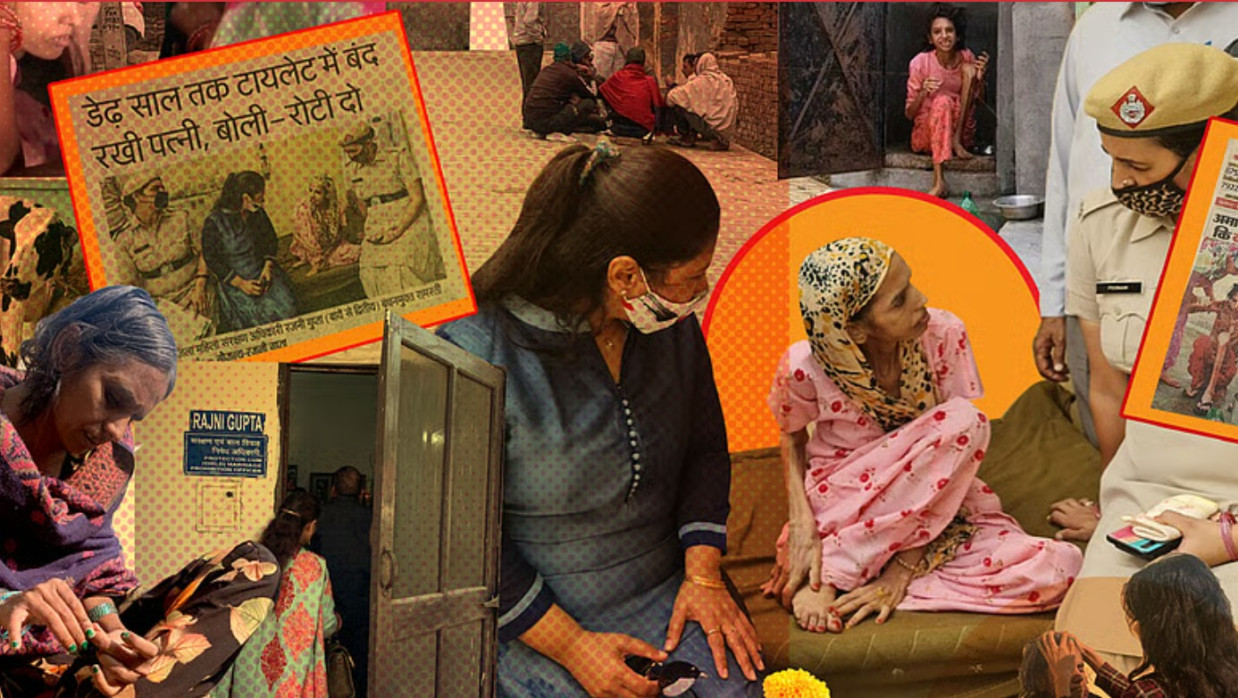
ON THE EVENING of 12 October 2020, a stranger tiptoed into the office of Rajni Gupta. Her files almost packed up, computer powering down, Gupta was about to call it a day. But the man carried a piece of information that would make her tremble even years later.
For two years, he said, a man had been holding his wife captive in the most horrifying circumstances. And Gupta, a women’s protection officer in the northern Indian state of Haryana, must rescue her. “But,” warned the man, asking that his identity remain secret, “do not inform the police.” Whisper networks in Indian villages are incredibly strong, and Naresh, the woman’s husband, would likely learn about any rescue attempt in advance.
“But why are you telling me now, after all these years?” Gupta asked, perplexed.
“Because he has gone too far,” the man replied.
Gupta works with the Indian government. Her job is to help survivors of gender-based violence understand their rights, get legal assistance, file court applications, and access shelter homes and other services. Under the law, she could not raid the couple’s home without involving the local police. Besides, things could take a dangerous turn.
So the two devised a plan: at the crack of dawn the next day, the man sauntered into the alleys of Rishpur village, laden with thick grey smog and the smells of autumn. Once he arrived outside Naresh’s two-storey home with its speckled grey walls, he shared his location with Gupta from his phone.
Within minutes, she was on her way there with her team of five, driving past fields of wheat, mustard and sugarcane along the highway that connects Rishpur and its few hundred families to the rest of the world. Ten minutes before they were to reach their destination, she informed the local police; they would take 20 minutes to reach Naresh’s home, giving her just enough time to conduct the raid and have them on the scene for protection if need be.
As luck would have it, the lofty metal gate guarding the courtyard of the house was ajar. The officers sneaked in and barged into a room on their left, where Naresh Rawal sat on a cot with a few other men from the village.
“Where is Ramrati?” they asked about his wife.
Befuddled, he got up and offered them a place to sit. “Hey, get them some chairs,” he directed the other men. But the team wasn’t interested in small talk: “Where is she?”
“Upstairs,” he said finally, walking out into the columnated courtyard, also used as a barn. Gupta’s team followed him, hurrying past sullen-looking buffaloes and dung cakes gridded neatly on the floor. “This space is sparkling clean for a barn area,” Gupta thought as she walked behind Naresh, who led everyone up a narrow staircase and onto an open verandah.
On one side of it stood two dark, minimally furnished rooms. On the other was a square platform, some two feet high, that acted as a terrace. In the right corner of this was a curiously small brick structure with a steel door, locked from the outside. Naresh jumped onto the terrace in one big leap and banged open the door.
What she saw inside still gives Gupta goosebumps.
WHEN RAMRATI was taken out of the bathroom, measuring no more than three feet on each side, she could not walk or even stretch out her legs. Her hair was dishevelled, her body covered in faeces. Her teeth were stained, and many were missing.
The inside of the door had been scratched in several places. There was an Indian-style toilet set into the floor, but no tap or bucket inside. Some water slipped in through the door on occasion was all there was to take care of flushing.
The officers stared in horror. Naresh appeared tense and scared but showed “no regret, there wasn’t a hint of it on his face,” Gupta recalled.
Soon the local police arrived. Soon the chatter spread across the village and the neighbours gathered on the verandah: “What?” “How?” “What next?”
They knew.
Many of them had heard Ramrati screaming from inside the bathroom. But an intervention could have turned into an ugly altercation – or worse, a nasty fight with Naresh, who some said didn’t talk much but was very abusive in arguments. So they chose to stay silent, for which they later apologised to Gupta.
A few women from the neighbourhood built a fire in a clay stove near the staircase and put on some water to bathe Ramrati. But she was famished, weighing just 35 kilograms. So they scrubbed her hands clean and fetched some food from the open kitchen set on the floor across the verandah. People in the village did their cooking early, so there were piping hot chapattis ready. Ramrati gobbled up eight of them. Then she guzzled down two cups of chai – she loved chai, the hotter the better. “She ate like she hadn’t eaten in years,” Gupta remembered. After that, the women bathed her.
When they finally sat her down, freed, fed and freshened up, outside the toilet where she had spent two years of her life, she ran her bony fingers over the bangles around one of the officers’ wrists. Bangles, lipstick, nail polish: Ramrati used to love them all. Before her confinement, she would put on a brightly coloured salwar-kameez, some makeup and jewellery, and make merry at village gatherings, weddings and the spring festival of Holi.
Naresh thought he had good reason to confine her: Ramrati was “crazy”. And she was a stubborn and violent woman, who didn’t do household chores, spilt food on her clothes and demanded to be fed very often. She had frequent accidents of incontinence, since she was unable to communicate the need to use the bathroom, and this is why he had no choice but to do what he did, he allegedly told the authorities – something he denied when I met him in December 2023.
As the police interrogated Naresh, the couple’s three children walked in. Aged 16, 13 and 11, dressed neatly in school uniforms, they put their bags down and looked around in confusion. To the questions that came their way, they repeated what their father had said: their mother was mentally unstable.
The eldest child, Ramrati’s only daughter, refused to touch her mother, Gupta told me when I met her for the first time, in April 2021. “I looked over at the barn area. The neatly dressed kids, this clean area… they all triggered a strange sense of anger in me,” she said. “I still can’t wrap my head around the fact that their buffaloes looked cleaner than the woman of the house.”
As the sun settled in the sky, the police took Naresh in. They charged him under Section 498A and Section 342 of the Indian Penal Code for cruelty to his wife and her wrongful confinement.
The next day, he secured bail and walked out of jail.
RAMRATI’S STORY drew immense media attention over the following weeks. Journalists from various news outlets and officials from various government departments descended upon the small village.
Past the sensational headlines, I was haunted by Ramrati’s story and the questions that arose in my mind: What happened to her afterwards? Where did she go after the rescue? Was she ever able to recover? How was she able to sleep in the bathroom? Did she have any dreams there? What did she do during her periods?
And what happened to Naresh? Was he still close to their children?
After the media circus died down, I travelled around Haryana to meet Ramrati and Naresh, their children and relatives and neighbours, and anyone else I could think of – doctors, activists, researchers, lawyers, government officials, police officers, people managing government-instituted shelter homes – who could give me answers.
There was so much to the story that never made it into the media.
SOME PEOPLE are smart. They are clever enough to know what to do, where to sit, what not to wear. Ramrati isn’t. That’s what her family told her father-in-law before they married her off to Naresh around 25 years ago.
She may not be the brightest person around, her family continued, but she is not the dumbest either, not too active but not entirely incapable of taking care of herself. She is, as many would say in rural Haryana, “bholi” – literally meaning innocent, but practically meaning someone who is not street smart. In this case, it would mean someone who may need to be told to clean the house, to cook the meals and do the laundry.
“You tell her to wash the dishes, she would. But if you don’t, she might just sit in a chair the whole day,” Sunil Kumar, Ramrati’s cousin, told me as we sat across from each other at his home in Kiwana, Ramrati’s natal village in Panipat district. “And if she happens to sit in that chair for, let’s say, four days in a row, she won’t let anyone else sit in that chair.”
Ramrati likely inherited these traits from her mother, Sunil said, although the older woman is “far better”. Her mother doesn’t sit idle, she roams around the house with ease, she does the chores, then sits down to talk to others. When they meet, Sunil said, she makes it a point to ask after him: “How are you doing, Sonu?”
“You see, this is normal behaviour,” he said. “It is informed by the expectations of society. It conforms to the norms.” Ramrati’s doesn’t.
Now in her 40s, Ramrati lost most of her immediate family years ago: her father when she was barely a teenager, her brother about a decade ago. And her mother, who is a little “bholi” like her, lives in another city and hardly visits. After Ramrati’s release from the bathroom, Sunil and his family assumed the responsibility of providing and caring for her.
“We always used to take extra care of her,” Sunil said, describing their shared childhood.
“You see, there were no daughters in our family, not even in the older generation,” explained Bidya, Sunil’s mother, pressing her fingertips against a hot glass of chai. “She was the only one.”
“Did she ever complain of domestic abuse?” I asked them.
Sunil thought for a moment. “Aisi chhoti moti baatein…” he began – Just some minor things. He went on, “See, there were minor incidents. She used to share with us when she was in a healthier state. But it wasn’t like [Naresh] was beating her up every day or that he was breaking stuff in the house.”
“Aisi koi baat nahi, thappad-thuppad maar diya hoga ek do baar,” Bidya added – Nothing really, he may have just slapped her a few times.
On the evening of the day after the raid, when the news of Naresh’s arrest reached the family, they rushed to the police station where he was being held. They refused to file a complaint against him. Without an official complaint in such cases, the police usually cannot proceed further.
Sunil said that they did so because Naresh hadn’t actually confined Ramrati, she likely sat in the bathroom on her own and refused to get out. “I told you she was stubborn,” he said.
I confronted him with an old media report where his mother and younger brother had said they didn’t want police action against Naresh because it might also affect the children.
That’s when Sunil admitted: they also knew.
A FEW MONTHS before Ramrati’s rescue, when the sun pierced through the monsoon clouds, the two brothers went to Ramrati’s home for Raksha Bandhan – a Hindu festival to celebrate the bond between sisters and brothers. They saw Ramrati sitting in the bathroom. She pleaded with them to get her out: “Bhai, I want to go with you.” They didn’t.
“Yes, I was quite upset initially, but after a lot of thought and a conversation with Naresh, who assured us he would take better care of Ramrati, I concluded that he hadn’t confined her,” Sunil offered by way of explanation. “You see, we only visited her on festivals. We did see her inside the bathroom, but we thought it was due to her mental condition.”
“What about her physical condition? Her clothes?” I asked. “Was she neatly dressed?”
“They looked fine to me,” he said.
She did seem “a little weak,” Bidya murmured.
So Gupta became the official complainant (and witness) in the case. While Naresh secured bail in under 24 hours, Ramrati remained at the hospital for about a month. Weeks of physiotherapy helped straighten her elbows by a few degrees. Months of other physical exercises and high-calorie foods such as milk and ghee helped her get back on her feet. She cried for hours at a stretch but smiled when a visiting government officer wore bright lipstick.
She moved in with Sunil’s family after being discharged, and Bidya pushed her to walk a few kilometres every day. Twice a day, she would take her out to the family’s farms, where they would work on the wheat and mustard crops. Ramrati would gather the grass that Bidya cut – “Sometimes she did things right, sometimes she didn’t” – then sit down to munch on the radishes, turnips and beetroots the family grew that winter. “Those beetroots actually helped her haemoglobin levels go up,” Bidya grinned.
In mid-January, three months after the rescue, Gupta and her team made a surprise visit. Ramrati sat basking in the winter sun, chatting with her aunt and her cousins’ wives. The team asked her to show them around the house. She strolled around with ease, glided up and down a staircase, smiled as she spoke.
When they reached the kitchen, the officers asked, “What are you making for us, Ramrati?”
“Chai!” she quipped.
“And she did make the chai,” Gupta told me. “We were overjoyed.”
A few weeks later, Gupta received a WhatsApp message from Sunil’s younger brother: some photographs and videos of Ramrati dancing at a family wedding. “That’s when we stopped following up on her,” Gupta said. “It finally looked like everything was okay.”
Nine months later, Ramrati moved back in with her husband.
“Why did you bring me here? I want to go to my kids,” Bidya recalled her saying. So Naresh came one day and took her back.
HARYANA, in the heart of northern India, forms a rough crescent around the west of the country’s capital, Delhi. It spans thousands of villages like Rishpur, as well as pockets close to Delhi with glitzy multinationals and multi-lane highways. It is also home to a deeply disturbing reality: a historically poor sex ratio. There are 879 women for every 1000 men here as per the last Indian census, from 2011 – something largely attributed to people’s preference for sons.
The extremely skewed sex ratio, combined with an entrenched patriarchal culture, often isolates survivors of domestic abuse in Haryana, just as it does across India. Despite a high incidence of domestic abuse, only around 30 percent of such cases in the state – as well as in the country – are officially registered with the authorities. In the state of Telangana, around 75 percent women in one official survey reported being afraid of their husbands most of the time.
Physical confinement is common as an instrument to punish and discipline women, even if in most cases it lasts a few hours or days. In Ramrati’s case, of course, it lasted years.
In 2005, after years of campaigning by women’s groups for authorities to acknowledge gender-based familial abuse beyond the context of dowry, India brought in the Protection of Women from Domestic Violence Act. It broadened the definition of abuse to include emotional, verbal, economic and psychological violence. It also mandated the appointment of protection officers in every state to act as contacts between survivors and the police.
Various media reports have pointed out that protection officers are often overburdened and unavailable, and sometimes insensitive to survivors’ needs. Many states have yet to appoint enough officers to account for the burden of abuse cases, with survivors left facing grievous delays.
In 2015, Haryana established all-women police stations, or mahila thanas, primarily to work on gender-based crimes. But an extensive 2020 study found out that this hasn’t encouraged more survivors to report abuse or made justice more accessible to them. According to Nirvikar Jassal, the study’s author and an assistant professor of political science at the London School of Economics, in practice these police stations have turned into informal “counselling centres” where the officers very often talk survivors into going back to their abusive families.
“What is counselling? Are these trained counsellors?” Jassal asked when we spoke over a Zoom call. The officers’ paternalistic attitude and a tendency to prioritise marriage keeps many women from accessing formal justice. He said he observed during his research that, many times, women did want to file First Information Reports (FIRs), the first step in the criminal justice process in India, but they were discouraged by the police. “And it was also good for the system,” he said, referring to the massive overload of cases in the Indian courts.
In a separate study, published in 2023, Jassal looked at over 400,000 FIRs filed with the police in Haryana between 2015 and 2018. After merging them with judicial records, he concluded that women are disadvantaged at every stage of the criminal justice process.
Jassal discovered that women who suffer violence wait an average of nine hours at police stations while registering their complaints, as against the usual seven in other cases. They are more likely to have their cases stalled, dismissed or assigned to junior officers. Their cases are significantly less likely than men’s to be sent to the judiciary. And if they do reach the judiciary, they spend longer in court by over a month and are more likely to yield in the accused’s acquittal.
If a man files a complaint on behalf of a female friend or relative, Jassal found, he is less likely to face these same hurdles.
Gupta, looking back at Ramrati’s case, lamented the fact that the whole operation ended with Naresh easily securing bail. The police, she felt, probably did not explain the extent of his brutality to the magistrate he appeared before, who may have assumed that Ramrati was “crazy” and that Naresh had no choice. “I wish they had called me to the court when he was produced,” she said.
Gupta still could not understand why Naresh did what he did. “It would have been easier if he had just poisoned her. Who was going to ask anything? Who was going to complain?” she said. “You could have just said she accidentally ate something.”
Payal, a human-rights lawyer from Haryana, who reviewed the case documents on my request, said that the FIR lacked many important details about Ramrati’s condition. “If someone had fought for her, the police could have invoked more serious criminal laws, like those involving attempt to murder, instead of treating it as a domestic matter.”
The case against Naresh is still pending in a Haryana trial court. If convicted, he could face imprisonment for up to three years.
IT WAS A December morning in 2023. A phone rang at a women’s police station on the outskirts of Panipat, 25 kilometres from Rishpur and around 90 kilometres from Delhi. Gupta, who works out of the station, answered the call.
“I don’t feel safe inside my house,” said a terrified female voice, from a city 50 kilometres away. “My husband brutally beats me. He said he would kill me.” The other day, the woman added, “he locked me inside the house. My mother-in-law also refused to open the door.”
It was a Wednesday. “I will be there on Friday,” Gupta said. “If you need immediate help, call 112” – an emergency helpline. “The police will be there.”
“But if he finds out, he could get even more aggressive,” the woman said. “And can I go back to that house again after the complaint?”
“Of course you can,” Gupta said. “In fact, don’t leave your home until you find a solution.”
I spent the next few days with Gupta. Sitting in her one-room office, tucked behind amaltas trees, she met several women: one forced to quit her job, one who faced verbal abuse from her husband’s family, one beaten until she bled. One woman recounted details of sexual abuse by her brother-in-law while her husband watched. Some were accompanied by their parents; others came alone, too tired to tell their story one more time. One woman. who came lugging a big bag from another city, asked, “Can I write it instead?”
When the husbands were summoned, Gupta heard them out patiently, politely asking them not to interrupt her while she spoke. She shared legal remedies with the women, although in most cases she asked them to go for a mutual settlement. “Legal battles are long and arduous, kid,” she would often say.
“Aren’t there any state-run shelter homes?” I asked Gupta after she ended the call with the woman whose husband and mother-in-law had locked her inside the house.
“There are one-stop centres,” she said. But “we don’t legally guide a woman to leave the husband’s home – she might want to return there and the responsibility would lie with us. So we ask them to stay at the marital home for as long as they can. We will provide protection. But immediate protection doesn’t mean protection on the same day. It can take a week.”
These one-stop centres are run by India’s ministry of women and child development. Set up after the notorious 2012 gangrape in Delhi, which sparked outrage across the country and the world, they work to provide support to women survivors of domestic violence, human trafficking, dowry abuse and other such crimes. There are some 700 such centres in India – with one in each of the 22 districts of Haryana.
In the spring of 2024, I visited the centre closest to Rishpur. A yellowed poster taped to a wall in the corridor listed out “rules” for a happy marriage. Among them: no yelling over petty things, no harking back to old issues, the person complaining more during a fight is at fault.
Down the corridor, in a medium-sized room, five single beds stood close to each other, awaiting survivors. Four mattresses stood stacked together in a corner, in case there were more people to accommodate. Outside, there was a shared bathroom and a kitchen. A woman can usually stay at the centre for up to five days and can expect basics like food, sanitary kits and legal counselling.
Isha Verma Mann, who managed operations at the centre, said they get around 500 cases every year, and that around 20 percent of these pertain to domestic violence. At the time I visited, no one was staying there. “Most women get their heads straight within a day and go back to their homes. Nobody really stays here for the full five days,” she smirked. “See, we don’t believe in separating couples. We counsel both parties, and women also accept their mistakes. If someone is determined to seek a divorce, however, we don’t stop them.”
I asked a policewoman stationed at the centre if she usually noticed signs of physical abuse on the women who came there. “Not much, just a slap or a punch, usually,” she replied. “They often have bruise marks, but that’s because women’s skin is so sensitive.”
When Ramrati’s story broke, the staff at the centre followed the coverage. According to them, hers was not a case of domestic violence. She was mentally unstable, according to Mann, “and a trouble to her family. The fact that their children support their father – what does that tell you about her?”
Exact data is hard to get, but experts say that most survivors of domestic abuse are forced to go back to their marital homes.
A SCRAWNY FIGURE sat on the floor of a brick-paved verandah. She wore a shade between bright green and turquoise on her fingernails and toes, and a pair of silver anklets on her left leg. To an outsider, she may have seemed like someone brooding over something deep and dark, her head lowered and gaze fixed to the ground. But Ramrati’s children assured me that she was just soaking up the bright winter sun.
“I am a girl from Kiwana,” she chirped, referring to the village where she grew up. “Most of my family is dead, though.” These were almost the only sentences longer than two words that she would speak in our conversations over the past few years at her home in Rishpur.
She giggled, hummed and mumbled, mostly to herself, and gave me her wide, incisor-less smile countless times. But she barely talked. Her face lit up when I gifted her a set of turquoise bangles that, incidentally, matched her nail polish. “Have chai,” she would often say in her chirruping voice, but she clammed up the moment I asked her about her husband or the confinement.
A police constable who accompanied me on one of the visits felt that Ramrati was likely being threatened by her family, all of whom – the children, the husband, the cousins, the aunt – maintain that she has always been mentally unstable. With the same degree of assurance, they say that Naresh never locked her in.
“It’s a lie. We have enemies. Everyone has,” Naresh told me. He insisted that Ramrati would sit in the bathroom “on her own.”
“But the officers told me they freed her,” I said.
“No, she was sitting outside when they arrived.”
“The media reports also said you had confined and tortured her.”
“Na, ji. Not at all. Why don’t you ask her yourself?”
Ramrati giggled and crooned nearby, her knees folded up and gently touching her chest.
“But does she talk?” I asked.
“No,” he said. “But we are still putting up with her. Who else would do that?”
Naresh, like most other people in his village, is a farmer. He comes from the Gujjar community, which has considerable caste privilege in the village and the region. To his children, he is also a decent cook, a caregiver to his sick wife, and a father who sacrificed a lot to bring them up, with help from his sisters.
“My father is my mother,” Pooja, the couple’s daughter, said. She was barely 16 when the news of her mother’s confinement broke, followed by unexpected visits from various officials and media persons, and the long legal case against her father.
But, most of all, it was her mother’s illness that compelled her to grow up early, she said. As a child, she would alternate with her two brothers to go stay with aunts in various cities. There the children would spend long periods, almost forgetting who their parents were. As she grew up enough to take on household chores – and as the only girl in the family – it fell on her shoulders to also be her mother’s caregiver.
She bathes her, dresses her, feeds her; combs her hair, paints her nails and checks her clothes for menstrual blood.
One afternoon, I sat with the family in one of the two rooms on the verandah trying to speak with Ramrati. Suddenly, she rose from the cushioned cot where she was resting and leapt out into the verandah, expressing a desire to take a shower. As she unbuttoned her red knit cardigan, exposing a terribly small waist underneath a blue floral kurta, Pooja squatted by the stove to warm up some water. She then took her mother behind a sheet of cloth hung up outside the bathroom. Minutes later, the two were out again, back in the sun. Ramrati looked at her daughter affectionately as Pooja rubbed her hair dry with a towel and put kohl under her eyes.
Three years earlier, soon after the rescue, Gupta wrote to the Child Welfare Committee (CWC), a government body, urging it to provide counselling to the children and investigate the matter. She felt that the children might have been accomplices in the act. “If they are found to be guilty of having supported their father, action should be taken accordingly,” she wrote. Mukesh Arya, the CWC’s chairperson at the time, recalled that his team found nothing alarming during the counselling session.
“We never received love from our mother,” Pooja told me. Her brother Sahil, leaning against a cot, nodded. “Our Papa-ji raised us. He did everything for us,” she said.
BUT WHAT mental issues did Ramrati have, exactly?
While everyone around Ramrati talked about her mental health, during my early reporting nobody could name her disorders. I didn’t find this detail even in the documents I accessed at Gupta’s office. When I asked Ramrati’s cousins and aunt, they mentioned “some stress and tension in her nerves.” A few weeks later, when I asked Naresh the same question, he said, “It’s something related to the brain. She feels pain in the nerves.”
Some time after the birth of her last child, Ramrati’s behaviour grew strange, according to her natal family. She spoke often, for example, about troubles with Naresh’s family – but her cousins interpreted this as a sign of lethargy and madness. They took her to a traditional healer, who suggested they take her to a doctor.
Psychiatrists at various hospitals did a lot of medical tests on her, Sunil claimed. When I asked to see the documents to better understand her condition, he said his family had given them to Naresh. Naresh confirmed that he had the papers until he was involved in a road accident a few years ago and lost most of them.
When I requested to see the medicines Ramrati had been taking for her mental health, her children showed me three pills: an antacid, a painkiller and a drug commonly prescribed to treat insomnia.
I went to see the doctor who had treated Ramrati immediately after her rescue. At the psychiatric ward of Panipat’s Civil Hospital, patients queued up outside the doctor’s office, silently but impatiently waiting for their turn. Inside, a red ribbon was tied across the room. On one side of it sat Dr Mona Nagpal at her desk; on the other stood her patients and their families, sharing their troubles and complaining about drugs that didn’t work.
Nagpal recalled diagnosing Ramrati with chronic schizophrenia, a condition whose symptoms usually include delusions, hallucinations, and disorganised speech and behaviour. But when I asked if Ramrati had experienced any hallucinations or delusions, her answer was no. The only florid psychotic symptom she displayed was an inability to communicate. Ramrati remained silent throughout their interview, Nagpal said.
“Could it be due to the trauma induced by confinement?” I asked.
“Definitely. It could be post-traumatic stress disorder,” Nagpal said.
PTSD develops after someone experiences or witnesses a traumatic event. It is often characterised by flashbacks, nightmares, severe anxiety and difficulty sleeping or concentrating.
I asked administrative staff at the hospital if they could check Ramrati’s medical records. After sorting through their archives for half an hour, they said the documents had gone missing, possibly due to the pandemic-induced chaos at that time.
Nagpal had sensed that Ramrati needed long-term admission for her atrophied limbs as well as her mental health. So she referred her to another government hospital – PGIMS, or the Pandit Bhagwat Dayal Sharma Post Graduate Institute of Medical Sciences, in Rohtak, another city in Haryana.
A few weeks later, I contacted the staff at PGIMS. Meanwhile, Naresh finally agreed to share some of Ramrati’s medical documents with me, claiming that she was still receiving treatment at the hospital.
But a psychiatrist there told me, on condition of anonymity and after reviewing the documents, that Ramrati never had any major disorder that needed regular intervention. She did experience anxiety and showed some behavioural changes, such as an inability to work and sleep, but these could be attributed to nutritional deficiency.
“There is no gross illness,” the psychiatrist said.
WHERE IS THE LINE between “madness” and common, treatable mental health disorders in a society where there are no open discussions about mental health? And how are people in such an environment supposed to react to these issues?
It appears, according to my investigation, that Ramrati’s relatively common disorders were exaggerated and misinterpreted as signs of laziness and madness by both her natal and marital families. These perceptions were then used to justify her long-term abuse and confinement by Naresh, which may have caused her further harm.
Hers is not an isolated case.
A few years ago, Sangeeta Rege, the former director of the Centre for Enquiry into Health and Allied Themes, a research centre in Mumbai, worked with a woman who, after being forced to live in a cramped space by her husband, did not talk for months. A doctor then diagnosed her with a serious mental disorder, which her husband and marital family used in a legal battle seeking divorce.
“There was no underlying mental health condition. It was just the circumstances they had created,” Rege told me. “They used it against her to say that she was mentally ill. It’s very easy to get fake certificates in the market.”
In Rege’s experience, this pattern is most commonly seen among men seeking to divorce or abandon their wives. She added that women with mental health issues and an inability to perform household tasks become easy targets of the labels “lazy” and “violent”, and for subsequent domestic abuse.
“Not that it’s very different in urban areas, but the stigma and lack of awareness is more in rural areas,” Rege said.
ONE DAY, Ramrati visited a friend close to her home. She wasn’t in, but Ramrati found the door open and saw some cash lying out in the open. She stashed it away underneath dried cow-dung cakes in the house and sneaked out.
A few days later, she heard her friend and her husband brawling on their verandah, frantically looking for the money. So she went back to their house, pulled the cash out and handed it over.
“She wanted to teach me a lesson. I was being reckless,” her friend said, smiling. She did not want to be named. “It was a lot of cash. She could have easily stolen it and I wouldn’t have even known. I can tell you she is the most honest woman in the world.”
In those days, about two decades ago, Ramrati used to laugh heartily. The two women would cook for each other, light some charcoal and tobacco in a hookah and puff on it, chatting for hours. Ramrati would sing and dance at social gatherings, celebrate festivals and talk to people around her.
Around 2006, a community health worker from the village visited her for a survey. Ramrati answered all the questions while she cooked and offered her chai. Another social worker asked her around the same time if her children could be taken out for a community event. She said, “Yes, but please don’t let them cross the road on their own.”
“Of course, she cared for her kids,” one of the workers told me.
I met with around ten people in Rishpur. All of them requested anonymity but said that Ramrati appeared perfectly functional to them in those years. The trouble apparently began after the birth of her first child. Multiple people told me that’s when Naresh started brutally beating her.
“He would beat her up over not making him food, over putting extra salt in his food, over chatting with her friends while she should be making him food,” one neighbour told me.
It also appeared, according to Gupta’s investigation, that Naresh was frequently locking her up inside a room.
Sunil and his family corroborated most of these accounts.
Someone who knew Ramrati well in the days before she was locked up, and who did not want to be identified, told me that not only Naresh but also his father had been involved in beating her up. Sick and dejected, she would often come back to her cousins’ home. They would “work on her health” and send her back.
“She was absolutely fine. He drove her crazy with all the torture,” Ramrati’s friend asserted.
Around 2014, the community health worker visited Ramrati again. This time, she saw her lying on a cot, almost lifeless, frail and sick, her house in a mess. The worker assumed that she was probably shaken by the murder of her brother some time ago. “Despite this, she asked if she could make us some chai,” the worker said. “We refused and left.”
After this, Ramrati’s condition appears to have deteriorated significantly, according to the accounts of her neighbours as well as her natal family. And as her health became worse, the episodes of confinement grew longer, finally ending with her locked in the bathroom.
From inside the bathroom, she would scream to her children. “O, Sahil. O, Pooja. Give me some water. Pooja, give me some water. Give me a chapatti,” her friend recalled her pleading. “And she used to call my name, I could hear it: ‘Open the door, please open the door.’”
Her screams would tear her friend apart. She would run away to block out the sounds that spilt out of the bathroom and onto the street. She would ask everyone around her to help Ramrati – “Please do it, it will earn you good karma” – but they were scared of the fights that could ensue.
The news spread around the village, but nobody intervened – not even when some of the villagers visited Naresh after his father’s death and saw Ramrati inside.
“Somebody lock Naresh up inside that bathroom for just a month and make him realise what he did,” her friend fumed when we spoke in the winter of 2023. “I want him punished.”
“Does he still beat her up?” I asked.
“I don’t know. But I hear her wailing all day sometimes,” she said.
Naresh denied that he or his father ever beat Ramrati, or that she still cries.
“She has seen a lot of pain,” Ramrati’s friend continued in a lowered voice. “She is still suffering. Now all I want is for the Almighty to rid her of her painful existence. She was my very good friend.”
Five years ago, after everyone refused to help Ramrati, her friend started feeling increasingly burdened with guilt. One day, she confided in a young man from the village and asked him what she could do to get Ramrati out.
“Tai, you want to get into a fight?” he said.
“Let them hurl abuses at me. Let them take me to court. Let them kill me! I am not scared of anyone anymore,” she replied.
So the man handed over his smartphone to the woman born decades before mobile phones took over India. Setting the camera to video mode, he taught her how to hold the phone straight and press the record button: “Remember, what you want to capture should be visible on the screen.”
Bearing these instructions and a determination to get Ramrati out of the bathroom, her friend climbed up to a neighbour’s terrace early one morning. While the village slept, she held the phone out and shot the small steel door behind which Ramrati sat, screaming and pleading for help.
She returned the phone to the young man. A few days later, he left for the office of Rajni Gupta.
IN THE FOUR YEARS that I stayed with the story, I couldn’t find all the answers I was looking for. I still don’t know how Ramrati slept inside the bathroom or if she had any dreams there. But as I moved further and deeper into my reporting, another question began to occupy my mind: what happens to her when I stop following up?
I wrote to Annapurna Devi, India’s minister for women and child development, and Manohar Lal Khattar, the local parliamentarian, to ask about the gaps in institutional support – including legal aid – exposed by Ramrati’s case. I also asked Khattar, who was the chief minister of Haryana at the time of the rescue, what steps his government had taken on the matter. Neither responded.
So I set off for Rishpur again, maybe for the last time, as 2025 drew to a close. I found Ramrati curled up on a cot on the verandah, snug under a shawl. She gave me her wide, incisor-less smile one more time and immediately held out her hand when I told her I had brought her some bangles. I had also come bearing some lipsticks and a bottle of nail polish.
Pooja had gotten married more than a year ago, as had one of Ramrati’s sons. His wife is her caregiver now.
Ramrati still loves chai – the hotter, the better. Naresh still rejects all the allegations against him. The bathroom now has a tap and a bucket inside.
Around the time of this trip, I met a lawyer in Haryana. After going through the case documents, she said she might be able to represent Ramrati on a pro bono basis, if the people involved in the case gave their consent. Gupta, the official complainant, said she’d be more than happy to.
The article appeared in the himalmag

0 Comments
LEAVE A COMMENT
Your email address will not be published