

Fiona André and Ulaa Kuziez
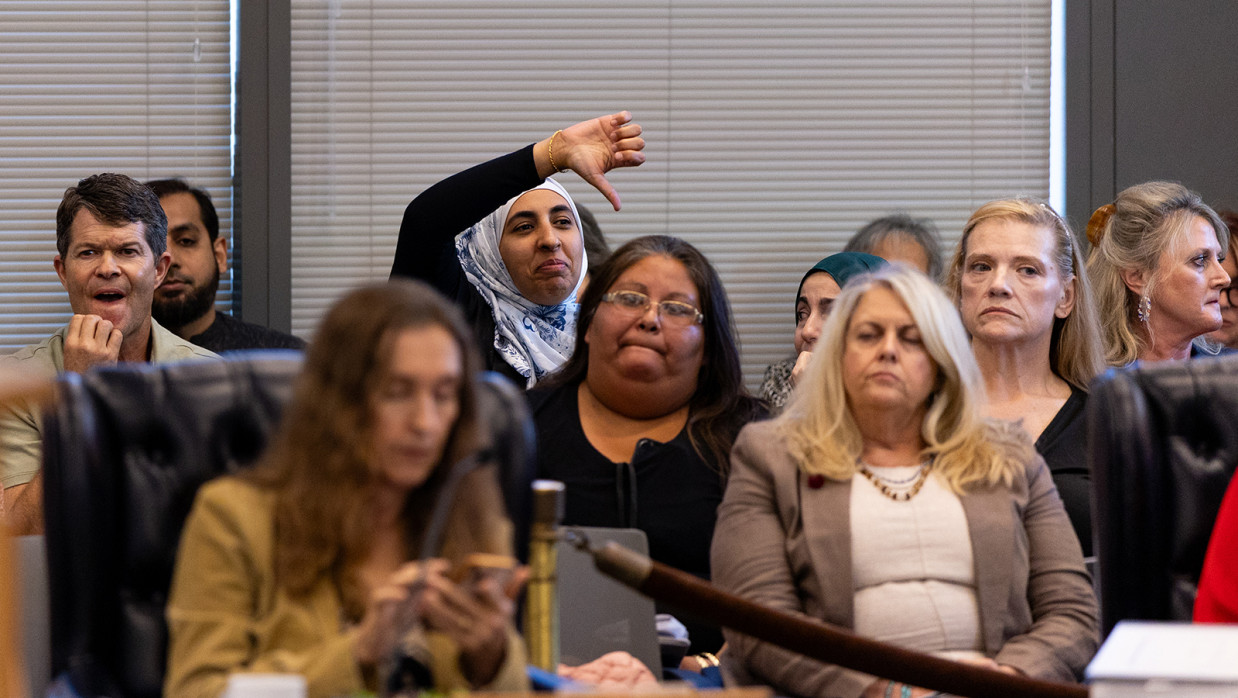
Inshira Daher waited hours to speak at a June Texas State Board of Education meeting. When her turn finally came around 7 p.m., the social studies teacher of 15 years was direct. “These children cannot yet distinguish a fact from an opinion,” she told the board. “And yet here we are prioritizing politically charged content over the fundamentals.”Daher, who is Muslim, was one of nearly 500 people who came to the Austin meeting to weigh in on a proposed social studies curriculum that would introduce Bible readings into classrooms and teach Islam through the lens of fundamentalism and medieval conquest.
Outside the hearing room, the day’s battle lines were already visible: In one overflow room, women in hijabs and many interfaith organizers strategized; in another, attendees clutched Bibles, some wearing hats that read “No Sharia allowed!”
That sentiment found perhaps its most direct expression from Tony Robertson, a local Republican party leader, who pleaded with the board: “Please do not Shariah our Texas” — warning, without evidence, that rejecting the curriculum would ultimately open the door to Islamic law replacing the U.S. Constitution.

Shaimaa Zayan, director of CAIR-Austin, poses outside the Barbara Jordan State Office Building in Austin, Texas, on Monday June 22, 2026. A leading Muslim advocate in Texas, Zayan partnered with interfaith groups to oppose the curriculum. “There are a lot of non-Muslims and Christian brothers and sisters who are also concerned,” she said. (RNS photo/Angela Wang)
The Republican-led board would go on to adopt the elementary and middle school curriculums four days later and a similarly controversial high school curriculum in early September. But by the time the 15-hour June meeting ended, one thing was already clear: While anti-Muslim rhetoric had become commonplace in Texas, a growing group of Muslims in the state was also pushing back, determined not to let anti-Muslim activists set the narrative.
As some national G.O.P leaders have made Islamophobic rhetoric a cornerstone of their 2026 midterm campaigns, Texas Muslims have increasingly found themselves in the eye of the storm. They have also faced a barrage of attacks, most led by state officials, from a ban on an Eid swim party to the Texas governor designating a Muslim civil rights group a terrorist organization.
On the ground, activists, attorneys and ordinary Muslim residents are packing city council meetings, staging protests, filing lawsuits and building interfaith coalitions. So far, they have had mixed success. Still, many said they are engaged in an existential fight.
Republican State Sen. Bob Hall wears an anti-Sharia pin outside of the hearing room at a Texas State Board of Education public comment session in Austin, Texas, on Monday, June 22, 2026. Hall testified earlier in the day against “Sharia law” in classrooms. (RNS photo/Angela Wang)
“We actually have to do something to stop this or else our kids are not going to have the same freedoms that we did growing up,” said Noor Wadi, a Dallas-based lawyer who has been a key figure in the efforts to push back.
In interviews with 20 residents in Austin and Dallas, many said the forceful response from Muslim residents reflects a broader shift in the largely immigrant community. For decades, diaspora Muslims avoided politics, trying not to “rock the boat” and “make any noise,” said Mustafaa Carroll, interim executive director of the Texas chapter of the Council on American-Islamic Relations, a Muslim civil rights group.

Mustafaa Carroll, interim executive director of CAIR Texas, poses for a portrait on the Texas Capitol Complex grounds in Austin, Texas, on Monday, June 22, 2026. (RNS photo/Angela Wang)
That shift has unfolded over a decade of escalating flashpoints, beginning with Trump’s 2016 election campaign — during which he called for a “Muslim ban” — and accelerating with Israel’s 2023 military assault on Gaza after Hamas’ Oct. 7 attacks. The latter led pro-Palestinian activists in Texas to try to pressure local city governments into passing symbolic ceasefire resolutions and University of Texas college students to demonstrate.
“Historically, we’ve prioritized spiritual wellness,” like building some of the state’s 330 mosques, said Imam Muhammad Abdullah of Dallas’ Masjid Al-Islam, a historic African American mosque. “Now we see that there needs to be another side, which is focused on building power, right? Because power protects your rights.”
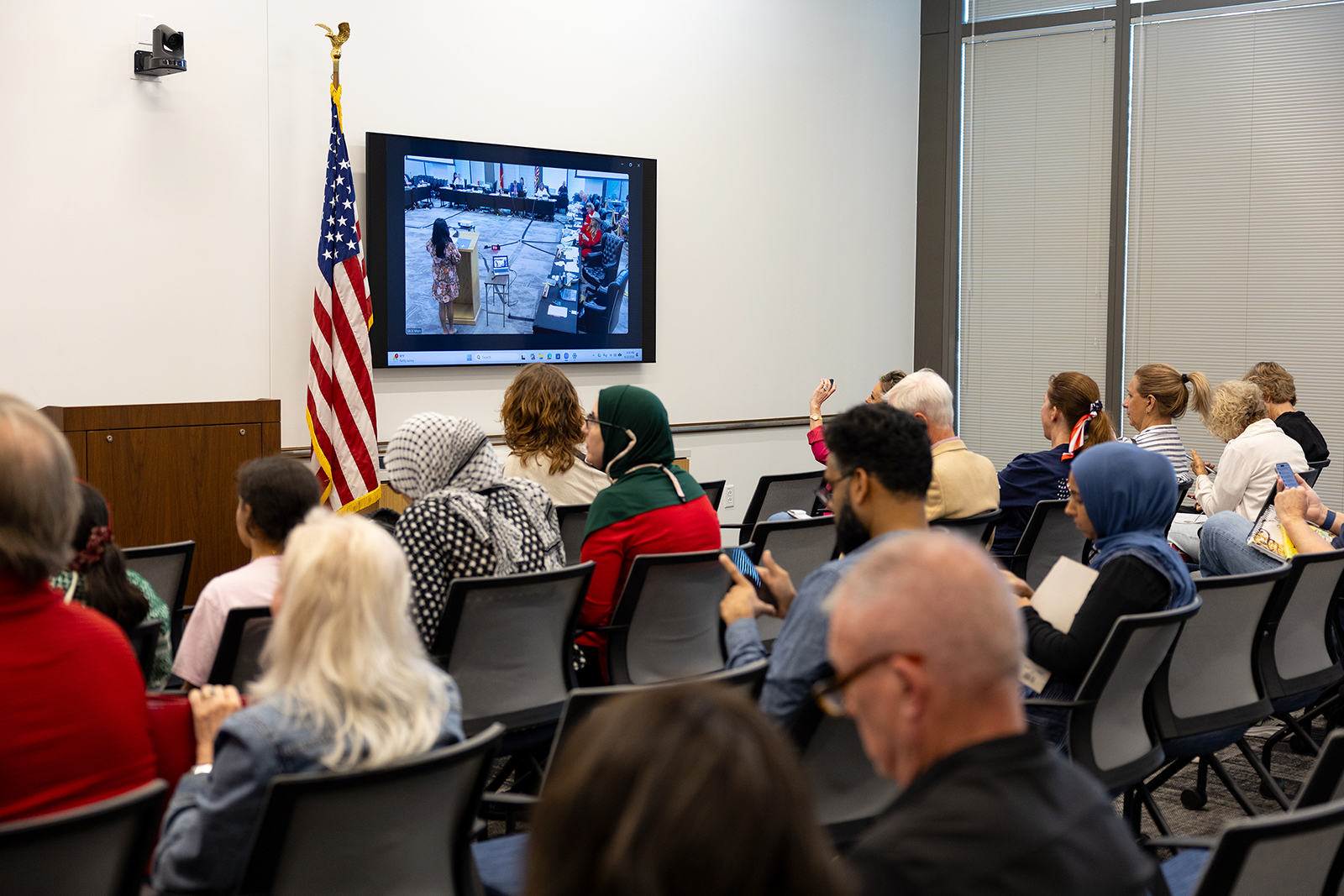
Members of the public listen to a Texas State Board of Education hearing from an overflow room in the Barbara Jordan State Office Building in Austin, Texas, on Monday, June 22, 2026. (RNS photo/Angela Wang)
Data suggests Muslims now represent about two percent of the state’s population, with an estimated 300,000 to 500,000 residents. Texas’ Muslim population has become the fifth-largest of any state, following waves of South Asian, Middle Eastern and North African immigration after federal reforms in the 1960s.
Meanwhile, Muslims also moved into elected positions. Currently, Texas has 10 Muslim elected officials in city councils and mayoral offices and one federal judge. In 2022, two Muslims were elected to the state’s legislature for the first time.
Mosques have also become increasingly open to hosting civic engagement events over the past few years, said Niloufar Hafizi, a policy manager with the Texas chapter of Emgage, a Muslim civic and political engagement group.
“The idea that just being Muslim is in itself political has really activated people,” she said.

The East Plano Islamic Center in Plano, Texas. (Photo by Anisa Bhatti/Wikimedia/Creative Commons)
The first major test came in February 2025, when the East Plano Islamic Center, one of the largest mosques in the state, unveiled plans for “EPIC City,” a 402-acre Muslim-centric residential complex in North Texas. The project set off a fierce anti-Muslim backlash, with conservative social media activists framing it as a sign of a radical Islamic agenda. State Republican leaders and U.S. Sen. John Cornyn from Texas criticized it as potentially discriminatory, saying it excludes non-Muslims, something that the developers denied.
Gov. Greg Abbott directed a dozen state agencies to investigate EPIC City, and the U.S. Department of Justice and the Department of Housing and Urban Development announced their own investigations (the DOJ has since closed its investigation). In May, a county judge ruled the project, subsequently rebranded The Meadow, could proceed after it agreed to comply with fair housing laws and revise its promotion materials.
The state is appealing that decision, which Abbott called a “flawed ruling,” saying: “This development will never see the light of day.”
Andrew Mahaleris, a press secretary for the governor, did not answer specific questions about the governor’s actions to stop The Meadow. Instead, he said the governor was continuously targeting “radical groups who seek to forcibly impose Sharia law on Texans” and that “efforts to create Muslim-only ‘no-go zones’ have been stopped in their tracks.”
In retrospect, Hafizi said, the backlash to EPIC was “an important alert” for what was to come — and the community’s need to push back.
A few months later, in September 2025, U.S. Immigration and Customs Enforcement agents arrested Marwan Marouf, considered a pillar of Dallas’ Muslim community. A U.S. resident since 1993, Marouf’s green card application was denied after DHS flagged donations he made in the 1990s to a Muslim charity whose leaders were convicted of sending funds to Hamas-run groups in 2008.

Marium Uddin, lawyer for Marwan Marouf, speaks during a press conference outside Richardson City Hall, Tuesday, Sept. 30, 2025, in Richardson, Texas. (Courtesy photo)
The arrest immediately triggered a strong response from community activists, including Wadi, a friend of Marouf from Dallas’ Muslim American Society mosque. Two weeks into his detention, Wadi and dozens of others packed a City Council meeting in Richardson, Texas, to pressure the council to pass a symbolic proclamation for his release (the effort was unsuccessful). A longtime Richardson resident, Marouf had once received a community service and leadership award from the town.
Wadi and others hosted press conferences, reached out to members of Congress to demand his release and even hired a bus to bring Dallas supporters to Houston for Marouf’s federal hearings.
“Ultimately it’s about truth,” said Marium Uddin, Marouf’s lawyer. “If we don’t correct the narrative that the government is pushing, then I feel that we’re complicit in allowing their good character to be destroyed.”
Marouf was deported to Jordan about three months after his arrest.
In early October 2025, just days after the Richardson City Council hearing, photojournalist and activist Yaakub Ira Vijandre was detained by ICE. The 39-year-old filmmaker was shooting the Richardson hearing for a documentary about Dallas’ Muslim life. ICE detained Vijandre, a Deferred Action for Childhood Arrivals recipient who immigrated from the Philippines in 2001, alleging he had posted and liked social media publications “glorifying terrorism.”His lawyers rejected the characterization.
They filed a habeas corpus petition, contending his arrest violated his First and Fifth Amendment rights. That case is pending. On Sept. 1, a federal judge ruled that the case could proceed, rejecting a claim by the Trump administration that federal courts had no jurisdiction to hear it. (Vijandre remains in a Georgia ICE facility.)
The next blow came in late November 2025, when Gov. Abbott designated CAIR a foreign terrorist organization and a transnational criminal organization, alleging it “employed, affiliated with and supported individuals promoting terrorism-related activities.” CAIR denied the allegations and is challenging the designation in court, arguing it violates its right to free speech, assembly and due process. That case is pending.

Texas Gov. Greg Abbott speaks in Kerrville, Texas, Friday, July 11, 2025. (AP Photo/Jacquelyn Martin)
“Instead of putting our heads down and continuing to be role model citizens, we’re fighting back, we’re standing up for ourselves,” said Imran Ghani, CAIR-Houston director.
As anti-Muslim attacks have continued to pile up, more Muslims in Texas are turning to the courts. In a WhatsApp group created by the Dallas-Fort Worth Muslim Bar Association, about 150 Muslim attorneys exchange information, sometimes teaming up on cases and crafting litigation strategies together.
“Not a day goes by without creating some sort of a subgroup,” said Uddin. “People are fired up. The Muslims that I know in these groups, they want to do everything that they can.”
Perhaps the most noteworthy success came earlier this year in response to Texas’ new school voucher program, which initially excluded the state’s accredited private Islamic schools from its approved list.
After Abbott designated CAIR a terrorist group, then-acting Comptroller Kelly Hancock asked Texas Attorney General Ken Paxton to issue an opinion on whether Hancock could exclude schools with ties to “foreign terrorist” and “transnational criminal” organizations, like CAIR. Paxton gave Hancock the go-ahead.
Lawyers in the WhatsApp group swung into action, connecting a few Islamic schools with legal representation. By early March, three Islamic schools and a group of Muslim parents filed a lawsuit challenging the exclusion. Within a week, a judge issued a ruling in their favor, asking state officials to include the schools and extend the application deadline. The state admitted the schools soon after.
Ehsan Sayed, a Muslim father whose kids attend a school that was part of the lawsuit, said the court win gave Muslim residents comfort that they can be treated equally under the law. He also believes it sent a message.
“It’s very important that we continue to do this … that the powers that be understand that the people are not going to put up with this,” he said.

The Fort Worth Independent School District meets June 23, 2026, in Fort Worth, Texas. (RNS photo/Ulaa Kuziez)
The plaintiffs now are asking the judge to certify a class-action lawsuit to ensure that the comptroller can’t discriminate against certain private schools in the future.
The Texas attorney general’s office didn’t respond to request for comments about this case. According to a ProPublica report from July, state officials are opposing the case, arguing that the plaintiffs have received the approval they sought.
But even when they don’t succeed, Muslim advocates say they are laying the groundwork for future wins by building interfaith relationships and coalitions.
In May 2026, when Shayma Alzubi, a Muslim Palestinian-American school principal, was reassigned after right-wing accounts flagged old social media posts, Muslim activists, education groups and interfaith leaders pushed back.
“We’re all connecting on these issues in a way that we want to uplift each other, and I think people are starting to realize that it’s impacting all of us,” said Wadi, who hosted press conferences in favor of Alzubi’s reinstatement. (Alzubi lost her promotion and was later reassigned).

Lawyer Noor Wadi speaks in support of Shayma Alzubi during a press conference, Tuesday, June 23, 2026, in Fort Worth, Texas. (RNS photo/Ulaa Kuziez)
Though he has lived through waves of Islamophobia before — after 9/11, following President Trump’s declared Muslim ban and during a 2017 run for Euless City Council — Muslim Democratic state Rep. Salman Bhojani said this moment is unlike anything he has experienced.
In August 2025, after Bhojani announced on social media he would visit an ill family member in Pakistan, Tarrant County Republican leader Bo French, who also is running for the state’s Railroad Commission, called for his denaturalization and deportation.
“When you’re talking about taking away citizenship because you’re Muslim, and they’re doing it to a state representative, think of what they can do to people who have no platform,” Bhojani said during a June interview at his law firm in Irving, Texas.
While French had previously made anti-Muslim remarks online, some directed at Bhojani, the attack came at a vulnerable time for the representative’s family. Bhojani said he received death threats and had his address doxxed, forcing his wife and children to relocate.

Rep. Salman Bhojani at his law firm on June 26, 2026, in Irving, Texas. (RNS photo/Ulaa Kuziez)
In April, in an effort to quell fears, Bhojani posted a 4-minute social video debunking claims that Muslims sought to replace the U.S. Constitution with Sharia, a sacred law that guides Muslims’ personal lives. In the video, Rep. Jon Rosenthal, the only Jewish member of the legislature, likened it to Halacha or Jewish religious laws.
A Republican colleague, Carl Tepper, replied with a photograph of the 9/11 attacks, showing a plane hitting one of the World Trade Center’s twin towers. That, Bhojani said, made him more determined.
“It emboldens me more to say this is the reason why I’m fighting, to stop this brainwashing of Texans that Muslims are bad and a threat and suspect class,” he said.
After Republican state representatives launched the Sharia Free Texas Caucus in March, vowing not to “stand idly by as Islamic influences seek to transform our great state into another conquered territory,” Democratic Reps. Bhojani and Suleman Lalani, the state’s two Muslim legislators, each formed a caucus: the Religious Freedom Caucus and the Texas Interfaith Legislators Caucus, respectively.
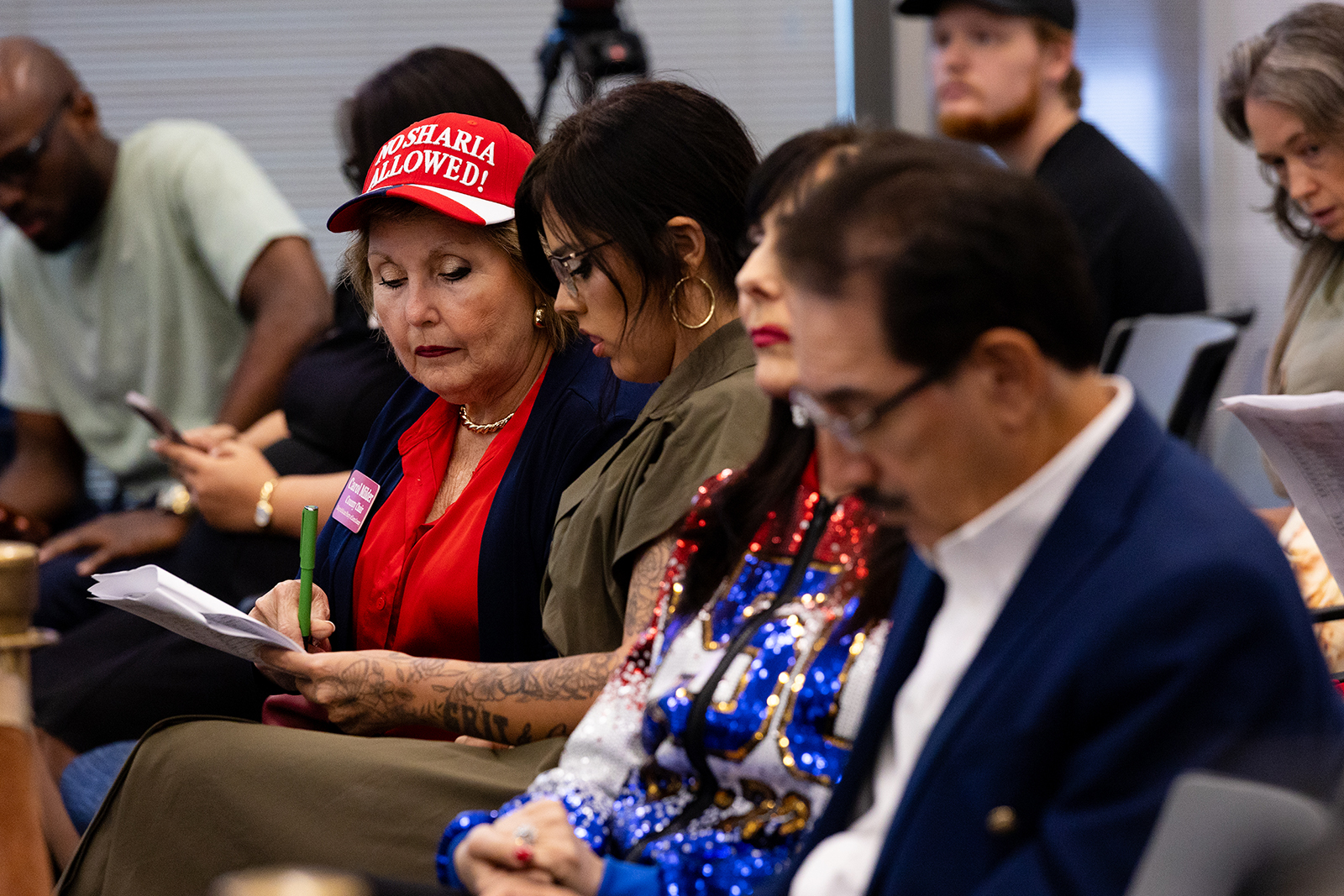
Carol Milder, chair of the Leon County Republican Party, wears a hat reading “No Sharia Allowed!” while attending a Texas State Board of Education hearing at the Barbara Jordan State Office Building in Austin, Texas, on Monday, June 22, 2026. (RNS photo/Angela Wang)
Their goal was to encourage dialogue and promote religious freedom. Then, in June, Bhojani embarked on what he called a “listening tour,” holding discussions in San Antonio and Houston. Nine state lawmakers, including at least one Republican, attended the events, which drew more than 100 people each. Among participants were Christians, Jews, Muslims, Hindus and Zoroastrians as well as also local elected officials and school board members.
Bhojani said he got a clear message from attendees that they wanted more: more gatherings and more legislators championing the separation of church and state.
At last week’s midterm convention in Dallas, Texas Republicans, including Abbott and U.S. Sen. Ted Cruz, targeted Islam in speeches. Cruz drew applause after claiming that Islam “produces murder and oppression.”
But as state leaders’ attacks intensify, so does the community’s resolve to fight them.
“We know what we’re up against,” said Uddin, the lawyer. “We’re not this naive, unsophisticated group of people who aren’t going to respond with courage and with integrity and with dignity.”
The article appeared in the religionnews
0 Comments
LEAVE A COMMENT
Your email address will not be published