

In February 2008, beneath the harsh afternoon sun of Accra, US President George W. Bush stood before a small gathering of journalists and dismissed swirling rumors with a chuckle. The United States, he claimed, had no intention of building military bases in Africa. “That’s baloney,” he said. The casual, dismissive word lingered,as such words often do when spoken from the heights of power. His comment was meant to close the matter, but history, as always, does not obey such instructions.
A decade later, in March 2018, Ghana’s parliament ratified a Defense Cooperation Agreement with the United States. There was no laughter this time. Outside the chamber, trade unionists, students, and opposition politicians stood with placards asking “What has been agreed?” The full text of the agreement had circulated in parts, summarized in official statements that spoke of “partnership” and “capacity-building.” A reading of the full document, which now sits in the open, reveals clauses that had been hidden behind the niceties of diplomacy. When read carefully, the agreement tells a story far more revealing than the assurances that accompanied it.
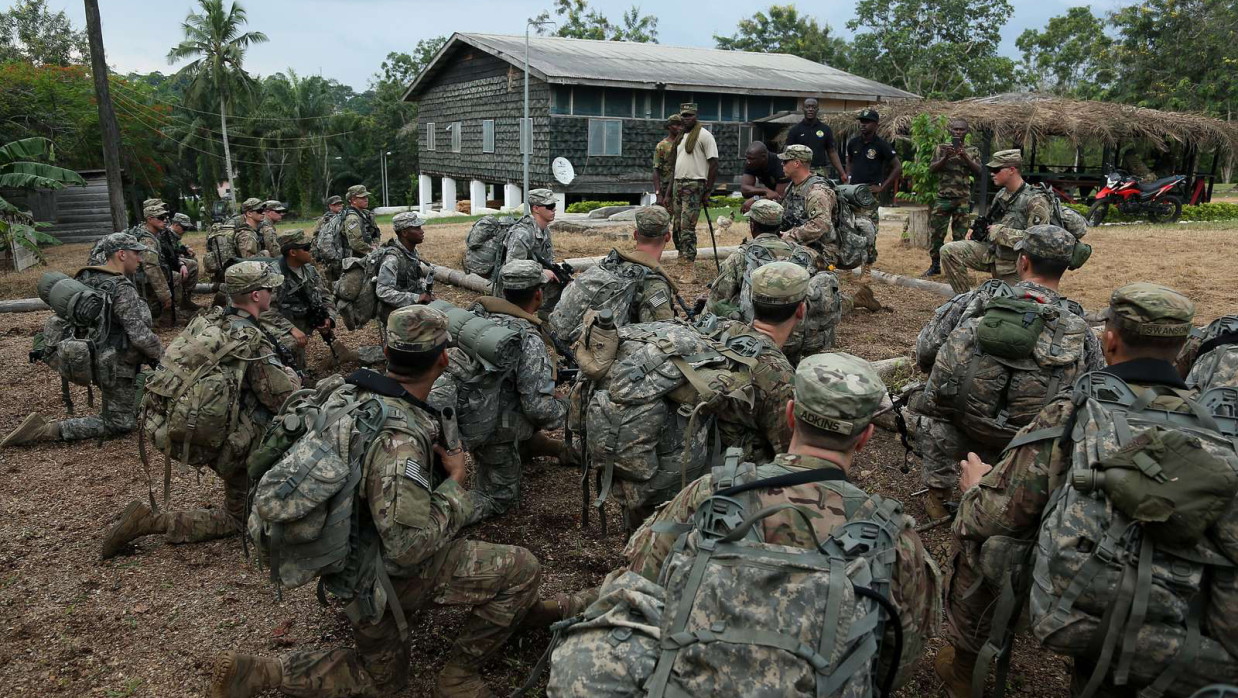
The agreement begins innocuously enough in the language of cooperation, but soon its tone shifts. The government of Ghana grants the United States “unimpeded access to and use of agreed facilities and areas” (Article 5). The phrase is deceptively calm. At Kotoka International Airport, where US forces operate, this clause takes on a material form: aircraft arrive and depart, equipment is unloaded, and personnel move through places that are Ghana but in practice are governed by the United States. The agreement does not call this a base because it does not need to. This surrender of sovereignty is clarified when the agreement allows US military and civilian personnel to “enter and exit Ghana with United States Government-furnished identification,” in other words, without visas – and permits them to carry weapons into and out of the country (Article 3) while exempting them from paying any tax (Article 9). Furthermore, US aircraft and vehicles are “exempt from any inspection” by Ghanaian authorities (Article 11). On the surface, the withdrawal of Ghana’s sovereignty in the face of US necessity recalls the old colonial treaties that granted colonial powers zones of privilege within African lands.
When the agreement was brought to parliament in 2018, the Minority Caucus argued that the government had agreed to it but that “the country derives virtually nothing” from it. Ghana’s Defense Minister, Dominic Nitiwul, told parliament that the US would pay $20 million to the Ghana Armed Forces in return. The Minority Caucus responded, “We fail to see how this amount can qualify as the direct benefit that we are deriving as a nation from this agreement, which is so disproportionately skewed in favor of the USA.” The government of that time, led by President Nana Akufo-Addo (president from 2017 to 2025) of the New Patriotic Party, argued that the US would help bring stability to the Sahel and West Africa. What this essentially meant was that African countries have decided no longer to defend their own lands, but to surrender them to foreign military intervention.
New Military Intervention
In 2008, President Bush said that the US was not interested in building a base. This was not entirely wrong. The US did not build large, permanent installations but rather a network of access points (aircrafts, logistical hubs, cooperative security locations) to allow for rapid and flexible deployment of US troops onto African territory.
In the Sahel, where foreign military presence has expanded dramatically over the past decade, instability has not receded. If anything, it has deepened. Armed groups have multiplied. Coups have proliferated. Civilian populations have borne the brunt. The presence of foreign forces has not addressed the underlying causes of conflict (poverty, inequality, the legacies of colonial borders, climate catastrophe). Instead, it has layered military solutions onto fundamentally political problems. Ghana, long seen as an island of stability, now stands at the edge of this storm.
Set against this quiet consolidation of military presence is a shifting political landscape across the continent. In Nairobi, a new set of conversations is unfolding. France, long the old custodian of colonial power in West and Central Africa, has sought to rebrand its relationship with the continent through summits and strategic repositioning, even as it draws down troops from the Sahel after a wave of popular uprisings against its presence. The relocation of diplomatic and strategic attention toward East Africa (symbolized by France’s Africa Forward Summit in Nairobi in May) signals not a retreat of imperial interests but their reconfiguration. At the same time, anti-imperialist forces, trade unions, and popular movements are preparing their own meetings in the same city (the Pan-Africanism Summit Against Imperialism), determined to name this moment for what it is: not partnership, but contestation. In the shadow of official summits, these gatherings insist that Africa is not merely a terrain for great-power maneuvering, but a site of political struggle where the language of sovereignty is being rewritten from below.
What emerges, then, is not an isolated agreement in Ghana, but a continental pattern that stretches from the Sahel to the Gulf of Guinea and now toward East Africa. The same arguments recur about security, stability, and partnership. The same clauses appear, such as access, exemption, and immunity. But so too does resistance. From the streets of Niamey to Ouagadougou, from Accra to Dakar, a new generation has begun to question the permanent presence of foreign militaries on African soil. The forthcoming anti-imperialist gathering in Nairobi is not merely a meeting; it is an attempt to consolidate this dispersed discontent into a political project. It asks a question that echoes far beyond Ghana: Can Africa secure itself without surrendering itself?
In 2018, the General Secretary of the National Democratic Congress (NDC) Johnson Asiedu Nketia, told the press that if his party comes to power, it would “suspend the agreement and initiate a far-reaching review.” From his party, senior parliamentarian Samuel Okudzeto Ablakwa wrote a strongly worded letter to the President: “Your silence on the agreement issue is very much out of character, and we are sincerely befuddled.” The NDC came to power in 2025, and Ablakwa was appointed the Foreign Minister. Despite what Asiedu Nketia and Ablakwa said in 2018, the new government has not initiated a public review or withdrawn from the agreement. The Socialist Movement of Ghana (SMG), which had been part of the fight against the agreement in 2018, has now initiated a campaign for its repeal. Kwesi Pratt, Jr., the General Secretary of the SMG, told me, “The intensified struggle against the Forward Operation Base of the US in Ghana is not a vindication of the stand we took in 2018 but an exposure of the deception of the forces of imperialism and their local agents. It is also a continuation of the battle of sovereignty initiated by Kwame Nkrumah, Ahmed Sékou Touré, and Modibo Keita.”
The ghost of that afternoon in 2008 lingers. “That’s baloney,” Bush said. There was to be no base. In fact, there is no base, but there is something greater than that: an open door to military intervention. Today, the documents available to read speak more clearly than Bush’s comments. They show a pattern of access, privilege, and exemption that, taken together, form something unmistakable. Africa’s future will not be written in the clauses of such agreements but in the struggles that contest them.

0 Comments
LEAVE A COMMENT
Your email address will not be published