

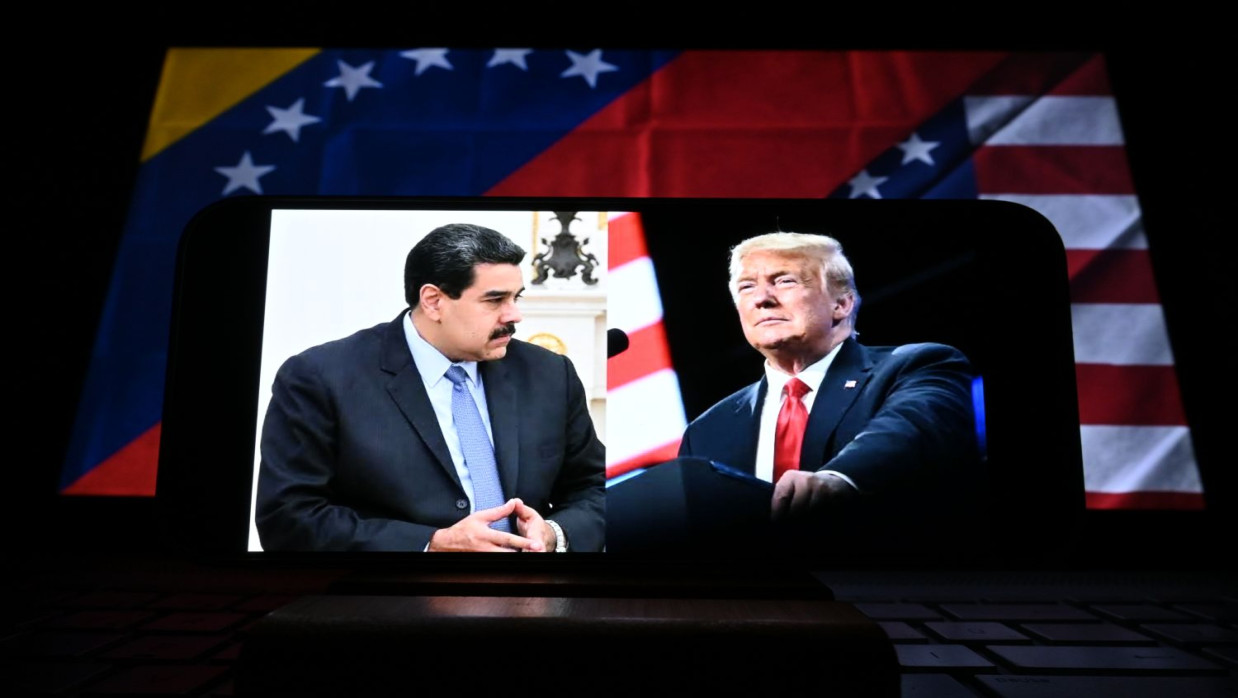
Our post-World War II order was based on an optimistic yet tenuous consensus that power would be tempered by the rule of law, sovereignty checked by collaboration, and aggression limited by organizations such as the UN and the ICC, as well as by treaties on everything from warfare to trade to diplomacy. It's being threatened now. The capture of Venezuela's strongman leader Nicolás Maduro by American special forces, followed by Washington's direct influence over the country's interim political trajectory, illustrates not only the changing nature of regime change but also the broader collapse of international norms. What appears to be a tactical success may in fact signal a strategic weakening of the global system itself.
Superficially, at least, Venezuela appears to be one of those unusual cases in which change can come swiftly after a long period of authoritarian rule. Since Maduro's fall from power, opposition politicians are meeting freely, security forces are not violently cracking down on protests, and foreign investors are returning to negotiate oil, gas, and mining deals. Political prisoners have been released, and a provisional administration under Delcy Rodríguez is attempting to stabilize the country under American pressure. These developments suggest that Venezuela has become more open than it was under its previous leadership.
Yet the deeper implications of this episode extend far beyond Venezuela. The manner in which the change occurred through unilateral military intervention without UN authorization reflects a world increasingly governed by power politics rather than institutional legitimacy. The precedent is troubling. If great powers increasingly act outside established frameworks, the authority of international law itself begins to weaken.
The Erosion of the United Nations System
The UN was created to resolve international disputes and prevent unilateral military intervention. The organization’s legitimacy rests on multilateral security, taking the place of unilateral action. But UN Security Council authorization has been sidestepped so many times in recent years, from Iraq in 2003 to Libya in 2011 to now Venezuela, and its credibility has slowly eroded.
In an ideal world, no interventions would take place outside the approval of the Security Council or obvious self-defense. In today’s world, great-power competition among the Permanent 5 has locked the Council in a stalemate. Either way, states with sufficient military might are going it alone under the guise of humanitarian need, counterterrorism, or strategic stability.
The Venezuelan situation only further undermines the notion that the UN will serve as the body conferring international legitimacy. It is fast becoming a venue for post-intervention discussion rather than for prior agreement.
The Crisis of the International Criminal Court
The International Criminal Court represents another pillar of the post-war legal order now facing uncertainty. Established to prosecute genocide, war crimes, and crimes against humanity, the ICC was intended to ensure that even the most powerful leaders could not act with impunity. However, its authority depends heavily on political cooperation from member states, and cooperation has been inconsistent at best.
The United States, Russia, and China, among other superpowers, are not covered by its mandate. Nor does it have many domestic teeth in its member countries. Justice is optional if arrests are left to the voluntary upholding of warrants.
This leads to problematic scenarios such as Venezuela. If one country can take it upon itself to militarily oust a government that deviates from its ideology, what's to stop it if it is unwilling to use a coalition of forces? Without international law that everyone respects, there will be selective enforcement.
Regime Change Without Rules
The Trump administration's Venezuela success story set a precedent for America to act less on alliances, institutions, and international agreements, and more on leverage and hostage diplomacy when dealing with foreign countries. Maduro fell as soon as the people in Venezuela, toppling him, realized it was in their best interest to side with the more powerful United States than a Socialist dictator. Of course, Iran isn't like Venezuela. It isn't built on mafia-like patronage networks that can be broken overnight. Maximum pressure has only hardened the resolve of Iranian hardliners, and the regime remains in place despite three decades of sanctions on Cuba.
A Return to Great-Power Competition
This erosion of the liberal international order is happening in tandem with the re-emergence of great-power rivalry. The US, China, and Russia are more willing to leverage bilateral pressure to achieve their aims than to engage in multilateral settings. Politics is increasingly about competing sanctions regimes, proxy wars, and regional bloc building.
Caught in the middle are smaller countries that must choose between potentially jeopardizing relations with one power or declining to side with another. The concept of neutrality is becoming obsolete. Venezuela has shown how foreign powers can easily exploit internal power shifts.
This trend threatens the principle of sovereign equality that once underpinned the international order. Instead, hierarchy and influence are reasserting themselves as organizing principles of global politics.
Democracy Without Institutions
Supporters of the Venezuelan intervention argue that removing an authoritarian leader created space for democratic recovery. That may be partially true. Yet democracy sustained by external pressure rather than internal legitimacy remains fragile.
Foreign investors will hesitate to commit long-term capital unless the rule of law is institutionalized rather than personalized. Elections delayed in favor of short-term stability may ultimately provoke unrest rather than prevent it. The continued detention of hundreds of political prisoners underscores how incomplete the transition remains.
True democratic reconstruction requires domestic consensus, credible electoral mechanisms, and independent institutions. External intervention can create opportunity but not permanence.
The Future of International Norms
The Venezuelan crisis is just one example of the overarching evolution of global governance. Organizations built for a bipolar or nascent post–Cold War world operate ineffectively today in a multipolar world. They struggle to reach consensus, lack the means to enforce their decisions, and face more legitimacy crises.
This unraveling can be stopped. Global institutions are not beyond repair. The UN Security Council could be expanded. The ICC could be given greater enforcement powers to enforce its rulings. International law could create more standing conventions around humanitarian intervention.
Failing that, the global order will continue to devolve into Might Makes Right.
Conclusion: Success or Symptom?
Trump foiling Venezuela might make life a little better for Venezuelans today, but it also represents a step towards legitimizing rogue power politics. Trump thinks he won a big diplomatic victory in Venezuela. The longer view suggests he lost a battle to preserve international norms. The world faces much bigger problems than Venezuela. World leaders should be less concerned with handling day-to-day crises and more focused on preventing the system from crumbling into crisis management.
Venezuela, in this sense, is not just a case study in regime change. It is a warning sign of a world in transition, one in which the rules are fading faster than they are being replaced.


0 Comments
LEAVE A COMMENT
Your email address will not be published