

Nirupama Subramanian
India’s government has often boasted about setting up more medical schools so that more students could aspire to become doctors, with Prime Minister Narendra Modi in 2022 announcing that the country would have “a record number of doctors” due to his government’s policy of establishing at least one medical school in every district.
Now it can claim another record – shutting down a brand-new medical school – weeks after more Muslims than Hindus qualified for its first intake of 50 students. The reason cited for the abrupt closure of the Shri Mata Vaishno Devi Institute of Medical Excellence-Medical school in Katra, in Reasi district of Jammu and Kashmir, was that it didn’t have an adequate number of teachers and infrastructure. A hurried physical audit was carried out by the regulator and the school was declared unfit, just four months after it was given the go-ahead by the same regulator.
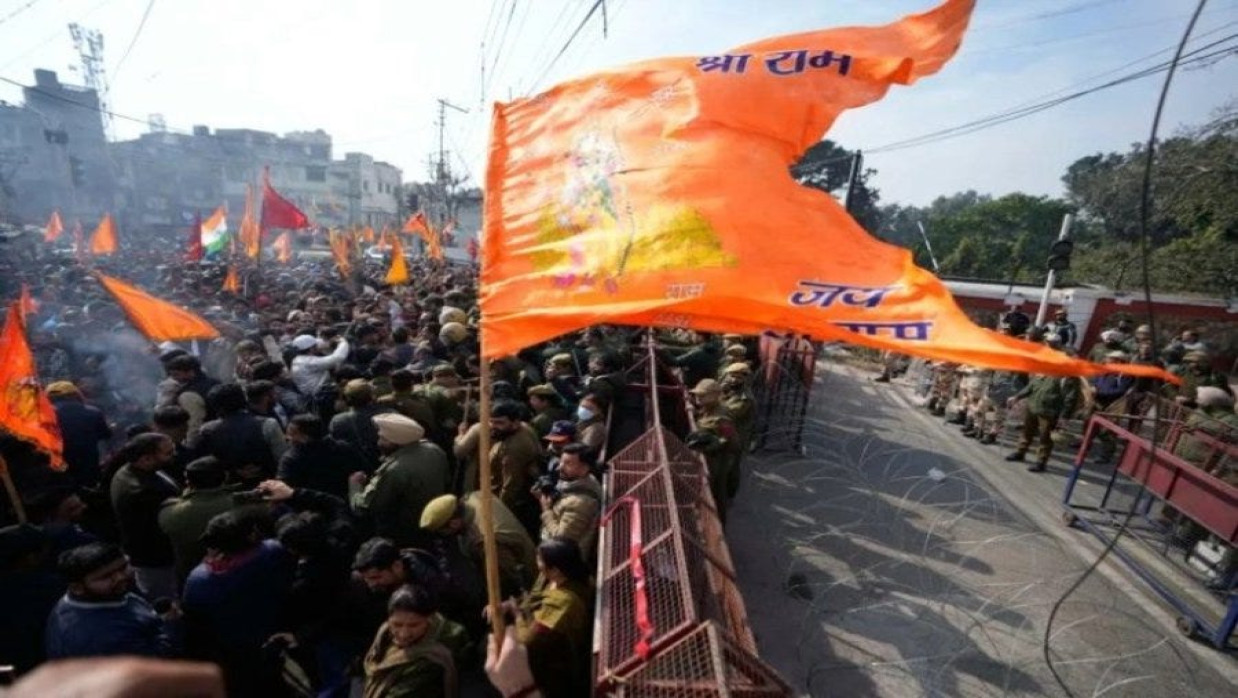
The real reason was given away by raucous celebrations that erupted at the closure in Jammu where the school was located. Muslims form the majority community in the centrally administered Jammu and Kashmir, but Hindus are the largest religious group in Jammu. Sweets were distributed when the closure was announced. Protestors beat drums and danced on the streets to celebrate, as if people were prepared to put up with the shortage of doctors and poor health facilities, rather than yield an inch on their prejudices
Agitation after admissions announced
Dozens of groups linked to Modi’s BJP and its parent organization, the Rashtriya Swayamsevak Sangh, had been agitating since the admission list for the school came out. Of the 50 seats, Muslim students qualified for 42, Hindus for seven, and a single Sikh. Most of the Muslims students were from Kashmir. All had qualified through a standardized national entrance test for medical schools known as the NEET, or the National Eligibility cum Entrance Test. Students aspiring to become doctors start cramming for the highly competitive exam two or three years before they graduate from high school. Every year, hundreds of thousands of aspiring candidates write the NEET. In 2025, the number was 2.2 million. Clearing the exam is akin to hitting the career jackpot.
Though the government has assured the school’s 50 students of transfers to other state-run medical schools in Jammu & Kashmir, uncertainty surrounds the process. The school, named after Jammu’s most famous Hindu deity, came up in collaboration with the management of the Vaishno Devi temple. The school was built as an extension of an existing “super-specialty” hospital, set up by the temple board in 2016, making its closure on grounds of inadequate infrastructure all the more specious.
The protesting Hindutva groups claimed the school was set up with money donated by the hundreds of thousands of Hindu pilgrims who visit the temple annually, and therefore the majority of the students must be Hindu. The annual fee was under Rs500,000 (US$5,502), a nominal sum compared to the steep costs at private institutions. They asked the government to scrap the admission list and take more Hindus. That could not have been done without tinkering with the exam results, which in turn could have caused nationwide outrage.
As for the other demand that most or all of the seats in the school should be reserved for Hindus, under Indian laws, government-run educational institutions and those managed by statutory bodies cannot discriminate between students on the basis of religion. Moreover, only minority communities, that is non-Hindu faiths, are permitted to run denominational educational institutions in which seats can be reserved for students of the same faith.
Easiest way out
For the government, shutting down the school was the politically least expensive option even if it left 50 students and newly hired faculty in the lurch. Omar Abdullah, the elected chief minister of Jammu & Kashmir, has few powers in the centrally administered territory. As an onlooker to the fracas, he too angrily backed the demand for closure, saying Kashmiri parents would be hesitant to send their children to study in such a highly politicized atmosphere.
Usually, the opening of a medical school in a small town is a cause for celebration as it brings with it more higher education opportunities, better health facilities and plenty of associated economic activity. Elected representatives routinely demand funds from the government to set up a medical school in their constituency. Bizarrely, it was the opposite in this case.
The agitation was gathering steam around the same time as a November 10 terrorist attack in Delhi in which two Kashmiri doctors were among those arrested. A third was killed in the car that exploded near the Mughal-era Red Fort, killing 25 people. A short video was discovered on his phone, in which he was seen debating with himself, somewhat incoherently, the perceived religious merits of suicide bombing versus the Quran’s disapproval of suicide. The Jammu protestors cited the alleged involvement of the doctors in the blast as a good reason to scrub the admission of Muslim students. Government voices expressed concern about the radicalization of Kashmiris, and public discussion centered on how the thick security cover in the Kashmir Valley couldn’t prevent transnational sources of Islamist extremism from seeping through. Few want to hear that domestic reasons could be fueling the alienation.
When the government did away with Kashmir’s special autonomous status in August 2019, Modi and his deputy, Union Home Minister Amit Shah, talked up the move as heralding a “new Kashmir,” that the removed constitutional provisions had given room to demands for separatism, and the changes would enable “integration.”
Over the intervening six years, the territory may have been integrated, but not the people. Kashmiris continue to be viewed with suspicion, with students, businessmen and traders in other Indian cities harassed or beaten as “terrorists” or “Pakistanis” after every terrorist attack in Jammu and Kashmir. Now, the closure of a medical school in deference to Hindutva has sent its own powerful message. Beyond Jammu and Kashmir, the government’s capitulation to unconstitutional demands from its majoritarian right-wing constituencies has strengthened the view that what Hindutva hates more than a Muslim is a successful Muslim.
Just as this saga was unfolding in Jammu, the free pass that religious bigotry and hate get in BJP-ruled India bubbled to the surface across the country with Hindutva mobs attacking Christmas celebrations, and two separate incidents of lynchings of migrant workers. For the first time in his 16 years in office, Modi attended Christmas morning service at Delhi’s Cathedral Church of the Redemption. But whatever symbolic value that gesture might have carried was lost in his silence at the acts of violence, and the shabby surrender in Jammu.
The article appeared in the asiasentinel
0 Comments
LEAVE A COMMENT
Your email address will not be published