

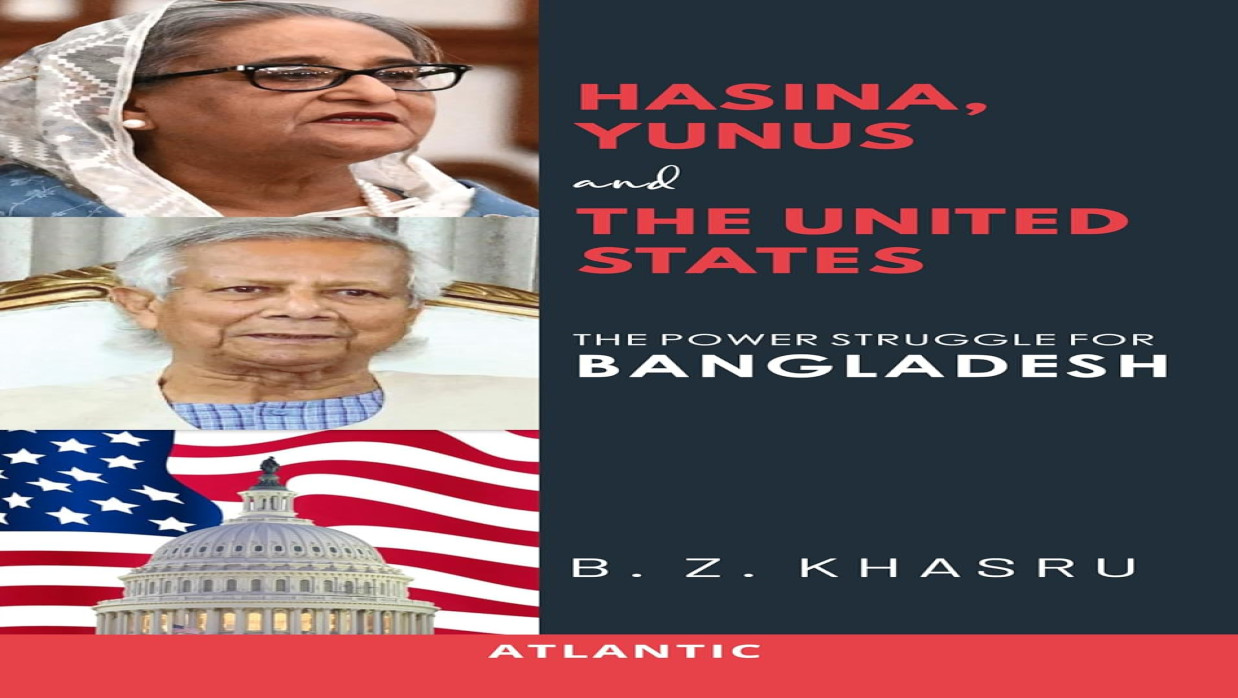
Print length, 298 pages
Language English
Publisher Atlantic Publishers & Distributors (P) Ltd.
Publication date August 2, 2025
Amazon hardcover $ 30.98
ISBN-10 : 8126941367, ISBN-13 : 978-8126941360
Item Weight : 1.12 pounds, Dimensions : 8.66 x 5.55 x 0.87 inches
Book Review: Hasina, Yunus, and the United States: The Power Struggle for Bangladesh
Author B.H. Khasru
B.H. Khasru’s Hasina, Yunus and the United States: The Power Struggle for Bangladesh arrives at a moment when Bangladesh’s recent political convulsions are still raw, contested, and intensely polarized. Written with the instincts of a seasoned journalist, the book attempts something ambitious: to place Bangladesh’s internal political rivalry—principally between Sheikh Hasina and Muhammad Yunus—within a wider geopolitical frame involving the United States and India. Khasru argues that Bangladesh’s contemporary political trajectory cannot be understood solely through domestic party politics; rather, it is the product of a triangular power dynamic where internal authority, international legitimacy, and regional strategy intersect.
The book positions itself neither as a memoir nor as a purely academic study. Instead, it reads as an investigative political narrative, blending reportage, diplomatic documentation, and interpretive analysis. For readers of South Asia Journal, accustomed to debates on sovereignty, external influence, and democratic legitimacy in the region, Khasru’s work offers a provocative and timely intervention.
The Core Argument
At the heart of Khasru’s book lies a far-reaching but straightforward claim: that the rivalry between Sheikh Hasina and Muhammad Yunus is not merely personal or ideological, but structural—reflecting two competing visions of legitimacy in Bangladesh.
Hasina, in Khasru’s telling, represents state-centric authority rooted in electoral dominance, party machinery, and strategic alignment with regional power—particularly India. Yunus, by contrast, embodies a transnational form of legitimacy derived from civil society, global finance, development discourse, and Western approval. The friction between these two models, the author argues, gradually hardened into open confrontation, with the United States emerging as an influential—if inconsistent—external actor.
Khasru situates this rivalry within Bangladesh’s longer post-1975 political history, but he gives particular emphasis to two periods: the military-backed caretaker regime of 2007–2008 (the so-called “One-Eleven” period), and the years following Hasina’s consolidation of power after 2009. According to the author, One-Eleven permanently altered Hasina’s perception of external intervention, reinforcing her suspicion that “alternative leadership projects” could be cultivated with foreign encouragement.
The United States as a Variable Actor
One of the book’s most controversial contributions is its portrayal of the United States as a fluctuating but consequential force in Bangladesh’s internal politics. Khasru does not claim a single, unified American strategy. Instead, he presents Washington as a site of competing impulses—democracy promotion, stability concerns, geopolitical rivalry, and bureaucratic inertia—whose net effect nevertheless shaped political outcomes in Dhaka.
Drawing on diplomatic cables, public statements, and interviews, the author suggests that American attitudes toward Hasina shifted over time, particularly as concerns grew over electoral credibility, governance, and human rights. In this context, Yunus’s international stature—bolstered by his Nobel Prize and deep connections within Western policy and philanthropic circles—acquired political salience at home.
To Khasru, this was not accidental. He implies that sections of the U.S. policy establishment viewed Yunus as a credible, reformist alternative to entrenched party politics, even if no explicit plan was ever formalized. Whether one accepts this interpretation or not, the book compels readers to confront an uncomfortable reality: in smaller states, international reputations can become domestic political assets—or liabilities.
India and the Regional Dimension
If the United States represents global power, India represents regional gravity. Khasru consistently frames India as Hasina’s indispensable strategic partner—one that prioritized continuity, predictability, and security cooperation over democratic experimentation.
From Delhi’s perspective, Hasina’s Awami League government ensured stability along India’s eastern frontier, cooperation on counterinsurgency, and insulation against unfriendly political forces. Khasru argues that this strategic alignment emboldened Hasina to resist Western pressure and to frame international criticism as interference rather than concern.
This triangular dynamic—U.S. unease, Indian support, and domestic consolidation—forms one of the book’s strongest analytical threads. It helps explain why Bangladesh’s political evolution has often appeared paradoxical: increasingly centralized and controlled at home, yet diplomatically resilient abroad.
Yunus as Political Symbol
While Yunus occupies the book’s title, he remains, in some ways, its most elusive figure. Khasru presents him less as a conventional politician and more as a symbol—of civil society, global moral authority, and non-partisan leadership. The legal and regulatory actions taken against Yunus and the Grameen institutions are interpreted as politically motivated attempts to neutralize that symbol.
Yet the book also raises questions it does not fully resolve. What would a Yunus-led political project have looked like in practice? How would it have navigated Bangladesh’s deeply entrenched party system, patronage networks, and electoral realities? Khasru gestures toward these issues but essentially leaves them open, perhaps reflecting the fact that Yunus himself long resisted formal political engagement.
For critical readers, this may be both a strength and a weakness. Yunus is neither idealized nor thoroughly interrogated as a political actor. Instead, he functions as a lens through which to examine how global legitimacy interacts with national sovereignty.
Strengths of the Book
The book’s primary strength lies in its narrative clarity. Khasru writes with momentum, making complex diplomatic and political processes accessible without oversimplification. His use of documentary material—particularly diplomatic reporting—adds texture and immediacy, reminding readers that politics often unfolds through conversations, cables, and perceptions as much as through elections.
Another notable strength is the author’s insistence on historical continuity. By repeatedly returning to the trauma of One-Eleven, Khasru highlights how political memory shapes decision-making. Hasina’s actions, in this reading, are not merely authoritarian impulses but defensive responses to a perceived pattern of external meddling.
Limitations and Critiques
At the same time, the book’s broad causal claims invite scrutiny. Diplomatic cables, while valuable, reflect the viewpoints and biases of their authors. They record what diplomats believed or were told—not necessarily the objective truth. Greater triangulation with court records, electoral data, and grassroots political analysis would have strengthened some of the book’s conclusions.
Moreover, the portrayal of the United States, while nuanced, sometimes risks appearing more coherent than reality allows. U.S. policy is rarely monolithic, and internal disagreements often dilute strategic intent. Readers with experience in Washington policymaking may wish for a deeper disaggregation of actors and institutions.
Significance for Bangladesh and Beyond
Despite these limitations, Hasina, Yunus, and the United States perform an essential service. It forces a conversation about sovereignty in an interconnected world. For Bangladesh and for many postcolonial states, the question is no longer whether external actors matter, but how their influence is mediated, resisted, or instrumentalized by domestic elites.
Khasru does not ask readers to sympathize uncritically with any single actor. Instead, he invites reflection on a more profound dilemma: how can democratic legitimacy be sustained when internal politics are inseparable from global power structures?
Conclusion
B.H. Khasru has produced a timely, challenging, and often unsettling book. It will not satisfy readers looking for a simple morality tale, nor will it resolve Bangladesh’s ongoing political debates. What it does offer is a coherent narrative that connects personalities, institutions, and geopolitics into a single explanatory framework.
For scholars, policymakers, journalists, and diaspora readers concerned with South Asia’s political future, this book deserves careful reading not as the final word, but as a serious contribution to an urgent and unfinished conversation.

0 Comments
LEAVE A COMMENT
Your email address will not be published