

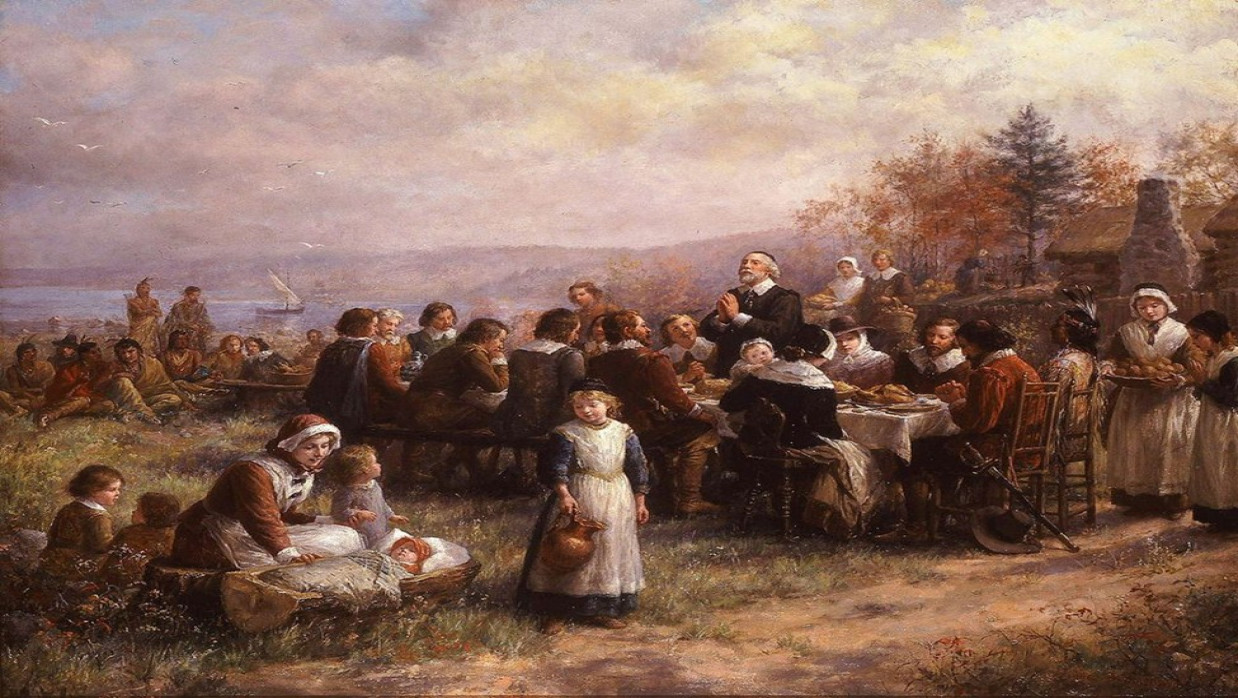
American elementary schoolchildren and glossy coffee-table history books often learn a similar story about Thanksgiving. It is a story of gratitude and generosity, harmony and cooperation: A small band of English colonists at Plymouth, unprepared and nearly starving through their first brutal winter in 1621, receive help from their Indigenous Wampanoag neighbors and then invite them to share a harvest feast. The tale of the first Thanksgiving is a story told and retold through generations of American schoolchildren. It has been washed smooth by time and repetition into something that can feel like myth, something it is hard to question or break apart. But it is also a story very carefully edited for national consumption and ideological reinforcement. It leaves out almost everything that actually happened, and nearly everything that followed.
The first problem with this story is that it centers the English colonists as the organizers and hosts of a harvest celebration. Indigenous nations, including the Wampanoag, stewarded this land for thousands of years before Europeans arrived. Their fall harvest feasts were an established and widespread practice of gratitude for the gifts of the land, the harvest, and the family and spiritual communities that sustained them. The English did not invent this ritual of thanksgiving on this continent. They learned it from the Indigenous nations around them.
The second problem, and by far the most disturbing omission, is the European arrival itself. Long before the Plymouth colonists disembarked, Indigenous nations along the Atlantic coast had been living through years of a horror story they had never seen before and couldn’t imagine after. European traders had already established relationships with Indigenous nations to the south and inadvertently introduced the deadly diseases to which they had long since built up immunity. The impact of these diseases was catastrophic. Entire Native villages were extinguished in mere months by smallpox, influenza, and measles. Historians estimate that by 1621, over 90 percent of Native people along the East Coast had already died of disease. Fields remained unplowed, communities dismantled, and thousands of years of knowledge, practice, and relationships ruptured.
The Wampanoag were one of the few surviving Indigenous nations in southern New England capable of maintaining organized communities, relationships, and resistance. Ousamequin, the leader of the Wampanoag people (known to the English as Massasoit), cautiously formed an alliance with the settlers because the Wampanoag themselves were suffering from European disease and had been threatened by some of their Native neighbors. The colonists did not rescue the Wampanoag from starvation. If anything, the Wampanoag were in the position of rescuing what was left of regional power and balance from the ruins of a radically destabilized Indigenous world.
This fragile, necessary alliance was not precisely a meet-cute between neighbors. But this third problem is that such nuance doesn’t fit neatly into the version of Thanksgiving told over the centuries by colonists and their descendants.
The mythology of the “first Thanksgiving” obscures yet another inconvenient truth about English colonists: They were not friendly, cooperative neighbors. They stole Indigenous land, took Indigenous crops during times of starvation, and encroached on Indigenous lands to expand their settlements with no permission or recourse for Indigenous nations. They brought systems of property ownership that Indigenous people did not share or respect. And English colonial leaders and settlers embraced a worldview that saw Indigenous people as the enemy, an obstacle on land promised by God for European “civilization.” Indigenous people were not, as the American story often makes it seem, passive victims. They were aggressive expansionists who the Pilgrims wanted nothing to do with, eager to find space for a growing population and a growing list of racialized European neighbors. For them, the Indigenous people who inhabited their desired land were trespassers. And for their Indigenous neighbors, the English were invaders.
Indigenous people were also, after centuries of encroachment, beginning to push back. Only a few decades after the harvest celebration of 1621, the myth of peaceful cooperation was already gone. One of the bloodiest examples was in 1637, during the Pequot War. European traders had arrived in Pequot territory years earlier, bringing European goods that colonists eagerly bought. They also brought alliances with Native communities that put pressure on the Pequot. The colony was also interested in the Pequot for their land, and the control over regional trade that came with it. But the Pequot had been there long before the English. Their land was desirable not because the English needed it for settlement, but because they wanted it for trade.
In the spring of 1637, English soldiers and their Native allies surrounded a fortified Pequot village at Mystic. There was no battle. The English set fire to the village and burned the Pequot people men, women, and children alive. Those who tried to escape as the fort burned were shot. Estimates of the death toll vary, but most agree that between 400 and 700 Pequot people were killed in about one hour. The English came back and killed more Pequot later that year. Historians believe that the war that year killed thousands of Pequot people. It shocked some English witnesses at the time; but for the colonists, it was not a massacre but a cause for celebration.
The next day, Governor John Winthrop of the Massachusetts Bay Colony proclaimed a “day of thanksgiving” to celebrate the “total subduing of the mighty Pequot enemy.” Some historians consider this declaration (not the meal two decades earlier) to be the first English “Thanksgiving” on North American soil. It is a fact, like most of the Pequot War, that one will be hard-pressed to learn from a history textbook, museum exhibit, or retelling of the national story. It is much easier, after all, to teach children about shared meals than it is to teach them about genocide.
Indigenous nations endured still more violence in the centuries that followed: disease, land seizure, broken treaties, labor, enslavement, missionary work, and federal campaigns to forcibly assimilate Indigenous people and eradicate Indigenous culture, history, and identity. In some cases, Indigenous children were taken from their families and sent to boarding schools where they were punished for speaking their own language or practicing their traditions. This is not, of course, the full story of American history, but rather a thumbnail of the violence visited on Indigenous people for over a century and a half after those first fateful arrivals. It is, after all, what colonization and settler colonialism look like in practice.
Thanksgiving as a national holiday did not exist for over a century and a half after the landing at Plymouth. It was not until 1863, when President Abraham Lincoln declared a national day of Thanksgiving during the Civil War, that the holiday was established. It was a period of national division and Lincoln, as one of his first acts as president, declared the holiday in part to give the nation a new national ritual and identity one that could unify people around themes of gratitude and providence. But Lincoln’s Thanksgiving left out the suffering of Indigenous people. Nineteenth-century Americans, anxious about the violence of their own origins, wanted a national holiday to be about celebration, not mourning. The version of Thanksgiving that the colonists of that century enshrined in the American imagination did not square with the violence of their colonial past. The national story pilgrims, grateful Natives, shared meals, harmonious communion, and required a storybook rendering of history. It required, in short, something false.
The creation of a mythology around the “first Thanksgiving” helps explain why many Indigenous people do not and cannot view Thanksgiving as a day of gratitude. Since 1970, Indigenous people in North America have observed a National Day of Mourning on Thanksgiving Day. Indigenous people from across the continent gather on Cole’s Hill in Plymouth, Massachusetts, where the first colonists landed, and they mourn. They mourn their ancestors, millions of Indigenous people killed by war, disease, and colonialism. They mourn a history that was erased, mitigated, or made less horrible in national memory. They mourn a collective loss of place, identity, and purpose. The mood is somber, reflective, and defiantly honest. It is not a counter-celebration. It is, in many ways, a refusal to celebrate. It is a counter-holiday that insists on telling the truth at a national holiday based on lies. It is a protest but also a family reunion and a public act of remembrance in a nation that is hostile or indifferent to Indigenous loss.
This refusal to celebrate does not mean that Indigenous people are ungrateful. It is not a rejection of gratitude; it is a broadening of it. Gratitude does not require forgetting. It does not require whitewashing or myth-making. It does not require a national story that places settlers as the hero and Indigenous people as the supporting player, or the villain, or a footnote, or an unwitting collaborator in someone else’s drama. Gratitude requires truth. It requires acknowledging that the wealth of some came on the backs of others. It requires the humility to understand that the national holiday that Americans celebrate today is not ancient history. It is not a distant story on a foreign continent. It is a story that happened in our own land to people whose descendants are among us, in prison, on the street, protesting, voting, making America.
Thanksgiving has also taken on a meaning for most Americans that has a real pull and value. It is a time for family and warmth and generosity and introspection, a moment to put down the feverish pitch of daily life, step back, and ask, “What is really important?” This holiday can be true and good. But it cannot be true and good while also actively ignoring the past, the terrible, and the inconvenient.
There is, of course, a balance to be found. A nation so young and new can ill-afford to start dismantling its own mythology. But there is also a maturity to confronting the past that is the beginning of wisdom. A nation that is not afraid to look honestly at itself is mature enough to change, grow, and become better. It is not the easy route. But I am willing to take it.
Reimagining Thanksgiving is not rejecting Thanksgiving. It is situating it in its proper place in the broader American story, with all the good and the bad. It reminds us that Indigenous people are still here. They are still here to tell their stories, to record their experiences, to pass on traditions, language, and identity. They are still here to demand restitution, treaty fulfillment, and an end to land seizures. They are still here as citizens, leaders, artists, scientists, poets, and activists, shaping the future of this nation. They are still here to teach us, to model systems of community and connection that have sustained this land for millennia, and to remind us that their traditions, stories, and ways of being still have lessons for a climate-ravaged world today.
If Americans are truly a people who believe in the power of gratitude, then they must also believe in the power of truth. The Thanksgiving myth that it was a story of friendship and cooperation between equals is only possible because of the colonization and extermination of Indigenous people that the myth obscures. Remembering this fact does not destroy the holiday. It only makes it more honest, more profound, and more reflective of the actual history that created this country.
This November, remember the Wampanoag and the Pequot and all the people who perished in disease, displacement, and war and who were not saved by European neighbors and settlers. Remember that, after thousands of years, their communities are still fighting to keep their languages and cultures and identities alive. Thanksgiving unmoored from truth is mere sentiment. Thanksgiving grounded in truth is a step toward a fuller understanding and a better, more just, more respectful nation.
Only by embracing all of American history can America truly honor all the people who made this land what it is today, not just the ones who made it into the storybooks.


0 Comments
LEAVE A COMMENT
Your email address will not be published