

Ayodhya’s Saffron Banner Does Not Celebrate a Temple but Hindutva Victory
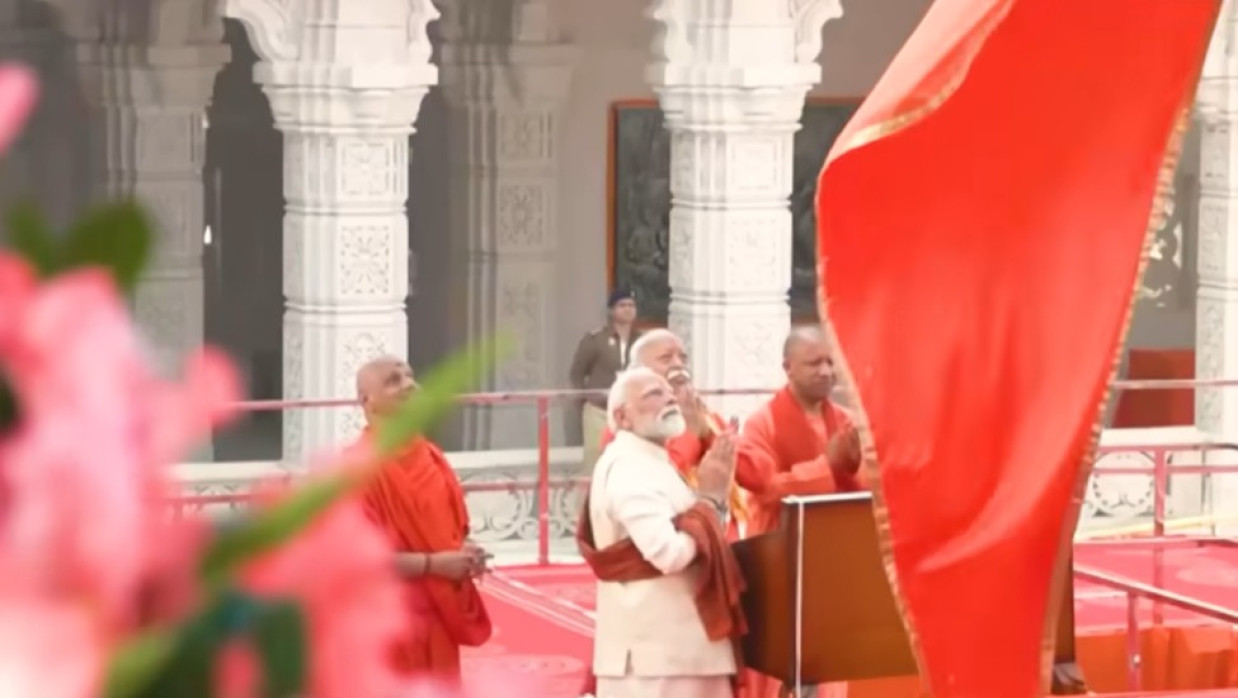
Prime Minister Narendra Modi hoisted the saffron flag on the Ram Mandir in Ayodhya on November 25, 2025. The ritual was, in Hindu terms, called Dhwaja Arohan. A temple can be physically completed, with the idol consecrated in January 2024, but the flag hoisting had a different significance. It was what the Rashtriya Swayamsevak Sangh (RSS) and its parent party, the Bharatiya Janata Party (BJP), have described as the “triumph” of a long civilizational “struggle.” The event was perfectly choreographed: The flag-raising took place at 12.35 am on November 25, to mark the Abhijit Muhurat on Vivah Panchami, the day the Lord married Sita. For a generation of Hindutva followers, it was the culmination of a millennial battle, with India as its victor.
But this triumph comes at a cost. The decades-long struggle to tear down the Babri Masjid and build the Ram Mandir was more than a religious movement. It was a political project. The mosque was a choice target, not because it could be proved beyond doubt that it was built on the birthplace of Ram, but because it was viewed as a symbol of “foreign rule.” The latter was a term used to whip up anti-Muslim sentiment. Historians still dispute the precise location of Ram’s birthplace. But the propagation of Hindutva does not care about those who question it. The project requires the belief that the only way to break away from 1,000 years of Muslim “rule” is to construct the Ram Mandir on the ruins of the Babri Masjid.
In other words, Modi’s raising of the saffron flag is also an attempt to symbolically declare the completion of the RSS's vision of an India defined as Hindu in terms of character, imagination, and public representation. The flag flying atop Ayodhya is not a signal of Indian integration but an announcement of a battle won by one religion over all the rest.
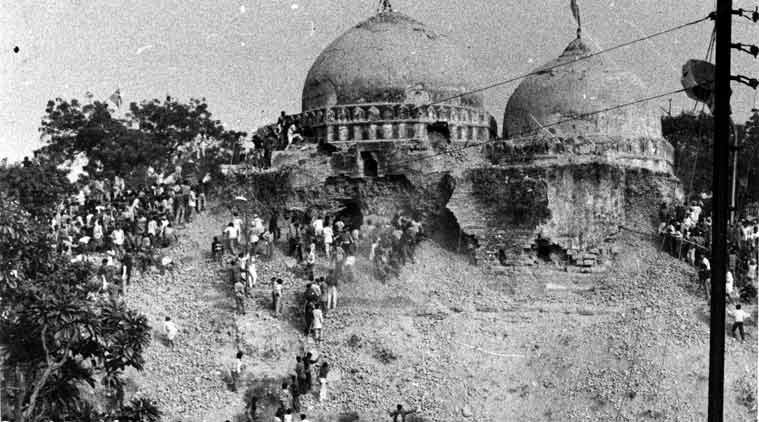
A violent mob mobilised by the Bharatiya Janata Party and Sangh parivar demolished the Babri Masjid in Ayodhya on December 6, 1992.
A History with Two Standards: How Babur is an Invader but Kanishka is an Indian Icon
To criminalize Muslim kings as “invaders” and claim non-Muslim invaders as “Indian” is central to the RSS playbook. A strange fact: Babur and Kanishka are two ancient Indian “rulers” whose place of origin is broadly the same region. Kanishka, who ruled between 127 and 150 CE, is a “great” Indian king because he helped spread Mahāyāna Buddhism. His empire included much of present-day India, Pakistan, and Afghanistan. In fact, he ruled from Peshawar and Mathura, with a throne in each city. He sent missionaries to Central Asia, spreading Buddhism to countries such as China. Under his patronage, Buddhism received a royal institutional boost through the convening of the Fourth Buddhist Council. Coins of Kanishka show him as a worshipper of a Zoroastrian deity, alongside a Hindu god, a goddess, and a Buddhist symbol. In contemporary India, Kanishka is readily accepted as part of the country’s ancient history.
Babur, on the other hand, is portrayed as an invader whose arrival in India in 1526 marked the beginning of 500 years of oppression. “Babar ka Aulad” is one of the most common slurs directed at Indian Muslims. In other words, the term is used to criminalize Indians simply because they are Muslim, by implying that their ancestors were “invaders” who destroyed the country. Yet, why is Kanishka remembered as an Indian king while Babur is routinely rejected as an invader? The answer is not geography or history but religion. Kanishka, as a Buddhist king, can be made part of the pre-Islamic period to which RSS ideologues like to refer as the “real” India. Babur, a Muslim, stands for the Muslim rulers, whether imperial or homegrown, that Hindutva ideology has long sought to discredit. The only question, for RSS ideologues, is not of origin or history but of religious identity. It is not geography but Islam that makes Babur an “invader.”
RSS ideologues, through their various mouthpieces, both intellectual and political, are extremely selective in whom they cast as “belonging” to India and whom they do not. National Security Adviser Ajit Doval recently asked about the “debilitating power of disinformation.” One may ask, in the same breath, can the RSS, the BJP, and Prime Minister Modi, through their persistent focus on defining Muslimness as outside India’s history, not be accused of one of the largest disinformation drives in modern Indian politics?
Ram Mandir, a Movement Based on Exclusion
As a political movement, Ram Mandir has been built on a central plank of exclusion. It is exclusion of Muslims in terms of religion: Building the Ram Mandir, its leaders have claimed, means tearing down a mosque built by invaders. Even though there is no conclusive evidence about Ram’s birthplace, the leaders have insisted that their way be taken as the right one. Unsubstantiated and self-interested archaeological “finds” have been latched onto for political purposes. The goal was never disinterested truth but a partisan political project.
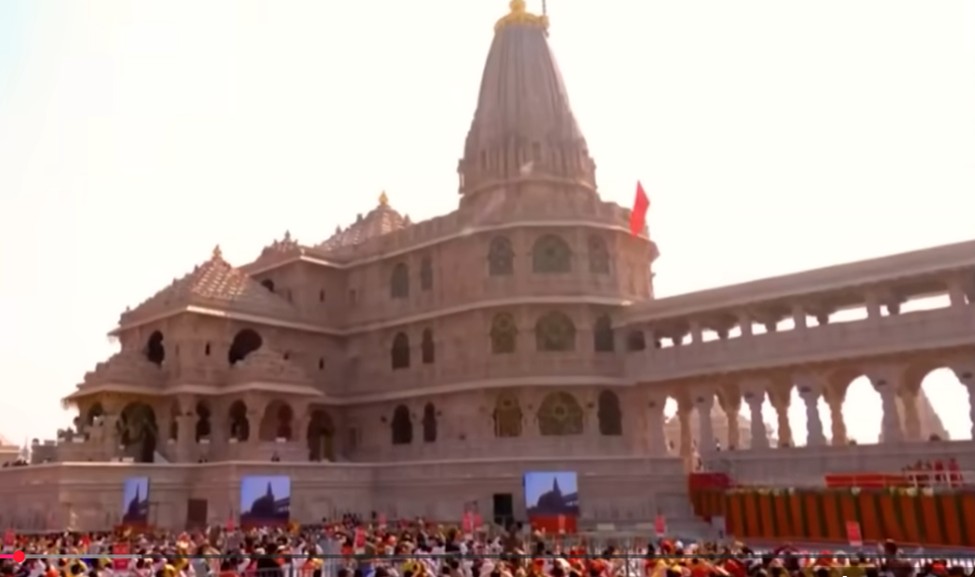
Image captured from a YouTube presentation
Hindutva leaders have also succeeded in convincing generations of Indians that without the Ram Mandir at Ayodhya, the country is forever chained to a “Muslim past.” To them, the Babri Masjid was not a temple but a symbol to be razed. The goal for the RSS and BJP was to construct a history in which Muslims would be the ones excluded. By claiming a Muslim mosque at a Hindu temple site and leading the charge for its destruction, Muslims were cast as “the other”: perpetual outsiders with little place in the national story. Hindutva’s success in transforming Indian nationalism from a pluralist model to a majoritarian vision has deepened this impulse toward exclusion. By casting a Mughal emperor and all the Muslims who came after him as “foreigners,” the project has not only been able to sell the site as contested, to take it for political purposes, but also to project Muslims as people with no stake in Indian history.
The exclusionary narrative, however, does not end with Muslims. The RSS-BJP has been able to successfully mobilize lower-caste Hindus for this project, but has never made them part of their vision of India. The saffron flag Modi was waving in Ayodhya was said to represent Bharat: the country, the nation, and the soil. But it also perfectly preserved the caste hierarchy. The Ram Mandir project, from its top leadership to its financing to its control over temple rituals, remained the monopoly of upper-caste Hindus. Dalits, Adivasis, and others were involved but only as followers, never as leaders or equal participants.
The Ram Mandir is, in other words, a monument to the politics of exclusion: of Muslims as “outsiders” through religious demonization, and of lower-caste Hindus as structural invisibility, despite their considerable demographic weight.
Saffron Triumph and the Rebirth of Bharat
In RSS-tinged propaganda over Ayodhya, Hindutva ideologues have often spoken of a “500-year struggle” against Muslims. “Invaders” first came, as the BJP-Media combine endlessly insists, with Babur’s conquest in 1526. The saffron flag at Ayodhya, in this telling, is to mark the end of 500 years of foreign Muslim domination of India. But this, of course, is selective memory, an attempt to rewrite Indian history to suit a political agenda. The British Empire, the “real” foreign domination, gets only passing mention if at all.
Why is the British Empire so peripheral to the RSS-BJP narrative of India’s subjugation? One reason is that it cannot be weaponized against contemporary Indian minorities the way the Mughal past can. But a second reason is that the British form of governance, with its laws, administration, and general political culture, is what the RSS looked to when building itself. To denounce colonial rule would mean undermining many of the state institutions that the BJP and RSS government has today.
The “rebirth of Bharat” Modi spoke of at Ayodhya, then, is not the return of a former India; it is the creation of a new Hindu Bharat, defined by its closeness to a mythologized cultural past and a spatial exclusion of Muslims. The saffron flag flying in Ayodhya is thus not just a symbol of victory over Muslims but a signal that this country has finally freed itself from foreign cultural domination. The flag is a proud assertion that, without Islam in the public sphere, India is pure; with it, Bharat is tainted.
The Fabric of India Today
It is a cliché in Indian public discourse that Narendra Modi has transformed Indian politics. Since his election as prime minister in 2014, particularly in the lead-up to the 2019 national elections, his worldview has reshaped the Indian state, public institutions, and the public sphere. Today, the RSS-BJP vision of India, once on the margins of Indian politics, now guides how the state operates. This paper, in brief, argues that India is at a turning point. From being the world’s largest experiment in secular democracy, it is now on a trajectory to becoming a Hindu-majoritarian nation. The outcome of this transformation is already visible in India today.
The political culture has shifted. Dissent is labelled as sedition. Minorities are singled out for victimization. The media landscape has been skewed, with pro-government voices drowning out diversity. The very idea of what it means to be Indian is changing. Once rooted in a constitutional identity and a commitment to civic nationalism, Indianness is now being defined by cultural conformity and Hindu identity. The narrowing of Indian identity is, in other words, already underway. This is the first risk. India’s diversity is its strength. The very basis of the country’s existence is pluralism. The large nation will fracture if its definition shrinks to the exclusion of Muslims, Christians, Buddhists, Sikhs, Parsis, and other Indian minorities.
But the challenge to India’s unity does not end with Muslims. The BJP-RSS’s mobilization of Dalit, Adivasi, OBC, and other lower-caste Hindus has failed to integrate them into the Hindutva vision. The very structural power that the RSS controls over temple rituals, finances, and leadership at the Ayodhya Ram Mandir is an example. The BJP-RSS’s political mobilization has not been matched with social or economic integration. Instead, by keeping key power structures in the upper caste's hands, the RSS has worked to create a Hindu India that does not include all Hindus equally. In a state where the government is already rolling back affirmative action, the deepening of economic inequality is assured.
India at a Crossroads: The Road Ahead
Unless it changes course, India is today on a path of prolonged internal disintegration. Divisions will deepen in society. Economic fissures will widen. Social conflict will intensify. Political volatility will become the new normal in Indian life. A country built on a foundation of exclusion and historical falsehoods cannot hold together. Trust cannot be earned when parts of society are built into the system, others pushed to the periphery. In a country so diverse, so large, India’s future is in doubt.
To restore itself as a stable nation, India must return to its plural roots, as enshrined in the Indian Constitution. India’s true wealth is its diversity. Its civilizational richness lies not in a single narrative but in a thousand streams of cultural expression. India’s destiny, in other words, is to live up to its founding principles. For India to take a path of social peace and economic prosperity, the state must recommit to the idea that every Indian, regardless of religion or caste, is equal before the nation. Political expediency may favor the BJP, RSS, and their Hindutva agenda in the near term. But the very future of the country depends on what Indians do over the next few years, and the next few decades.
The saffron flag at Ayodhya may be a symbol of political victory for the BJP and RSS, but it is no symbol of national unity. It does not erase centuries of Muslim, Buddhist, Sikh, Christian, and thousands of other influences that have shaped India into a modern nation. And it is no measure of a nation’s greatness. A temple, no matter how grand, cannot be a Hindu temple unless it includes all those who call themselves Hindus. India’s future today is whether it will choose the path of inclusion or drift deeper into the uncertain precipice of Hindu majoritarianism.


0 Comments
LEAVE A COMMENT
Your email address will not be published