

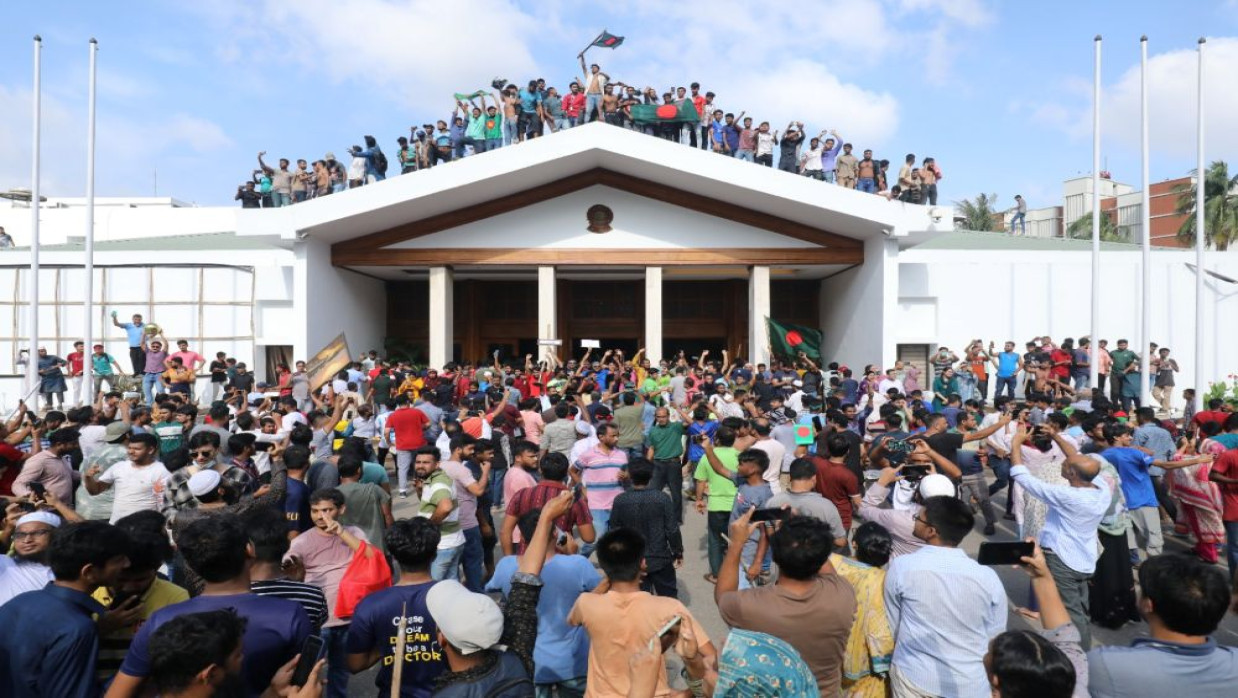
Bangladesh has to figure out how to bring justice to the people who suffered from enforced disappearances, oppression, and the uprising of July 2024. They must hold those responsible for a once-ruling regime accountable and build a nation free of revenge. Bangladesh finds itself at this juncture in history. Bangladesh faces many issues to resolve following the July/August 2024 Uprising. These include delivering justice to those affected, holding political figures accountable, strengthening political institutions, and coming together as a nation. While we may have deposed a previous government, we have not eliminated the politics and system that allowed this regime to stay in power.
The government committed many wrongs, and the uprising wasn't just against one party. The people of Bangladesh rose up against a government that abused its power. By sacrificing their lives as students and working citizens, they showed the country they wanted change and better representation.
Over time, we may forget the harm done under the last regime. Those who may be guilty of allowing oppression can clear their names without facing justice.
We should not forget about what happened in our recent history. But we must also learn from what we know was done to us. Bangladesh needs to find a way to bring justice to these crimes and hold the right people accountable.
The Human Cost of Authoritarian Rule
Perhaps the most disturbing legacy of the previous political order is the extensive record of allegations concerning enforced disappearances, extrajudicial killings, arbitrary detention, and torture.
Many have reported stories of men being taken from homes, workplaces, street corners, and public areas. They took individuals away, claiming they belonged to some agency, and the individuals had no markings identifying them. Some of these individuals returned but had no story of what happened to them, or refused to speak about their time gone. Many never returned.
Stories of secret prisons are disturbing to hear about. Many of those who survived reported that they were held in solitary confinement, electrocuted, beaten, and threatened. They also reported threats to their loved ones. More research should be done on this topic, and forensic evidence gathered to prove these events took place.
Not only did the people who were kidnapped suffer from this.
The family members of those who were taken never knew if their loved one was alive or dead. They went to police stations, hospitals, jails, and other governmental buildings trying to find answers. Many women had to raise their children without knowing if their husband was still alive or not. Children had no explanation for why their parents weren't there.
There isn't an explanation for your loved one when you don't know what happened to them.
Disappearance has affected many, not only those who were kidnapped but their families as well. Disappearance has ruined many lives. It shows that your country can get away with murder and not have to face any repercussions.
The violence occurred in July/August of 2024. An estimated 1,400 may have died during the riots and violence. According to a UN human rights report released in February 2025.
These findings warrant rigorous accountability. They should not, however, be used to dispense with the need to establish individual responsibility through credible legal proceedings.
Political Leadership and the Burden of Responsibility
Sheikh Hasina's political legacy cannot be assessed solely through infrastructure development, economic growth, or her family's historical association with Bangladesh's independence.
Her supporters frequently emphasize the construction of bridges, power plants, highways, and other national projects. They also invoke the extraordinary historical role of Sheikh Mujibur Rahman in Bangladesh's liberation struggle.
These achievements should be noted in history. But development or being born into a political family doesn't make you above criticism.
There are many things to consider when looking at whether a country is run fairly. Not just whether it has prospered, but whether people have freedoms. Can people speak out about their government, hold elections they know will be fair, and turn to the state for help if wronged?
While Hasina has been in power, many issues have arisen. Questionable elections and courts that are not free to make decisions. Threats against political figures and limiting freedom of speech. Police that act above the law. All these issues can happen when one branch of government has too much control. People were labeled traitors for speaking against the government.
Particularly troubling has been the perceived absence of meaningful remorse among sections of the former ruling establishment concerning the suffering associated with political repression.
For families who lost loved ones, expressions of political self-justification cannot substitute for acknowledgment of harm.
They can be blamed for the climate of abuse, but not only for allowing official policy. That alone doesn't prove criminality; you need to show that certain people knew what was happening or had the power to act. They may have participated in them or failed to stop and punish crimes when they had an obligation to do so.
So, we can say they were morally responsible and politically accountable, but not criminally liable.
The Awami League's Historical Achievement and Political Decline
The Awami League occupies an important place in Bangladesh's national history. Its leadership in the struggle for autonomy and independence remains part of the country's political inheritance.
But historical achievement does not guarantee permanent political legitimacy.
Political organizations are ultimately judged by their contemporary conduct, how they treat citizens, and their willingness to operate within constitutional limits.
The central problem confronting the Awami League is therefore not simply the loss of political power. The question is whether the party can acknowledge the failures and alleged crimes of its time in government and undertake credible internal reform.
There is something to take away from this open letter written to Awami League members by retired US diplomat Jon F. Danilowicz. As someone who has met many Bangladeshi politicians during his time here, including Sheikh Hasina and Awami League politicians. He feels that there should be a separation between those who took responsibility for atrocities and the common Awami League politician who may or may not feel the same way.
He urges them to consider their decision to keep supporting Sheikh Hasina and understand that their careers don't have to follow hers.
Something they should consider is:
One political party cannot be convicted as a whole just because some high-ranking officials have done wrong. Just as a member of a political party shouldn't go unpunished for participating in atrocities.
The Awami League needs to reform and take a stand against its members' recent actions. Instead of ignoring the situation. Stand up for the victims, work with investigators, and stop committing political violence. Make changes within their own political party.
A political party that refuses to examine its past cannot credibly claim to represent a democratic future.
Journalists, Intellectuals, and the Responsibility of Public Discourse
One of the most contentious questions concerns the role of journalists, commentators, academics, and self-described human rights advocates who defended the former government.
The media could also be accused of helping condone these violations. By stating what officials accused the opposition of, downplaying these violations, or labeling them as enemies of the country.
This can be looked at further.
The media should not just spread what the government says. Journalism should question the government. It should help uncover wrongdoing and raise awareness for those who cannot speak for themselves.
Journalists go too far when they create false allegations. When they help pinpoint people who are being persecuted illegally or start violence, they have gone too far and could be considered criminals.
However, we must clearly distinguish between political opinion, partisan reporting, deliberate disinformation, and legally punishable participation in atrocities.
Supporting an unpopular political leader, criticizing the July uprising, or questioning allegations against the former government does not by itself constitute a crime against humanity.
International criminal law imposes demanding standards concerning the nature of an offense, the relevant mental element, and an individual's contribution to criminal conduct.
The experience of Rwanda demonstrates that media organizations can play a destructive role when they deliberately and directly incite mass violence. But that precedent cannot justify criminalizing every journalist whose political commentary is considered objectionable.
They should investigate allegations backed by facts. Be it incitement to violence. Working with illegal security forces, destroying evidence, or whatever else can be proven to be a crime. These actions should be taken with impartiality and based on facts. They should also allow the media to investigate unethical behavior within the profession and publish the information. Whether that be corrections or facts that can support these actions. It should be about exposing those who may have helped with this cause. Not silencing people from sharing their opinion.
India's Role and the Crisis of Public Trust
Bangladesh's domestic reckoning also carries significant implications for relations with India.
New Delhi maintained a close strategic relationship with Sheikh Hasina's government, regarding it as an important partner in regional security, connectivity, trade, and the management of cross-border challenges.
From India's perspective, continuity in Dhaka offered geopolitical predictability and cooperation on issues affecting its northeastern states.
However, many Bangladeshis came to believe that India's political establishment placed excessive emphasis on maintaining relations with a particular leader rather than cultivating confidence among the broader Bangladeshi population.
Her fleeing to India only added fuel to the fire.
Many feel that since we as Bangladeshis want to hold someone accountable, India giving her shelter has been an unfair decision. India feels it has every right to do what it believes is best for its country. And Bangladesh feels they have every right to bring that person to justice if there are any crimes committed on our soil.
Both countries need to work together and find a legal solution. Whether it be through extradition or other means.
The larger issue is one of political judgment.
A durable bilateral relationship cannot depend upon the fortunes of a single individual or party. It must rest upon mutual respect, recognition of sovereignty, equitable cooperation, and sensitivity to public opinion.
Respecting Bangladesh's democratic aspirations better serves India's long-term interests than appearing indifferent to the suffering caused by the former government.
Bangladesh, meanwhile, should distinguish legitimate criticism of Indian government policy from hostility toward Indian citizens.
Geography, history, commerce, and shared environmental challenges make constructive relations indispensable.
Transitional Justice: Beyond Punishment
The demand for accountability is understandable. But criminal prosecution alone cannot repair the damage inflicted by prolonged authoritarian rule.
Bangladesh needs a comprehensive transitional justice framework.
Transitional justice refers to the combination of judicial and nonjudicial measures through which societies confront serious human rights violations and attempt to rebuild public trust.
Its principal elements include truth-seeking, criminal accountability, reparations, institutional reform, and guarantees against recurrence.
The first requirement is a credible national record of what happened.
This body of work should gather information from survivors and family members. Former government officials, security services, doctors, and eyewitnesses should also contribute. It should gather information and documentation to determine what happened to the missing.
No political influence should affect this process.
Remaining neutral, protecting witnesses, and allowing victims to play a role will ensure effectiveness.
Second, we need accountability through just courts.
If there is credible evidence that someone was involved in torturing, killing, or kidnapping citizens, they should be prosecuted in court if the case warrants it.
These courts should not show favoritism.
Third, we need reparation.
While money cannot replace the loss of life. It can go a long way to help with children's schooling, medical bills, and support families who have loved ones who were kidnapped.
Survivors of torture require specialized rehabilitation, including treatment for long-term physical injuries and psychological trauma.
A victim-centered process should let affected families participate in decisions about reparations rather than treating them merely as recipients of government assistance.
Reforming the Institutions of Repression
We cannot achieve transitional justice without addressing the institutions responsible for these crimes.
The Rapid Action Battalion, Detective Branch, and all other intelligence agencies must be further investigated. They face numerous allegations of heinous crimes.
The question should not be limited to whether to abolish, rename, or reorganize a particular agency.
The more important issue is whether Bangladesh can establish a security architecture in which unlawful detention, torture, and disappearance become operationally difficult, legally detectable, and personally costly for perpetrators.
Necessary safeguards include reliable detention registers, immediate notification of arrest, access to legal counsel, independent inspection of detention facilities, judicial oversight, and effective mechanisms for investigating complaints against officers.
Command responsibility must also be addressed. Senior officials should not be able to escape scrutiny simply because subordinates physically carried out the abuses.
Equally important is protecting professional officers who refuse unlawful instructions or disclose credible evidence of misconduct.
Security sector reform should not be about firing and replacing people haphazardly. We need to establish institutions that serve the Constitution, not individual politicians.
If we fail to do this, we will only see certain criminals prosecuted.
Preserving the Memory of July
The July uprising must become part of Bangladesh's documented national history, not merely a recurring political slogan.
A credible July museum and memorial initiative could preserve photographs, testimonies, documents, personal belongings, medical records, and other evidence of the events.
The experiences of those killed, injured, detained, or permanently disabled deserve careful historical preservation.
The museum should also explain the broader institutional conditions that allowed political violence to escalate.
It should be accessible to researchers, students, journalists, and the public, subject to appropriate privacy protections.
Schools should help advance research on our history, politics, and what our constitution gives us.
However, we need to remember things correctly and not turn it into political propaganda.
Many times in Bangladeshi history, political forces have distorted or erased memories from public knowledge.
July should not see this happen again.
As a country, we should recognize our founding fathers, understand the wrongs committed under subsequent regimes, and pay tribute to those who stood against oppression. All without being told what to think about certain aspects of history.
Remembering victims is not vengeance. It is a responsibility owed to future generations.
Reconciliation Cannot Be Imposed
Reconciliation is perhaps the hardest part of Bangladesh's political transition.
You cannot tell the victims to forgive. You cannot tell a country that they can come together when families don't know what happened to their loved ones.
Truth and justice must come before we can begin to reconcile.
I believe Danilowicz took a good step with his comments to members of the Awami League. We should continue encouraging those who know what they did wrong to come forward and work with truth and reconciliation efforts. And become part of the change through our democracy.
For individuals who committed serious crimes, reconciliation cannot automatically mean immunity.
For others who were politically associated with the former government but did not participate in criminal conduct, there must be a legitimate path toward peaceful civic and political participation.
This is essential to avoiding collective punishment.
Bangladesh has repeatedly seen political victory followed by exclusion, retaliation, and the concentration of power. Breaking that cycle requires a commitment to constitutional protections that apply equally to political allies and adversaries.
A democratic society must protect even unpopular opinions.
The strongest sign that Bangladesh has moved beyond authoritarianism would be establishing institutions that administer justice without political interference.
The Unfinished Promise of July
The July uprising gave Bangladesh an extraordinary opportunity to redefine the relationship between citizens and the state.
But a popular movement's moral legitimacy does not automatically guarantee the success of the political order that follows.
If we want these sacrifices to matter, our country needs stronger democratic practices. It needs free courts, accountable law enforcement, and protection of basic human rights.
Simply changing political figures will not be enough.
We must challenge our tendency toward corruption, bullying, institutional abuse, and bigoted behavior that has taken root over many governments.
We also need to resist using past injustices to justify current wrongdoing.
Justice can be served fairly only if we apply it equally. If our current leaders use these methods against those who came before them, what difference does that make from what we experienced in the past?
Bangladesh's political parties, civil society organizations, professional associations, journalists, and younger generations all have responsibilities in this transformation.
International partners can provide technical assistance, forensic expertise, and support for judicial and institutional reform. But the process must remain nationally owned.
Bangladesh has two options for what they want to become as a country. One is to keep fighting each other with accusations and retaliation. With strong authoritarian institutions in place. Or they can learn from the disappearance of people and all the pain that was caused, and those who gave their lives in July. And turn that into something positive. A lasting constitution for the people. Obviously, the second option will be harder. Requiring many years of patience. It requires courage and strong, independent institutions that know the difference between justice and revenge.
Above all, it requires recognition that no leader, political party, security organization, or public figure stands above the law.
Bangladesh owes its victims the truth. It owes survivors meaningful justice and rehabilitation. It owes the families of the disappeared answers. And it owes future generations a political system where citizens never have to fear that disagreeing with those in power could cost them their liberty or their lives.
Bangladesh's end goal shouldn't just be about removing Sheikh Hasina from power. It should be about ensuring the country prevents these wrongs, and other actions she helped foster, from happening under any future political regime.


0 Comments
LEAVE A COMMENT
Your email address will not be published